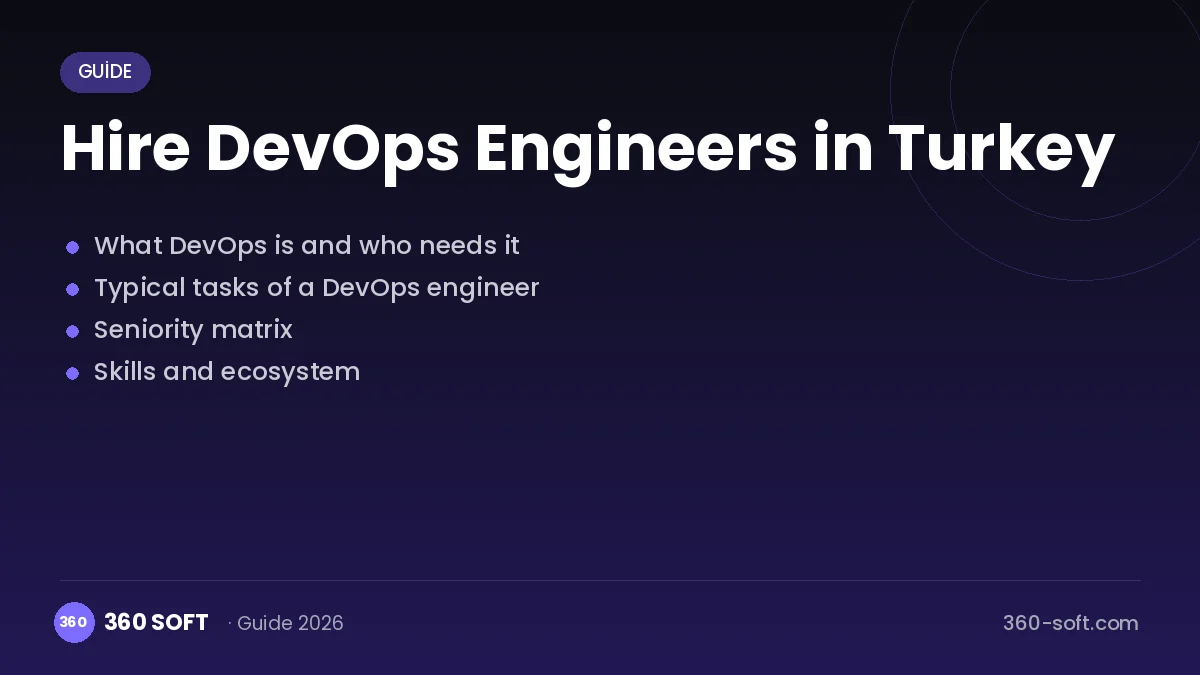
Hire DevOps engineers in Turkey. A good DevOps engineer turns slow, manual and risky releases into an automated, observable and secure delivery pipeline. Our DevOps engineers join your team or take ownership of your infrastructure, working in your cloud accounts and repositories with a large daily overlap with European working hours, and with 7/24 shift options for operations.
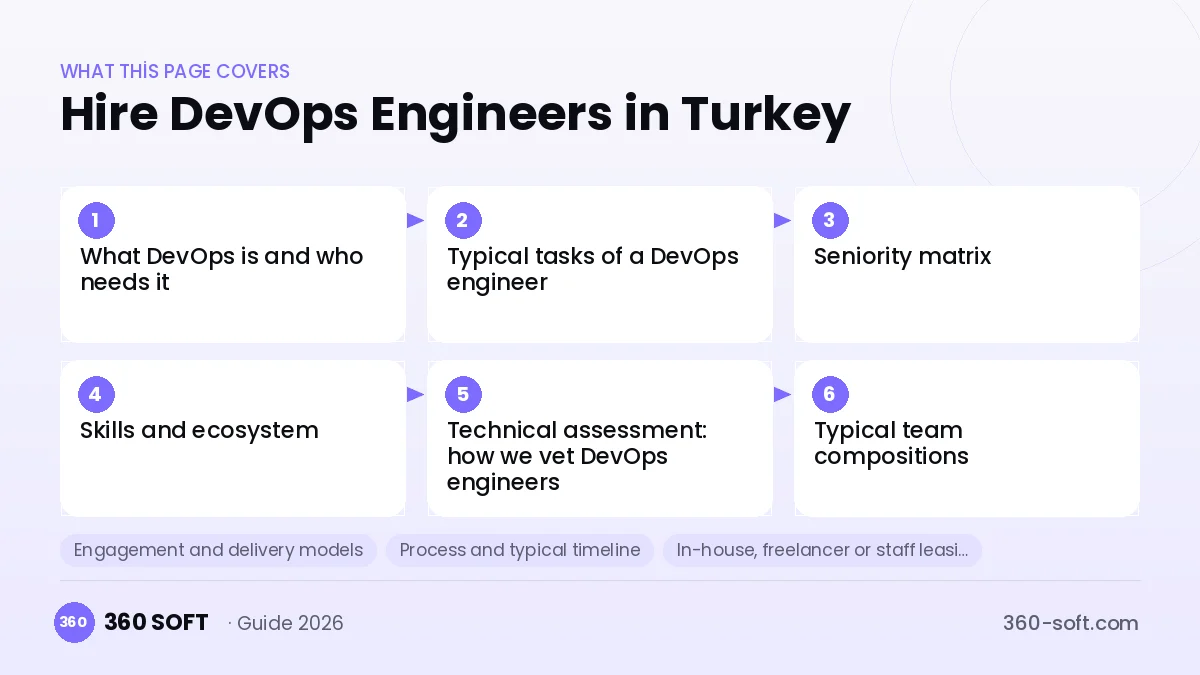
This page covers who needs DevOps capacity, typical tasks, a seniority matrix, the tools we work with, how we vet candidates, KPIs, pricing factors and how the contract protects your systems and data. For managed services, see our DevOps services; for other roles, go back to hire developers in Turkey.
What DevOps is and who needs it
DevOps combines development and operations practices so that software can be built, tested, released and run reliably. In practice that means infrastructure as code, CI/CD pipelines, containers, monitoring and incident response. Companies typically need a DevOps engineer when releases are manual, when the cloud bill grows without control, when outages are discovered by customers, or when developers spend more time on servers than on product.
Typical problems without DevOps
- Deployments done by hand, outside working hours, with frequent rollbacks
- Servers configured manually, with no record of what changed
- No monitoring or alerting, so incidents are noticed late
- Cloud costs rising without visibility per service or environment
- Secrets stored in code or shared in chat
Typical tasks of a DevOps engineer
| Area | Typical tasks |
|---|---|
| CI/CD | Build, test and deployment pipelines with GitHub Actions, GitLab CI, Jenkins or Azure DevOps |
| Infrastructure as code | Terraform, Pulumi, Bicep or CloudFormation; reusable modules and environments |
| Containers and orchestration | Docker images, Kubernetes clusters (EKS, AKS, GKE or on-premise), Helm, GitOps with Argo CD or Flux |
| Observability | Prometheus, Grafana, Loki, ELK or OpenSearch, OpenTelemetry, alerting and on-call runbooks |
| Security | Secret management with Vault or cloud KMS, image scanning, least-privilege IAM, patching |
| Cost and reliability | Right-sizing, autoscaling, backups, disaster recovery tests, FinOps reporting |
Seniority matrix
| Level | Typical experience | Independence | Expected skills |
|---|---|---|---|
| Junior | 0–2 years | Supervised operational tasks | Linux, shell scripting, Git, Docker basics, one CI tool |
| Mid-level | 2–5 years | Owns pipelines and environments | Terraform, Kubernetes, one major cloud, monitoring stack |
| Senior | 5+ years | Owns platform design, mentors others | Multi-account cloud architecture, security hardening, incident leadership, cost optimisation |
| Lead / platform architect | 8+ years | Sets platform strategy | Platform engineering, SRE practices, compliance requirements, roadmap and budgeting |
Skills and ecosystem
| Category | Examples |
|---|---|
| Cloud | AWS, Microsoft Azure, Google Cloud, plus on-premise and hybrid setups |
| Operating systems | Linux (Ubuntu, RHEL, Debian), Windows Server where needed |
| Configuration | Ansible, cloud-init, Packer |
| Scripting | Bash, Python, PowerShell, Go for tooling |
| Databases in operations | PostgreSQL, MySQL, Redis, managed database services, backup and replication |
Technical assessment: how we vet DevOps engineers
Interview topics
- Designing a CI/CD pipeline with tests, approvals and rollbacks
- Kubernetes networking, resource limits and troubleshooting a failing pod
- Terraform state management, modules and drift
- Monitoring strategy: what to alert on and how to avoid alert fatigue
- Handling a real incident: communication, root cause and post-mortem
Practical task
Candidates containerise a small application, write Terraform for its infrastructure and a pipeline that deploys it, or debug a broken deployment we prepared. We assess clarity, safety and repeatability.
Infrastructure code review criteria
| Criterion | What we look for |
|---|---|
| Reproducibility | Everything in code, no manual steps |
| Security | No secrets in code, least privilege, encrypted storage |
| Modularity | Reusable modules, clear variables and outputs |
| Operability | Health checks, logs, metrics and documented runbooks |
Typical team compositions
| Scenario | Suggested composition |
|---|---|
| Startup or single product | 1 mid-level or senior DevOps engineer shared across the team |
| Cloud migration | 1 platform architect, 1–2 DevOps engineers, developer support for application changes |
| 24/7 production operations | A rotation of DevOps or SRE engineers on 7/24 shifts with clear escalation paths |
Engagement and delivery models
Our DevOps engineers work remotely, on-site or in a hybrid setup. Most DevOps work is remote; on-site or hybrid presence is useful for data-centre work, on-premise clusters or regulated environments. Shift plans can cover nights and weekends.
- Dedicated specialist (staff augmentation): one or more DevOps engineers join your team full time, follow your processes and report to your lead.
- Dedicated team: a cross-functional team with a lead, sized from 1 to 200+ people, that owns a product area or a backlog.
- Project-based delivery: a defined scope with milestones and acceptance criteria, delivered by a team we manage.
- Extended coverage: 7/24 shift plans for support, monitoring or release windows where the work needs it.
Process and typical timeline
| Step | What happens | Typical duration |
|---|---|---|
| 1. Discovery call | We clarify scope, stack, seniority, time zone overlap and working model | 1–2 days |
| 2. Shortlist | We share pre-screened DevOps profiles with our technical assessment notes | About 1 week |
| 3. Your interviews | You interview the candidates; a trial task can be added | A few days |
| 4. Contract and onboarding | Service agreement, NDA and DPA signed, access set up, equipment ready | Typical start in 1–2 weeks |
| 5. Ongoing delivery | Regular check-ins, performance reviews and a replacement process if the fit is not right | For the agreed term |
In-house, freelancer or staff leasing with 360 Soft
| Criterion | In-house hire | Freelancer | Staff leasing / outsourcing with 360 Soft |
|---|---|---|---|
| Time to start | Often months including notice periods | Fast, availability varies | Typical start in 1–2 weeks |
| Employment admin | On you | On the freelancer | Handled by 360 Soft in Turkey |
| Continuity | Depends on retention | Risk of sudden unavailability | Replacement process included |
| Scaling up or down | Slow | One person at a time | From 1 to 200+ people |
| IP and confidentiality | Employment contract | Needs careful drafting | IP assignment and NDA in the B2B agreement |
KPI and SLA table
| Indicator | What it measures | How to set the target |
|---|---|---|
| Deployment frequency | How often you release to production | Baseline first, then improve quarter by quarter |
| Lead time for changes | Commit to production time | Agree a target per service |
| Change failure rate | Share of releases causing incidents | Agree a ceiling |
| Mean time to recovery (MTTR) | How fast service is restored after an incident | Defined in the SLA by severity |
| Availability | Uptime of critical services | Agree SLOs per service |
Factors that drive the price
| Factor | Effect |
|---|---|
| Seniority | Architects and senior SREs cost more |
| Cloud and tool scope | Multi-cloud, Kubernetes at scale or compliance work add to the rate |
| Coverage | Business hours, on-call or 7/24 shifts |
| Working model | On-site or hybrid presence and travel |
| Term and team size | Longer terms and larger teams are priced differently |
We do not publish fixed prices; you receive a written quote based on your environment and coverage needs.
Risks and mitigations
| Risk | Mitigation |
|---|---|
| Too much access in one person’s hands | Least-privilege roles, audited access, break-glass procedures |
| Outages during migration | Staged rollouts, blue-green or canary deployments, tested rollback |
| Undocumented infrastructure | Everything as code plus runbooks and architecture diagrams |
| Engineer not the right fit | Replacement process in the contract |
Security, data protection, NDA and IP
You sign a B2B service agreement with 360 Soft; the specialists are engaged by us in Turkey. All work product is assigned to you under an IP assignment clause, and every team member signs confidentiality and IP undertakings before getting access. Where personal data is processed, we sign a GDPR data processing agreement (DPA) with Standard Contractual Clauses, or the UK IDTA for UK clients, and we comply with Turkey’s data protection law KVKK. Engineers work in your cloud accounts with named, revocable credentials and access logging; production access levels are agreed in writing.
Legal note
This page is general information, not legal advice. Contract terms are agreed per project. Our team operates under Turkish law and Turkish sector rules; the local rules of your own country (for example on data protection, sector regulation or contractor classification) also apply, so we recommend a review by your own counsel.
Illustrative scenario: from manual releases to an automated pipeline
Illustrative scenario, not a client case. A software company deploys its web application by copying files to two virtual machines every other Friday evening. A DevOps engineer containerises the application, writes Terraform for staging and production, builds a pipeline with automated tests and a manual approval step, and adds dashboards and alerts. Releases move to working hours and become small and frequent, and rollbacks take minutes instead of hours.
Checklist for choosing a DevOps engineer
- Do they have hands-on experience with your cloud and orchestration platform?
- Can they show infrastructure code they wrote and explain its design?
- How do they handle secrets and access?
- Have they led or supported real incidents and post-mortems?
- Can they cover the hours you need, including on-call?
- Are IP assignment, NDA and the DPA signed before access?
What to expect in the first 30 days
| Period | Focus | Expected output |
|---|---|---|
| Week 1 | Access, inventory of environments and pipelines | Infrastructure map and risk list |
| Weeks 2–3 | Quick wins | Monitoring gaps closed, one pipeline automated or hardened |
| Week 4 | Roadmap | Prioritised improvement plan with effort estimates |
Selected corporate projects
Some of the projects 360 Soft teams have been involved in: TurkStream IT outsourcing project, Vezne 24 and Pratik İşlem financial system infrastructure. For all projects, see our case studies.
Frequently asked questions
Can the engineer work on our existing servers?
Yes. DevOps engineers can work with your existing on-premise or cloud servers and improve them gradually; a migration is not a precondition.
Do you provide 24/7 support?
Yes. We can set up on-call rotations or 7/24 shift coverage with response times defined in the SLA.
Is a security audit included?
Security hardening is part of the daily work. A formal audit or penetration test can be added as a separate scope.
What is the difference between a DevOps engineer and an SRE?
A DevOps engineer focuses on delivery pipelines and infrastructure automation; an SRE focuses on reliability targets, incident response and capacity. Many engineers cover both.
Which cloud providers do you work with?
AWS, Microsoft Azure and Google Cloud, as well as on-premise and hybrid environments.
Do we need to move to Kubernetes?
Not necessarily. For small systems, managed container services or virtual machines with good automation are often simpler and cheaper.
Can you help us migrate to the cloud?
Yes. We plan the migration, build the target environment as code and move workloads in stages.
How quickly can a DevOps engineer start?
We typically share pre-screened profiles within about a week, with a start in 1–2 weeks after your approval.
Who owns the infrastructure code?
You do. All code, scripts and documentation are assigned to you under the service agreement.
What if the engineer is not the right fit?
A replacement process is part of the agreement.
Hire DevOps engineers with 360 Soft
Tell us about your project, your stack and when you need someone, and we will send matching profiles and a written quote. Use our contact page, call +90 850 335 10 87, message us on WhatsApp or email info@360-soft.com. For broader needs, see IT outsourcing services.
Need DevOps engineers? Tell us what you need and we will share matching profiles and a written quote. WhatsApp · +90 850 335 10 87 · info@360-soft.com
Related
- Hire developers in Turkey: all technologies
- Hire a dedicated software development team
- DevOps services
- Hire.NET developers
Related services
- Hire Flutter Developers in TurkeyHire Flutter developers in Turkey: vetted Dart engineers for iOS and Android apps, EU time zone overlap, IP…
- Hire iOS (Swift) Developers in TurkeyHire iOS developers in Turkey: vetted Swift and SwiftUI engineers with App Store experience, EU time zone…
- Hire Java DevelopersHire Java and Spring Boot developers from Istanbul for microservices, integrations and modernisation. Remote…
- Hire Laravel and PHP Developers in TurkeyHire Laravel and PHP developers in Turkey: vetted engineers for APIs, SaaS and legacy upgrades, EU time…
- Hire Node.js Developers in TurkeyHire Node.js developers in Turkey: vetted TypeScript backend engineers for APIs and microservices, EU time…
- Hire Python DevelopersHire Python developers from Istanbul for Django and FastAPI back ends, data pipelines and AI integration…