Energy sector outsourcing means that electricity generation, transmission, distribution and retail companies, natural gas distributors, renewable energy investors (solar and wind) and pipeline or infrastructure projects run part of their IT and OT operations, software development, field maintenance coordination, customer services, data and reporting with an external team defined by contract. Energy is critical infrastructure: outages hit society and the economy directly, and the sector is licensed and regulated. That is why outsourcing in energy has to be designed around security, continuity and compliance first, and cost second. 360 Soft builds the operations team together with the software that makes the process traceable, and the team can work remotely, on site or in a hybrid model.
On this page you will find which tasks energy companies can hand over, the regulatory and cybersecurity framework, field and central team models, service level and pricing tables, risks, a vendor checklist and answers to the most common questions.
Typical challenges for energy companies
- Assets spread over a wide area: power plants, substations, solar and wind sites and pipeline stations sit in different regions, often in remote places. Keeping permanent IT and maintenance staff at every location is expensive.
- The IT/OT boundary: separating SCADA, RTUs and industrial control systems securely from the corporate IT network, and managing patches and access in a controlled way, needs specialist skills.
- Fault and customer call peaks: in distribution and retail, call volumes multiply within hours during storms, snow or planned outages.
- Data and reporting load: generation data, meter readings, market transactions and regulatory reports must be collected from many different systems.
- Sudden capacity needs during projects: commissioning a new plant, line or system creates a temporary but intense need for IT, software and documentation work.
- Scarce specialists: experienced people in OT cybersecurity, energy market software and industrial networks are hard to find and hard to keep.
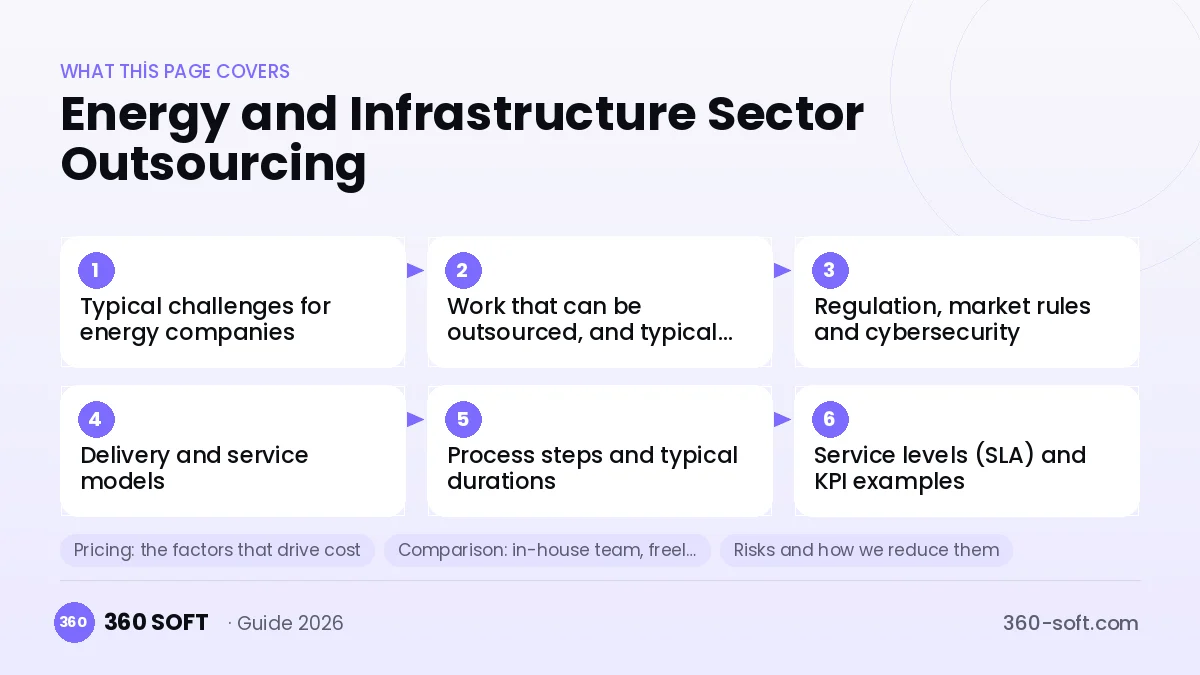
Work that can be outsourced, and typical roles
| Work area | Typical roles | Main tasks | Tools and technologies |
|---|---|---|---|
| IT infrastructure and support | System administrator, network specialist, help desk, field IT technician | User support at head office and site offices, server and network operations, backups, connectivity for remote locations | ITSM, virtualisation, SD-WAN, satellite or mobile links |
| OT and SCADA support | OT network specialist, SCADA engineer, cybersecurity specialist | Network segmentation, access management, monitoring, patch planning, incident response | SCADA/HMI software, industrial firewalls, IEC 62443 approach |
| Software development | Backend/frontend developer, data engineer, test engineer | Asset monitoring and maintenance software, field mobile apps, market and billing integrations | Web and mobile stacks, time-series databases, REST/MQTT |
| Field maintenance coordination | Field coordinator, dispatcher, maintenance planner | Work order planning, preventive maintenance calendar, fault logging, collecting field reports | CMMS/EAM, field mobile app |
| Customer and subscriber services | Customer agent, complaints specialist | Fault report intake, billing and contract questions, outage notifications | Contact centre, CRM, IVR |
| Data, reporting and back office | Data analyst, data entry operator, document controller | Validating generation and meter data, data support for regulatory reports, project documentation | SQL, BI tools, document management systems |
For the field side see our field and technical service outsourcing page; for central and site IT staffing see IT staff leasing; for fault hotlines see call centre and customer service outsourcing; and for data and document work see back office and data entry. Larger software programmes can be delivered through an offshore development centre in Türkiye.
Regulation, market rules and cybersecurity
Energy market activities are based on licences and regulation, and outsourcing does not remove the licence holder’s responsibility under the law. The framework below is general; it should be assessed with your compliance team and legal counsel according to your licence type and activities. Our team operates from Türkiye, so the Turkish framework is described first; when you buy from another country, the energy, cybersecurity and data protection rules of your own jurisdiction (for example NIS2 in the EU or national critical infrastructure rules in the Gulf) also apply.
- Energy Market Regulatory Authority (EPDK): regulates and supervises licensing, tariffs, quality of service and consumer services in the electricity, natural gas, oil and LPG markets in Türkiye. The electricity market is governed by Electricity Market Law No. 6446 and the gas market by Natural Gas Market Law No. 4646.
- Quality of service and consumer services: distribution and retail companies have regulatory rules and deadlines for fault reporting, outage notifications and answering applications and complaints. An outsourced contact centre must be designed and reported against these rules.
- Cybersecurity: EPDK has issued rules and competency requirements on the cybersecurity of industrial control systems in the energy sector, and national cybersecurity principles and incident reporting apply to critical infrastructure. International references are ISO/IEC 27001, the energy-specific ISO/IEC 27019 and the IEC 62443 series for industrial automation.
- Renewables: licensed and unlicensed generation plants must manage generation data and plant information regularly under the applicable regulations and support schemes, so data accuracy is a critical SLA topic.
- Occupational health and safety: for field staff, Turkish OHS Law No. 6331 and professional qualification and authorisation certificates for work at height and electrical work apply. The outsourced team takes on the coordination, IT and data side, not the hazardous field work itself; if that changes, authorisation and certificate requirements are clarified separately.
- Personal data: subscriber data, meter consumption data and field staff data are protected under KVKK (Law No. 6698), and under GDPR or local data protection law where it applies.
Delivery and service models
| Model | How it works | Best fit in energy |
|---|---|---|
| Remote | The team works from the 360 Soft office or remotely over approved secure connections | Software development, reporting, second-level IT support, monitoring |
| On site | The team works at the plant, site office, control centre or head office | Field IT, OT network work, control room shifts, project office |
| Hybrid | Remote central team plus rotating field technicians | Multi-site solar or wind portfolios, pipeline stations |
| Service model | Definition | Example |
|---|---|---|
| Dedicated team | A permanent team for your company or project | Site and central IT team for the duration of a project |
| Staff augmentation | Specialists added to your existing team | OT security specialist, data engineer |
| Managed service | The whole function handed over under an SLA | 24/7 IT monitoring and help desk, fault reporting hotline |
| Project-based | One-off work with a defined scope | Asset monitoring software, system migration, site network installation |
Teams range from a single specialist to 200+ people, 24/7 shifts are possible, and a defined replacement process keeps the service running if a team member leaves. For a single specialist or a small team, a typical start is 1–2 weeks; a full managed service with security onboarding takes longer, as shown below. See also staff augmentation in Türkiye.
Contract note for international buyers
For buyers in the EU, UK, US and MENA we work under a B2B service agreement with 360 Soft as the service provider: the team is employed, managed and paid by 360 Soft, and deliverables and service levels are defined in the contract and its statements of work. The agreement includes an NDA, assignment of intellectual property in all work product to you, and, where personal data is processed, a GDPR data processing agreement (DPA) with Standard Contractual Clauses for transfers to Türkiye (the UK IDTA or Addendum for UK data). Processing in Türkiye is also covered by KVKK (Law No. 6698). Where we provide people for your sites, the structure follows Turkish subcontracting rules and is not a temporary agency work arrangement; in public energy companies, procurement may also be subject to public tender rules. This is general information, not legal advice; your counsel should review the final terms.
Process steps and typical durations
| Step | Content | Typical duration |
|---|---|---|
| 1. Discovery and risk assessment | Locations, systems, IT/OT boundaries, critical assets and regulatory requirements are mapped | 2–4 weeks |
| 2. Service design | Role and permission matrix, SLA, escalation chain, security rules and reporting are agreed | 2–3 weeks |
| 3. Security and access set-up | Authentication, privileged access management, logging and site entry procedures | 2–4 weeks |
| 4. Transition and training | Knowledge transfer from the current team or vendor, site induction, OHS training | 3–6 weeks |
| 5. Pilot | Start with one region or one group of plants | 4–8 weeks |
| 6. Full operation | Monthly SLA report, quarterly risk and security review | For the contract term |
Illustrative scenario: one view for a multi-site solar portfolio
Illustrative scenario: an investor operating many solar plants in different regions tracks inverter and monitoring system faults through emails from several EPC contractors and maintenance crews. The outsourced team brings the monitoring data of all plants into a single dashboard, defines alarm rules, opens a fault record and forwards it to the maintenance crew as a work order, and verifies closure with photos and location data. The monthly report shows fault counts and response times per plant. This is an example of how the service can be set up, not a description of a specific client.
Service levels (SLA) and KPI examples
| Area | KPI | Measurement source | Note |
|---|---|---|---|
| IT support | Response and resolution time by priority | ITSM records | Travel time to field locations is defined separately |
| IT infrastructure | Availability of critical systems | Monitoring system | Excluding planned maintenance windows |
| OT security | Time to detect and report unauthorised access attempts | Security monitoring logs | Linked to the incident reporting procedure |
| OT security | Compliance with access reviews and patch plan | Access and change logs | In windows that do not affect generation |
| Field coordination | Time from alarm to work order, adherence to preventive maintenance plan | CMMS records | By criticality of the plant |
| Customer services | Answer rate, complaint response time | Telephony and CRM | Designed in line with regulatory deadlines |
| Data and reporting | Data accuracy rate, report delivery time | Validation checks | Aligned with the regulatory calendar |
Pricing: the factors that drive cost
We do not publish fixed prices, because the cost depends on scope, location and security requirements. These are the models we use and the factors that move the price.
| Model | How it is calculated | Suitable for |
|---|---|---|
| Per person per month | Monthly fee per role | Dedicated IT and OT teams, software team |
| Hourly | Actual specialist hours | Security assessments, consulting, emergency response |
| Fixed price | One fee for a defined scope | Asset monitoring software, site network set-up, system migration |
| Outcome-based | Fee per plant, asset or closed work order | Multi-site monitoring and fault coordination |
| Factor | Effect |
|---|---|
| Number and remoteness of locations | Remote sites add travel, accommodation and rotation costs |
| 24/7 coverage | Control centre and monitoring services need shifts |
| OT expertise | Industrial security and SCADA experience raise the unit rate |
| Security and compliance requirements | Extra audit, logging and documentation time |
| OHS requirements | Site training, personal protective equipment and medical reports |
| Project duration | On short projects, set-up costs are spread over fewer months |
Comparison: in-house team, freelancers or outsourcing
| Criterion | In-house | Freelancer | Outsourcing |
|---|---|---|---|
| Coverage of remote locations | Expensive; staff at every site | Continuity risk | Rotation and regional team plan |
| OT security expertise | Hard to recruit | Depends on one person | Team with backup |
| Security and audit | Direct control | Hard to audit | Contract, NDA, access logs and audit rights |
| Flexibility during projects | Low | Medium | High |
| Accountability | Internal processes | Limited | SLA and monthly report |
| Knowledge continuity | High | Low | With documentation and handover clauses |
If you are weighing the options for your own case, our why Türkiye page explains time zone, talent and cost aspects of working with a team in Istanbul.
Risks and how we reduce them
| Risk | Mitigation |
|---|---|
| External access creating a vulnerability in the OT network | Privileged access management, session recording, time-limited access, IT/OT segmentation |
| A wrong change stopping generation | Change management, approval workflow, test environment and rollback plan |
| Field accident | OHS training, permit-to-work system, coordination with the main employer, hazardous work kept with authorised crews |
| Leak of critical information | Confidentiality agreements, classified document access, device policies |
| Dependence on the vendor | Documentation, configuration backups and an exit plan |
| Team turnover | Backup staff, site induction documents and a knowledge transfer checklist |
Security, data protection, confidentiality and IP
- Information security: the service is designed along ISO/IEC 27001 and 27019 principles; access to critical assets uses multi-factor authentication and is logged.
- Data protection: the energy company is the data controller and 360 Soft the processor. Purpose and retention of subscriber and consumption data are defined in the contract, with a GDPR DPA and SCCs where EU or UK data is involved, and KVKK for processing in Türkiye.
- Confidentiality: every team member signs an individual confidentiality undertaking; network diagrams, plant layouts and security configurations are kept under restricted access.
- Intellectual property: rights to software, scripts, reports and documentation produced for you are assigned to you by contract, and source code is delivered regularly.
- Incident response: the notification chain, deadlines and responsibilities for security incidents are written into the contract and the incident response plan.
Vendor checklist
- Can the vendor propose a team lead who understands the IT/OT boundary, SCADA and industrial networks?
- Are quality of service and reporting requirements from your regulator reflected in the SLA?
- Can the vendor show concretely how it handles privileged access, session logging and change management?
- Is there a travel, rotation and response time plan for remote locations?
- Are OHS obligations and the limits of authority for field work made clear?
- Is the incident response plan and notification chain defined in writing?
- Does the vendor commit to documentation, configuration backups and an exit plan?
- Is the vendor open to verifying its references and competence claims with documents?
Outsourcing in new plant and infrastructure projects
In large projects such as power plants, transmission lines, pipelines or storage facilities, IT and software needs are very different from the operating phase. Setting up project offices, network and user support at construction sites and camps, document control systems, secure data exchange between project partners and test records during commissioning call for an intensive team for a limited time. When the project is complete, most of that need disappears.
That is why a project-phase team is designed with an exit plan from day one: the systems, documentation and configurations that will stay for operations are identified, and the handover schedule to the operating team is part of the project plan. In projects with international partners, multilingual support, shifts across time zones and the partners’ information security requirements are also part of the service design.
Selected projects
For our IT experience in energy infrastructure projects, see the TurkStream IT outsourcing case study.
Frequently asked questions
Which tasks can energy companies outsource?
The most common areas are IT infrastructure and support, OT and SCADA support, software development, field maintenance coordination, customer and subscriber services, and data, reporting and document work.
Do energy regulations prevent outsourcing?
Outsourcing is generally possible, but the licence holder remains responsible under the regulations. Quality of service, reporting and cybersecurity requirements must be written into the contract and the SLA, and local rules in your country apply as well.
Can an outsourced team access OT and SCADA systems?
Only within the scope you approve, through privileged access management, session recording and time-limited permissions. Changes follow an approval workflow and a rollback plan.
Which security standards do you use as a reference?
We use ISO/IEC 27001, the energy-specific ISO/IEC 27019 and the IEC 62443 approach for industrial automation. Your internal policies and the regulator’s rules take precedence.
Can you provide on-site support at remote plants?
Yes. On-site support can be provided with regional or rotating field staff; travel and response times are written into the SLA per location.
Does the outsourced team do high-voltage or hazardous field work?
Our service focuses on IT, OT, software, coordination and data. Hazardous field work stays with crews holding the required authorisations; our team supports the planning and record-keeping side.
Can a fault reporting hotline be outsourced?
Yes. The contact centre is designed around regulatory deadlines and your procedures, and a capacity plan for severe weather events is prepared in advance.
What do you offer for solar and wind portfolios?
Monitoring data in a single dashboard, alarm rules, fault logging and work order coordination, and monthly performance reporting. Custom monitoring software can be developed if needed.
How is pricing set?
Per person per month for dedicated teams, hourly for consulting and emergency response, fixed price for defined projects, and per plant or per asset for multi-site monitoring.
How is subscriber data protected?
The energy company is the data controller and 360 Soft the processor. Role-based access, logging and confidentiality undertakings apply, data stays in environments you define, and a GDPR DPA with SCCs is signed where needed.
How long does the transition take?
From discovery to full operation typically 3 to 6 months, depending on the number of locations, security requirements and handover terms with the current vendor. Individual specialists can usually start in 1–2 weeks.
Which contract model do you use?
A B2B service agreement: the work is delivered by the 360 Soft team under its own management within an SLA, with NDA, IP assignment and a data processing agreement. It is not a temporary staffing arrangement.
Plan your energy operations team with us
Share your locations, systems and the work you want to hand over, and we will propose a scope, team and service levels that include your security requirements. Call or WhatsApp us on +90 850 335 10 87, write to info@360-soft.com, message us directly on WhatsApp, or use the form on our contact page. 360 Soft Marketing Yazılım ve Danışmanlık Ltd. Şti., Nidakule Ataşehir Batı, Barbaros Mah. Begonya Sk. No:1 D:2, 34746 Ataşehir/İstanbul.
Related pages
- All outsourcing services (hub)
- Field and technical service outsourcing
- Call centre and customer service outsourcing
- Manufacturing sector outsourcing
- DevOps and cloud operations
- IT staff leasing
- Offshore development centre in Türkiye
- Türkçe version of this page
Related services
- ERP Support and Management OutsourcingERP support outsourcing from Istanbul: functional consultants, developers and admins for SAP, Dynamics 365…
- Field and Technical Service OutsourcingField and technical service outsourcing: certified technicians, dispatch and remote pre-diagnosis for…
- Field Data Collection OutsourcingField data collection outsourcing in Türkiye: store and shelf audits, mystery shopping, surveys and asset…
- Finance Back Office OutsourcingFinance back office outsourcing: AP/AR, bank and account reconciliation, expenses, e-invoice and e-ledger…
- Financial Services OutsourcingFinancial services outsourcing: customer support, KYC checks, AML alert pre-review, disputes, collections and…
- Food and Beverage OutsourcingFood and beverage outsourcing: cold-chain monitoring, warehouse, traceability, QA documentation and field…