Retail chains live on thin margins, seasonal peaks and hundreds of small operational tasks that never stop: customer questions, store IT tickets, price changes, product data, stock counts and new store openings. Many retailers do not need more head office staff for this; they need a reliable team that can scale with campaign calendars and store counts. 360 Soft builds dedicated outsourcing teams for retail and store chains from Istanbul, working remotely, on site in Türkiye or in a hybrid model, from a single specialist to teams of 200+ people.
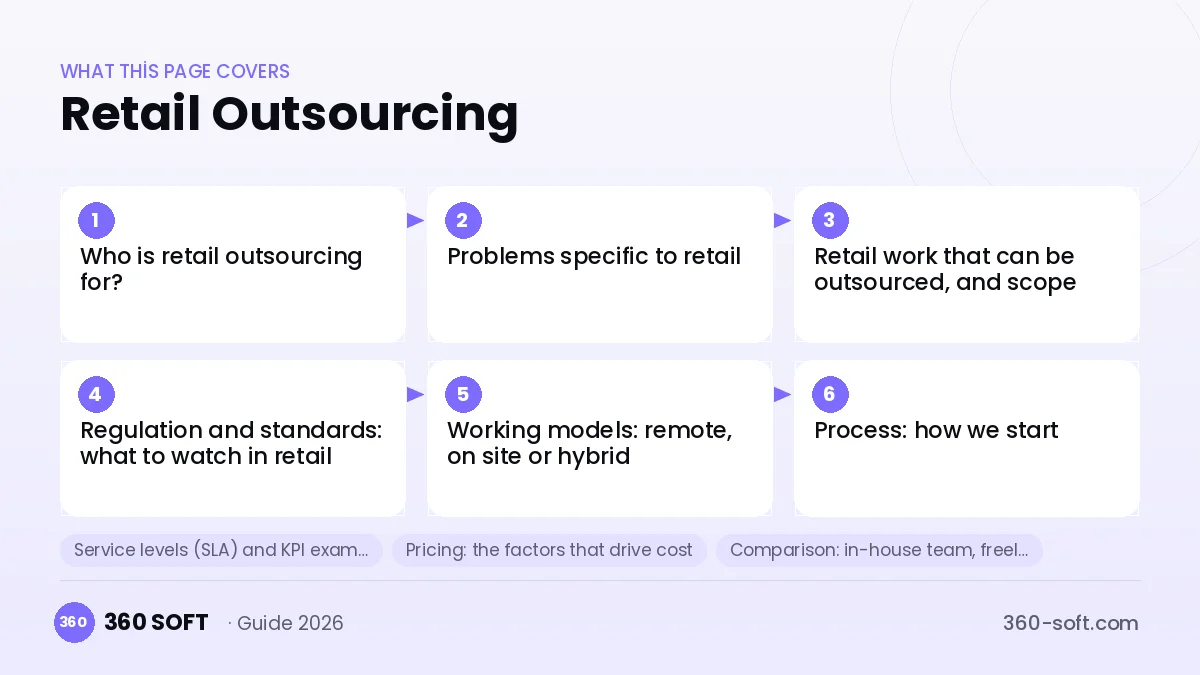
This page explains who retail outsourcing suits, the problems typical of the sector, which work can be handed over, a typical team structure, the regulatory points to watch, working and contract models, the onboarding process, SLA and KPI examples, pricing factors, a comparison with in-house hiring and freelancers, risks, security and a vendor checklist. For an overview of all services, see our outsourcing services hub.
Who is retail outsourcing for?
- Store chains (fashion, electronics, home, DIY, grocery and pharmacy-style formats) with dozens or hundreds of stores and a central support function under pressure.
- Omnichannel retailers that combine stores, a web shop, marketplaces and click-and-collect, and need one team that understands all channels.
- International brands entering Türkiye or the region that need Turkish-speaking customer service, store support and field coordination without building a local organisation first.
- Franchise systems that want a consistent support standard across franchisees.
- Growing retailers preparing for new store openings, a new ERP or POS rollout, or a large campaign season.
Problems specific to retail
- Extreme peaks: Black Friday, season changes, back to school and holiday periods multiply contact volume and store tickets for a few weeks, then drop again.
- Store downtime costs sales: a POS, handheld terminal or label printer that does not work at opening time means queues and lost revenue.
- Price and promotion errors: differences between shelf price and till price create customer complaints and regulatory risk.
- Product data at scale: thousands of SKUs, variants, images and marketplace listings need constant maintenance.
- High staff turnover: store and call centre roles turn over quickly, and every new hire needs training.
- Fragmented systems: ERP, POS, WMS, e-commerce and CRM rarely talk to each other cleanly.
Retail work that can be outsourced, and scope
The table summarises the areas retail chains most often hand over to an external team, the typical tasks and the tools used. Each area can be contracted on its own or combined with others in one agreement.
| Area | Typical tasks | Technology and tools |
|---|---|---|
| Field and technical service | Installing tills, POS, handheld terminals, label printers, network and cameras; incident response; new store setup; preventive maintenance | Field service software, mobile work orders, spare parts tracking |
| Contact centre and customer service | Phone, live chat, email and social media requests; order and return tracking; complaint handling; loyalty programme questions | Cloud telephony, omnichannel CRM, knowledge base, chatbot |
| Warehouse and logistics operations | Store shipment preparation, picking and packing, returns intake, transfers, stock count teams | WMS, handheld terminals, barcode and RFID |
| Store help desk | IT and application requests from stores, remote resolution, dispatching field technicians when needed | ITSM ticketing, remote access, asset management |
| Central price and promotion operations | Entering price changes, configuring promotions in ERP and POS, preparing label print lists | ERP, pricing tools, electronic shelf label integration |
| Product data and catalogue | Creating product records, editing images and descriptions, marketplace listings, variant and barcode mapping | PIM, marketplace integrations |
| Digital marketing team | Campaign content, performance ads, CRM and email campaigns, local store pages | Ad platforms, marketing automation, analytics |
| IT and software team | POS and ERP integrations, mobile apps, reporting, data warehouse, automation | APIs, ETL, BI tools |
Typical team structure by role
| Role | Responsibility |
|---|---|
| Operations / service manager | Single point of contact, SLA reporting, capacity planning around the campaign calendar |
| Team leader | Daily shift management, quality checks, coaching, escalation handling |
| Customer service agent | Multichannel customer contacts, orders, returns, complaints, loyalty questions |
| Store support specialist (1st and 2nd level) | Store tickets, POS and application issues, remote fixes, dispatching |
| Field technician | Installation, repair and maintenance in stores, new store openings |
| Catalogue and pricing specialist | Product data, price and promotion entries, four-eyes checks |
| Stock count team | Periodic and year-end counts, cycle counts, reconciliation support |
| Software developer / data analyst | Integrations, reports, dashboards and automation |
RFID, automation and software
Not every problem is solved by adding people. Where stock accuracy or count effort is the bottleneck, RFID tagging and handheld readers can cut count time and improve availability; see our RFID inventory systems page. Repetitive work such as price file preparation, product data checks or report generation can often be automated by our software team, so the operations team focuses on exceptions. RFID or robotics are never a requirement for outsourcing; we recommend them only where the business case is clear.
Regulation and standards: what to watch in retail
Outsourcing a task does not remove legal responsibility; in most cases it stays with the retailer and is passed through to the vendor by contract. A good vendor therefore knows the relevant frameworks and builds them into its processes. Because our teams operate in Türkiye, the Turkish rules below apply to the work we do there. In addition, local consumer, advertising and data protection rules in your own country apply to your business. This summary is general information, not legal advice.
- Consumer Protection Law No. 6502 and regulations: withdrawal rights, defective goods, returns and exchanges and complaint handling. Customer service scripts and templates are written to fit this framework (and, for your other markets, to the local equivalent such as EU consumer law).
- Price labelling rules: prices must be shown clearly and correctly; shelf and till price mismatches cause problems in inspections. This is why price and promotion operations use four-eyes checks.
- Commercial advertising and unfair commercial practices: discount announcements and reference prices must be accurate and provable.
- Law No. 6563 and the Message Management System (İYS): commercial SMS, email and calls require recorded consent in Türkiye; similar opt-in rules exist under ePrivacy rules in the EU and PECR in the UK.
- KVKK (Law No. 6698): customer and loyalty data are personal data; access, retention and transfer are controlled. For EU and UK customers, GDPR applies in parallel.
- Card data security: agents never collect card numbers by phone or chat outside a PCI DSS compliant flow.
- Cash registers and e-documents: fiscal devices, e-invoice and e-archive procedures in Türkiye are followed by field and store support teams.
Working models: remote, on site or hybrid
| Model | Best for | Notes |
|---|---|---|
| Remote | Customer service, store help desk, catalogue, pricing, digital marketing, software | Fastest to start; team works from our Istanbul office or approved home setups |
| On site | Field service, stock counts, warehouse, new store openings in Türkiye | Planned by region and store calendar |
| Hybrid | Mixed scopes, for example remote help desk plus regional field technicians | Most common model for store chains |
Contract models: dedicated team (people work only for you), staff augmentation (specialists join your existing team, see staff augmentation), managed service (we own the outcome against SLAs) or project-based work such as a store opening wave or an annual count. Teams can run 7/24 in shifts where needed.
Contract note for international buyers
We work under a B2B service agreement with a defined scope, SLAs and acceptance criteria. Standard documents include a mutual NDA, an IP assignment clause so that all work product, scripts, knowledge base articles and code belong to you, and a data processing agreement (DPA). For EU and UK clients the DPA covers GDPR, with Standard Contractual Clauses (and the UK IDTA or Addendum) for transfers to Türkiye; personal data processed in Türkiye is also subject to KVKK (Law No. 6698). Team members are employed by 360 Soft under Turkish labour law, so you do not take on employer obligations in Türkiye. Local rules in your own country continue to apply to your business and should be reviewed with your legal advisers.
Process: how we start
- Discovery call: channels, volumes, store count, systems, campaign calendar and pain points.
- Scope and proposal: roles, team size, working hours, SLAs, reporting and a pricing model.
- Contract and security: service agreement, NDA, DPA and access design (least privilege).
- Recruitment and training: selecting people, training on your products, systems, policies and tone of voice.
- Pilot: a limited scope, region or channel with daily feedback.
- Full operation and improvement: scaling to full scope, monthly reviews and peak season planning.
A typical start takes 1 to 2 weeks for smaller remote teams; larger or field-heavy scopes are planned in phases. If a team member leaves or is not the right fit, our replacement process provides a trained substitute so service continues.
Service levels (SLA) and KPI examples
The targets below are examples of what is usually measured. Actual values are agreed per contract based on your baseline.
| Area | Example KPIs |
|---|---|
| Customer service | Answer rate, average speed of answer, first contact resolution, CSAT, complaint closure time |
| Store help desk | Response and resolution time by priority, remote resolution rate, repeat tickets |
| Field service | Time to site, fix rate on first visit, store opening readiness on schedule |
| Price and promotion | Error rate, changes completed before store opening, shelf and till price consistency |
| Catalogue | Products live per day, data completeness, marketplace rejection rate |
| Stock count | Count completion on schedule, variance rate, recount rate |
Pricing: the factors that drive cost
We do not publish prices because cost depends on scope. The factors below shape every proposal; we usually offer a monthly per-person fee, hourly pricing, a fixed fee for projects or a volume-based model.
| Factor | Effect on cost |
|---|---|
| Channels and languages | Each additional language or channel adds skills and coverage requirements |
| Working hours | Extended hours, weekends and 7/24 coverage need more shifts |
| Seasonality | Peak capacity can be agreed as a flexible pool rather than permanent headcount |
| Store count and geography | Drives field travel, regional technicians and count team sizes |
| Systems and integrations | More systems mean longer training and more complex access design |
| Reporting depth | Custom dashboards and daily reporting add analyst effort |
Comparison: in-house team, freelancers or outsourcing
| Criterion | In-house team | Freelancers | Outsourcing with 360 Soft |
|---|---|---|---|
| Peak flexibility | Low, hiring is slow | Medium, availability varies | High, flexible capacity pool |
| Management effort | High | High, many individuals | Low, one accountable partner |
| Continuity | Depends on turnover | Weak | Replacement process and documented knowledge |
| Quality control | Internal effort | Hard to standardise | SLAs, QA and reporting |
| Speed to start | Weeks to months | Fast for one person | Typically 1 to 2 weeks |
Risks and how we reduce them
- Wrong information to customers: approved knowledge base, scripts and QA sampling.
- Price errors: four-eyes checks and pre-opening validation.
- Data leakage: least-privilege access, no local downloads, logged activity.
- Peak season under-capacity: forecasting with your campaign calendar and a trained reserve pool.
- Knowledge loss at contract end: documented processes and an exit and handover plan in the contract.
Security, data protection, confidentiality and IP
Access is granted per role, with named accounts, MFA where your systems support it and logged activity. Customer data stays in your systems wherever possible. Every team member signs confidentiality undertakings, and all work product, including scripts, knowledge base content and code, is assigned to you. GDPR and KVKK obligations are documented in the DPA.
Vendor checklist
- Has the vendor run retail or high-volume consumer operations before?
- Can it scale for peak weeks without lowering quality?
- Are SLAs, KPIs and reporting clearly defined in the contract?
- Is there a replacement process for team members?
- Are data protection, access control and IP assignment documented?
- Is there an exit and handover plan?
- Can operations and software (automation, integrations, RFID) be combined?
Illustrative scenario: preparing for a campaign week
Illustrative scenario. A store chain with a few hundred stores plans a major autumn campaign. Six weeks before, the operations manager agrees the expected contact volume with marketing. The core customer service team is extended with trained reserve agents, the store help desk adds evening shifts, the pricing team prepares and double-checks the campaign price lists, and field technicians check label printers in priority stores. After the campaign, capacity returns to normal and a short report lists what to improve next time. This is an example of how the model works, not a description of a specific client.
Selected projects
You can review one of our applications in robotics and AI interfaces on the CarrefourSA and MediaMarkt case study page.
Frequently asked questions
Which retail tasks are best suited to outsourcing?
Customer service, store help desk, field service, price and promotion operations, product data and catalogue work, stock counts and digital marketing are the most common. Strategic decisions such as pricing policy and assortment stay with you.
Can we combine several services in one contract?
Yes. Customer service, store support, field service and catalogue work can run under one agreement with one operations manager and shared reporting.
How do you add capacity for campaign periods?
We plan with your campaign calendar and keep a trained reserve pool, so extra agents or technicians can join for peak weeks and step back afterwards.
Does the team work in stores or remotely?
Customer service, help desk, catalogue and pricing work is usually remote. Field service, counts and store openings in Türkiye are on site. Most chains use a hybrid model.
Which contract model is used?
A B2B service agreement with SLAs, plus an NDA, IP assignment and a GDPR DPA with SCCs (UK IDTA where relevant). KVKK applies to data processed in Türkiye.
How is the price determined?
By scope: roles, team size, working hours, languages, seasonality, store count and systems. We propose per-person monthly, hourly, fixed or volume-based pricing.
How is our customer data protected?
Role-based access, named accounts, logged activity, confidentiality undertakings and a DPA. Data stays in your systems wherever possible.
How do we track service quality?
Through agreed KPIs such as answer rate, resolution time, CSAT and error rates, with regular reports and monthly reviews.
How long does it take to start?
A typical start takes 1 to 2 weeks for remote teams. Larger or field-heavy scopes are rolled out in phases.
Is RFID or robotic counting required?
No. We recommend RFID or automation only where the business case is clear; outsourcing works without them.
Do you also build retail software?
Yes. Our software team can build integrations, reports, mobile apps and automation alongside the operations team.
Will we lose process knowledge when the contract ends?
No. Processes are documented throughout, and the contract includes an exit and handover plan.
Plan your retail operations team with us
Tell us your channels, store count, systems and campaign calendar, and we will propose roles, SLAs and a pricing model. Call or WhatsApp us on +90 850 335 10 87, write to info@360-soft.com, message us directly on WhatsApp, or use the form on our contact page. 360 Soft Marketing Yazılım ve Danışmanlık Ltd. Şti., Nidakule Ataşehir Batı, Barbaros Mah. Begonya Sk. No:1 D:2, 34746 Ataşehir/İstanbul.
Related pages
- All outsourcing services (hub)
- Call centre and customer service outsourcing
- Field and technical service outsourcing
- Warehouse and logistics outsourcing
- E-commerce sector outsourcing
- Digital marketing team
- RFID inventory systems
- IT staff leasing
- Türkçe version of this page
Related services
- RFID and Drone Inventory Counting ServiceInventory counting as a service: counting team, RFID readers, barcode terminals and drones provided, with…
- RPA and Process Automation OutsourcingRPA and process automation outsourcing: process discovery, UiPath and Power Automate bot development, managed…
- Sales and Telesales OutsourcingSales and telesales outsourcing from Istanbul: lead qualification, meeting booking, telesales and renewals in…
- SAP Outsourcing and SAP AMS SupportSAP outsourcing and SAP AMS from Istanbul: S/4HANA, FI/CO, MM/SD, ABAP, Basis and integration teams, from one…
- SOC and Security Monitoring OutsourcingSOC outsourcing: 24/7 SIEM and EDR monitoring, alert triage, investigation and incident response by L1-L3…
- Software Maintenance and Support (AMS) OutsourcingApplication management services (AMS) from Istanbul: ITIL-based L1-L3 support, bug fixing, maintenance and…