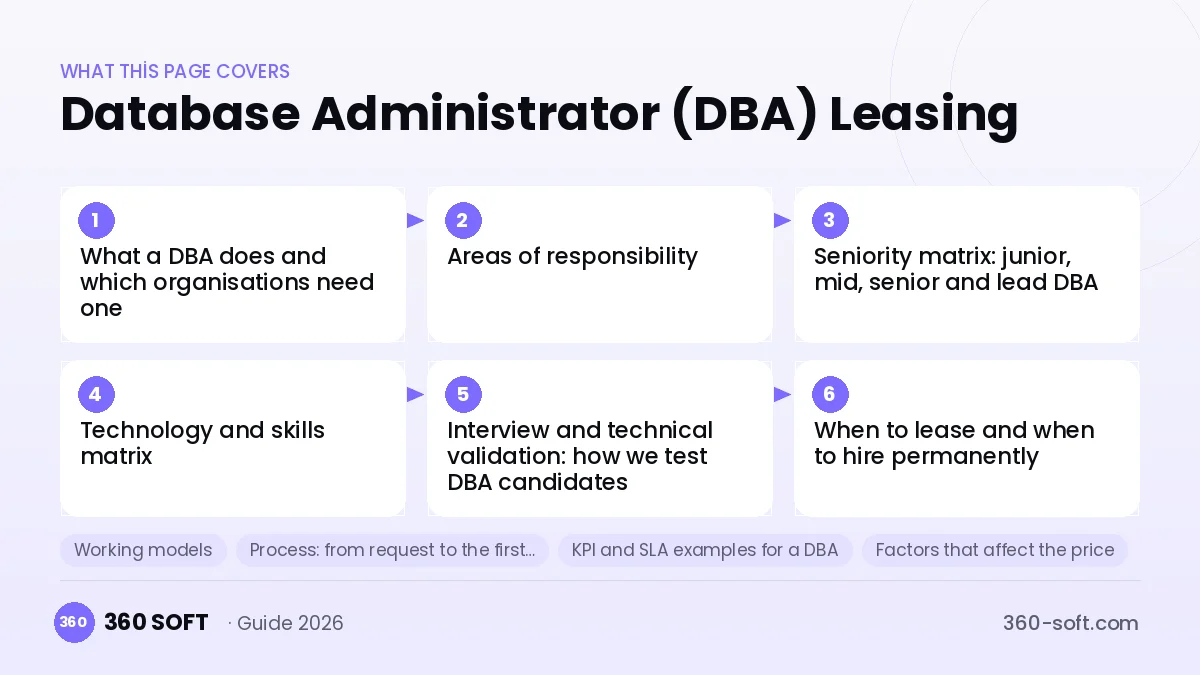
Leasing a database administrator (DBA) through 360 Soft gives you a specialist who keeps your databases fast, available, backed up and secure, without the long search for a scarce permanent hire. Our DBAs work with Oracle, Microsoft SQL Server, PostgreSQL, MySQL/MariaDB and NoSQL platforms, on-premises and in the cloud. They work under a service agreement with 360 Soft, remotely, on-site or in a hybrid model, and 7/24 on-call or shift coverage can be arranged. This page explains the DBA role, seniority levels, the technology matrix, how we test candidates, KPI and SLA examples and the factors that shape the cost. It is part of our IT staff leasing services.
What a DBA does and which organisations need one
Every business-critical application depends on a database, but few companies notice their database until something breaks: a report that took seconds now takes minutes, a backup that nobody tested fails during a restore, or an audit asks who can read customer data. A DBA prevents those moments. Organisations that typically need a dedicated or leased DBA:
- Banks, payment companies and insurers running high-volume transactional systems.
- E-commerce and retail businesses with peak seasons and strict uptime expectations.
- Software companies whose SaaS product runs on a growing PostgreSQL or SQL Server estate.
- Enterprises with Oracle or SQL Server licences that need tuning, patching and audit readiness.
- Companies migrating databases to AWS, Azure or Google Cloud.
- Organisations that lost their only DBA and need cover immediately.
Areas of responsibility
| Area | Typical tasks |
|---|---|
| Availability | High availability and replication (Always On, Data Guard, streaming replication, Galera), failover tests |
| Backup and recovery | Backup strategy, RPO/RTO definition, regular restore tests, disaster recovery runbooks |
| Performance | Query and index tuning, execution plan analysis, wait statistics, capacity planning |
| Security | Roles and least privilege, encryption at rest and in transit, auditing, masking of personal data |
| Maintenance | Patching, version upgrades, statistics and index maintenance, housekeeping jobs |
| Migration and design | Platform migrations, cloud moves, schema reviews with developers |
| Monitoring | Alerting, dashboards, incident response and root-cause analysis |
Seniority matrix: junior, mid, senior and lead DBA
| Level | Experience | What you can expect |
|---|---|---|
| Junior DBA | 1–3 years | Routine monitoring, backup checks and maintenance tasks under supervision |
| Mid-level DBA | 3–6 years | Independently runs production databases, tunes queries, handles incidents and patches |
| Senior DBA | 6–10 years | Designs HA/DR, leads migrations and upgrades, handles complex performance problems |
| Lead DBA / data platform architect | 10+ years | Owns the database strategy across platforms, sets standards, advises on licensing and architecture |
Technology and skills matrix
| Platform | Typical skills |
|---|---|
| Oracle | RAC, Data Guard, RMAN, ASM, AWR/ASH analysis, Exadata (where required) |
| Microsoft SQL Server | Always On availability groups, SSIS/SSRS, Query Store, index tuning, Azure SQL |
| PostgreSQL | Streaming and logical replication, Patroni, pgBouncer, partitioning, extensions, Amazon RDS/Aurora |
| MySQL / MariaDB | InnoDB tuning, Galera cluster, ProxySQL, replication topologies |
| NoSQL and others | MongoDB, Redis, Elasticsearch, Cassandra |
| Cloud and automation | AWS RDS, Azure SQL, Cloud SQL, Terraform, Ansible, scripting in Bash, PowerShell or Python |
Interview and technical validation: how we test DBA candidates
- Platform interview: deep questions on the database engines you run, led by a senior engineer.
- Performance case: the candidate analyses a slow query and execution plan and explains the fix.
- Recovery scenario: a database is corrupted at 03:00; the candidate walks through restore steps and communication.
- HA/DR design: they sketch an availability design for given RPO and RTO targets.
- Security questions: privilege models, auditing and protecting personal data.
- Reference check: with previous managers or clients, where the candidate allows it.
You interview the shortlist and make the final decision.
When to lease and when to hire permanently
Leasing works well when you need DBA capacity quickly, for a migration or upgrade project, for 7/24 coverage that one internal person cannot provide, or for a platform skill (for example Oracle RAC) that your team lacks. A permanent DBA makes sense when the role is stable and long-term and you can wait for recruitment. Many companies combine both: an internal owner plus leased DBAs for shifts and specialist work.
Working models
- Remote: the specialist works from Türkiye inside your tools, with agreed overlap hours for EU, UK or Gulf time zones.
- On-site: at your office in Istanbul, or travelling for workshops, kick-offs and critical phases.
- Hybrid: mostly remote with regular on-site days.
- On-call and shifts: business-hours support, extended hours or 7/24 rotation with agreed response times.
Process: from request to the first week
| Step | What happens | Typical duration |
|---|---|---|
| 1. Brief | Platforms, versions, environment size, required coverage and access model | 1–2 days |
| 2. Shortlist | Tested DBA profiles | 3–7 days |
| 3. Interviews | You interview and choose | 2–5 days |
| 4. Contract and access | Service agreement, NDA, DPA, accounts with least privilege | Typical start in 1–2 weeks overall |
| 5. First week | Health check of backups, HA, security and performance; prioritised findings list | First week |
KPI and SLA examples for a DBA
| KPI / SLA | What it shows |
|---|---|
| Database availability | Uptime of production databases against the agreed target |
| Backup success and restore tests | Share of successful backups and frequency of verified restores |
| RPO and RTO achieved in tests | Whether recovery targets are met in practice |
| Incident response time | Time to acknowledge and start working on alerts |
| Query performance | Response time of key queries and reports over time |
| Patch compliance | Share of databases on supported, patched versions |
| Audit findings | Open database-related findings from security or compliance audits |
Targets are agreed with you individually; the values depend on your architecture and coverage model.
Factors that affect the price
We do not publish prices because every engagement is scoped individually. The main factors are:
| Factor | Effect |
|---|---|
| Seniority and platform | Senior Oracle or multi-platform DBAs cost more than mid-level single-platform DBAs |
| Coverage model | Business hours, extended hours or 7/24 on-call and shifts |
| Environment size and criticality | Number of instances, data volume and regulatory requirements |
| Working model | On-site work and travel add cost compared with remote |
| Duration and allocation | Full-time or part-time; longer engagements are usually priced more favourably |
| Working hours | Overlap with distant time zones or 7/24 shift coverage |
Permanent DBA, freelancer and leasing compared
| Criterion | Permanent hire | Freelancer | Leased via 360 Soft |
|---|---|---|---|
| Time to start | Often 2–4 months | Fast, availability varies | Typically 1–2 weeks |
| Continuity | High | Risk of leaving mid-project | Replacement process if the fit is not right |
| Employer obligations | On you | Contract risk depends on your country | With 360 Soft under Turkish labour law |
| Scaling | Slow | One person | From 1 to 200+ people |
| Control over daily work | Full | Limited | You direct the work; we handle employment |
Risks and mitigations
| Risk | Mitigation |
|---|---|
| Privileged access by an external person | Named accounts, least privilege, session logging, MFA and access revoked at the end |
| Single point of failure | Documentation, runbooks and an optional backup DBA |
| Unknown legacy environment | Structured health check in the first week |
| Changes causing incidents | Change control, test environments and agreed maintenance windows |
| Poor fit | You choose; replacement process if it still does not work |
Confidentiality, data protection and IP
The DBA works under a B2B service agreement between your company and 360 Soft; there is no employment relationship between you and the specialist. The standard package includes a mutual NDA, an IP assignment clause under which all work product, documentation and code created for you belongs to you, and written access rules for your systems.
- EU/EEA buyers: a GDPR Data Processing Agreement (Art. 28) with Standard Contractual Clauses for transfers to Türkiye.
- UK buyers: the UK International Data Transfer Agreement (IDTA) or the UK Addendum to the SCCs.
- Türkiye: the team operates under KVKK (Law No. 6698), the Turkish personal data protection law.
- Access hygiene: named accounts, least-privilege access, MFA, your VPN or VDI where required, and access revoked on the last day.
Legal note
The specialist is employed by 360 Soft under Turkish labour law; payroll, social security and statutory obligations remain with us. This page is general information, not legal advice. Sector rules in Türkiye (for example BDDK for banking or SPK for capital markets) apply to work done there, and the local rules of your own country also apply; please have the agreement reviewed by your legal counsel.
Checklist for choosing a DBA provider
- Which platforms and versions do you run, and where (on-premises, cloud, hybrid)?
- What are your RPO and RTO targets, and when were restores last tested?
- Do you need business-hours support, extended hours or 7/24 coverage?
- How will privileged access be granted, logged and revoked?
- Are there regulatory requirements such as banking, payments or personal data rules?
- Who approves changes and maintenance windows?
- Which KPIs will you review monthly?
Example scenario
Illustrative scenario: a SaaS company in the UK runs its product on PostgreSQL and its only DBA has resigned. A senior PostgreSQL DBA joins remotely within two weeks, reviews backups and replication in the first week, finds that restores were never tested, and sets up automated restore checks and alerting. A second DBA is later added to cover a 7/24 rotation. This is an example of how the role can be used, not a report of a specific client result.
Frequently asked questions
Which database platforms do your DBAs cover?
Oracle, Microsoft SQL Server, PostgreSQL, MySQL/MariaDB and NoSQL platforms such as MongoDB and Redis, both on-premises and on AWS, Azure and Google Cloud.
Can you provide 7/24 DBA coverage?
Yes. 7/24 on-call or shift rotations can be arranged with several DBAs and agreed response times.
Can a leased DBA work on our production systems?
Yes, under the access rules you define: named accounts, least privilege, MFA, your VPN or VDI and logged sessions.
Do you support database migrations to the cloud?
Yes. Senior DBAs plan and run migrations to managed services such as Amazon RDS, Aurora, Azure SQL or Cloud SQL.
Can a DBA help with performance problems only?
Yes. A short engagement focused on performance tuning is possible, followed by recommendations for your team.
How quickly can a DBA start?
The typical start is within 1–2 weeks after the brief, depending on platform and coverage requirements.
Is a part-time DBA possible?
Yes, for smaller environments a part-time allocation can work, often combined with on-call cover.
Do I interview the candidates myself?
Yes. We run technical validation first and you interview the shortlist and decide.
How is personal data protected?
Through the NDA, a GDPR data processing agreement with SCCs for EU clients or the UK IDTA, KVKK compliance in Türkiye and technical access controls.
What happens if the DBA is not the right fit?
We start the replacement process and arrange a documented handover so that operations continue.
Talk to us about your team
Tell us your database platforms, environment size, the coverage you need and your target start date. We reply with DBA profiles and an indicative timeline. Call +90 850 335 10 87, message us on WhatsApp, email info@360-soft.com or use our contact page.
360 Soft Marketing Yazılım ve Danışmanlık Ltd. Şti. · Nidakule Ataşehir Batı, Barbaros Mah. Begonya Sk. No:1 D:2, 34746 Ataşehir/İstanbul, Türkiye.
Related pages
- IT staff leasing hub
- Data engineer leasing
- System and network administrator leasing
- Cyber security specialist leasing
- Hire DevOps engineers
- Türkçe: Türkçe sürüm
Related services
- Help Desk and IT Support Specialist LeasingLease help desk and IT support specialists for L1–L3, remote or on-site, business hours or 7/24. From 1 to…
- Project Manager and Scrum Master LeasingLease an experienced project manager or Scrum Master from Istanbul. Agile, PRINCE2 or hybrid, remote or…
- System and Network Administrator LeasingLease system and network administrators: Windows, Linux, AD, VMware, firewalls, VPN. Remote or on-site…
- Business Analyst LeasingLease an experienced business analyst from Istanbul: requirements, user stories, BPMN and UAT support. Remote…
- Cloud Architect LeasingLease a senior AWS, Azure or Google Cloud architect from Istanbul for migration, landing zones and FinOps…
- Cyber Security Specialist LeasingLease cyber security specialists: SOC analysts, vulnerability management, security engineers, GRC. Remote or…