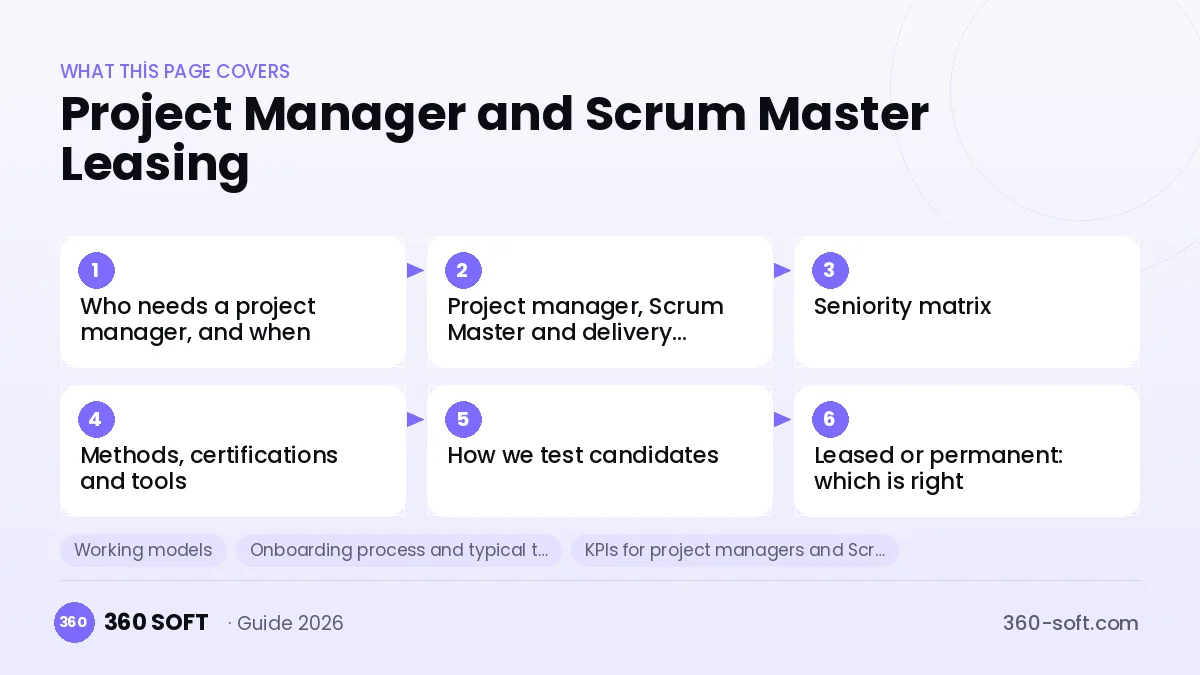
Hiring a project manager or Scrum Master through 360 Soft gives you an experienced specialist who plans your software and IT projects, coordinates teams, surfaces risks early and reports to management honestly and on a regular rhythm. The specialist works under a service agreement with 360 Soft and runs your project with traditional (PMP, PRINCE2), agile (Scrum, Kanban) or hybrid methods. On this page you will find the difference between a project manager and a Scrum Master, seniority levels, a methods and tools matrix, how we test candidates, when leasing is the right choice and which KPIs can be used to measure the role. This page is part of our IT staff leasing services.
Who needs a project manager, and when
The most common sentence in software projects is “we are almost done”. The team has been at ninety percent for months, business units do not know what will arrive when, and nobody owns the dependencies between vendors and internal teams. A project manager turns that fog into a plan with dates, owners and visible risks. Typical situations where companies bring in a leased project manager or Scrum Master:
- A strategic project (ERP, core system replacement, mobile app, data platform) starts and nobody internally has the capacity to run it full time.
- A project is late or over budget and needs an independent person to re-baseline scope, schedule and budget.
- The company is moving from waterfall to Scrum or Kanban and needs a Scrum Master who has done the transition before.
- Several vendors and internal teams must deliver to one deadline and someone has to own the integrated plan.
- The internal PM is on leave or has left, and the project cannot wait for a permanent hire.
- An international programme needs a coordinator who works in English and overlaps with European and Gulf business hours.
Project manager, Scrum Master and delivery manager: the difference
The titles are often used interchangeably, but the responsibilities differ. Choosing the right role is the first step to a successful engagement.
| Role | Main focus | Typical responsibilities | Best fit |
|---|---|---|---|
| Project manager | Scope, time, budget, risk | Plan and baseline, stakeholder management, status reporting, change control, vendor coordination | Fixed-scope or deadline-driven projects, multi-vendor programmes |
| Scrum Master | Team process and flow | Facilitating Scrum events, removing impediments, coaching the team and Product Owner, improving velocity and predictability | Product teams working in sprints, agile transformations |
| Delivery manager | Continuous delivery across teams | Release planning, cross-team dependencies, delivery metrics, operational readiness | Organisations with several product teams and frequent releases |
| Agile coach | Organisation-level change | Coaching leaders, designing team topology, scaling frameworks (SAFe, LeSS) | Companies scaling agile beyond one or two teams |
Seniority matrix
| Level | Experience | What you can expect |
|---|---|---|
| Mid-level PM / Scrum Master | 3–5 years | Runs one team or one mid-size project independently, keeps the backlog and plan healthy, reports clearly |
| Senior PM / Scrum Master | 5–10 years | Handles several teams or a complex project with vendors, manages budget and change requests, recovers slipping projects |
| Programme manager / lead | 10+ years | Owns a portfolio or a multi-year programme, sets governance, reports to executive level, mentors other PMs |
Methods, certifications and tools
We match the specialist to the way your organisation already works, rather than forcing a new method on you.
| Area | Examples |
|---|---|
| Methods | Waterfall, PRINCE2, PMBOK, Scrum, Kanban, Scrumban, SAFe, hybrid models |
| Certifications (where held) | PMP, PRINCE2 Foundation/Practitioner, PSM I/II, CSM, SAFe SA/SSM, ITIL |
| Planning and tracking | Jira, Azure DevOps, MS Project, Smartsheet, Asana, Monday, ClickUp |
| Documentation and collaboration | Confluence, Notion, SharePoint, Miro, MS Teams, Slack |
| Reporting | Burn-down and burn-up charts, cumulative flow, RAID logs, Power BI or Excel dashboards |
A certificate is a useful signal, not a guarantee. We look first at what the candidate has actually delivered and how they handled projects that went wrong.
How we test candidates
Before we present a project manager or Scrum Master, we test them in situations that look like your project. Typical steps:
- Scenario interview: the candidate receives a short brief of a delayed project and explains how they would re-plan it in the first two weeks.
- Artefact review: we ask for anonymised examples of plans, RAID logs, sprint reports or steering committee decks.
- Facilitation exercise: Scrum Master candidates run a short retrospective or refinement session with our team.
- Stakeholder role-play: how the candidate handles a sponsor who wants more scope without more time or budget.
- Language and communication check: written and spoken English at the level your stakeholders need.
- Reference check: with previous managers or clients, where the candidate allows it.
You then interview the shortlisted candidates yourself and make the final decision.
Leased or permanent: which is right
Leasing is the right choice when the need is tied to a project, when you need someone within weeks rather than months, or when you want to try the role before committing to a permanent hire. A permanent hire makes more sense when the role is a long-term part of your organisation and you have time for a full recruitment process. Many clients start with a leased PM for one project and decide later.
Working models
- Remote: the specialist works from Türkiye in your tools and time-zone overlap; the most common model for EU, UK and Gulf clients.
- On-site: the specialist works at your office in Istanbul, or travels for kick-offs, workshops and steering meetings.
- Hybrid: mostly remote with regular on-site days.
- Full-time or part-time: a part-time PM or a Scrum Master shared across two teams is possible when the workload fits.
Onboarding process and typical timelines
| Step | What happens | Typical duration |
|---|---|---|
| 1. Brief | We agree the role, method, project size, language and working model | 1–2 days |
| 2. Shortlist | We present tested candidates with a short profile | 3–7 days |
| 3. Interviews | You interview and choose | 2–5 days |
| 4. Contract and start | Service agreement, NDA, access set-up, kick-off | Typical start in 1–2 weeks overall |
| 5. First 30 days | Project health check, baseline plan or sprint cadence, first steering report | First month |
KPIs for project managers and Scrum Masters
These are indicators you can agree with the specialist at the start. They measure the health of the project and the process, not just activity.
| KPI | What it shows |
|---|---|
| Schedule variance / milestone hit rate | Whether committed milestones are delivered on time |
| Budget variance | Actual cost against the baseline |
| Sprint goal achievement | How often the team meets its sprint goal |
| Predictability (say/do ratio) | Planned versus completed work over several sprints |
| Cycle time and lead time | How quickly work items move from start to done |
| Open risks and overdue actions | Whether the RAID log is actively managed |
| Stakeholder satisfaction | Short periodic survey of sponsors and business owners |
Factors that affect the price
We do not publish prices because every engagement is scoped individually. The main factors are:
| Factor | Effect |
|---|---|
| Seniority | Programme-level leads cost more than mid-level PMs |
| Method and certification | Specialist frameworks such as SAFe or regulated-sector experience |
| Language | Fluent English or additional languages such as German or Arabic |
| Working model | On-site work and travel add cost compared with remote |
| Allocation | Full-time, part-time or shared Scrum Master |
| Duration | Longer engagements are usually priced more favourably |
| Working hours | Overlap with distant time zones or 7/24 shift coverage |
Permanent PM, freelancer and outsourcing compared
| Criterion | Permanent hire | Freelancer | Leased via 360 Soft |
|---|---|---|---|
| Time to start | Often 2–4 months | Fast, availability varies | Typically 1–2 weeks |
| Continuity | High | Risk of leaving for another project | Replacement process if the fit is not right |
| Employer obligations | On you | Contract risk depends on your country | With 360 Soft under Turkish labour law |
| Scaling | Slow | One person | From 1 to 200+ people |
| Control over daily work | Full | Limited | You direct the work; we handle employment |
Risks and how we mitigate them
| Risk | Mitigation |
|---|---|
| The PM does not understand your domain | Domain-matched shortlist and a structured onboarding week |
| Reports look green while the project is red | Agreed KPIs, RAID log reviews and direct access to the team |
| Poor fit with your culture | You interview and choose; replacement process if it still does not work |
| Knowledge leaves with the person | Documentation in your tools from day one and a handover plan |
| Time-zone friction | Agreed overlap hours and meeting rhythm before the start |
Confidentiality, data protection and IP
The project manager or Scrum Master works under a B2B service agreement between your company and 360 Soft; there is no employment relationship between you and the specialist. The standard package includes a mutual NDA, an IP assignment clause under which all work product, documentation and code created for you belongs to you, and written access rules for your systems.
- EU/EEA buyers: a GDPR Data Processing Agreement (Art. 28) with Standard Contractual Clauses for transfers to Türkiye.
- UK buyers: the UK International Data Transfer Agreement (IDTA) or the UK Addendum to the SCCs.
- Türkiye: the team operates under KVKK (Law No. 6698), the Turkish personal data protection law.
- Access hygiene: named accounts, least-privilege access, MFA, your VPN or VDI where required, and access revoked on the last day.
Legal note
The specialist is employed by 360 Soft under Turkish labour law; payroll, social security and statutory obligations remain with us. This page is general information, not legal advice. Sector rules in Türkiye (for example BDDK for banking or SPK for capital markets) apply to work done there, and the local rules of your own country also apply; please have the agreement reviewed by your legal counsel.
Project manager selection checklist
- Is the project goal, scope and deadline written down in one page?
- Have you decided between a PM, a Scrum Master or both?
- Which method and tools must the specialist use from day one?
- Who is the sponsor and who makes scope decisions?
- What language and overlap hours do your stakeholders need?
- Which KPIs will you review after 30 and 90 days?
- Are NDA, IP and data protection terms agreed before access is granted?
Example scenario
Illustrative scenario: a mid-size e-commerce company in Europe is replacing its order management system with two external vendors and an internal team. The go-live date has already slipped once. A senior project manager joins remotely, spends the first two weeks building an integrated plan and a RAID log, introduces a weekly steering meeting and splits the cut-over into two releases. A Scrum Master is added for the internal team three weeks later. This is an example of how the role can be used, not a report of a specific client result.
Frequently asked questions
Should I hire a project manager or a Scrum Master?
If you need someone responsible for scope, timeline, budget and vendors, choose a project manager. If your team already works in sprints and needs better flow and facilitation, choose a Scrum Master. Larger programmes often need both.
Is a PMP or PRINCE2 certificate required?
Not necessarily. Certificates are useful, and we can shortlist only certified candidates if you require it, but we weight real delivery experience and references more heavily.
Can a leased project manager manage my internal team?
Yes. The specialist coordinates your team day to day within the authority you define. Formal line management, such as performance reviews, normally stays with you.
Can the PM take over a project that has gone off track?
Yes. Recovery is a common reason to bring in a senior PM. The first weeks are usually spent on a health check and a realistic re-baseline.
Can one Scrum Master work with several teams?
An experienced Scrum Master can usually support two teams. Beyond that, quality tends to drop, so we discuss workload before the start.
How quickly can the specialist start?
The typical start is within 1–2 weeks after the brief, depending on seniority and language requirements.
Is a part-time project manager possible?
Yes, when the workload allows it, for example for a smaller project or a portfolio-reporting role.
Do I interview the candidates myself?
Yes. We pre-test candidates and you interview the shortlist and make the final decision.
What happens if the fit is not right?
We start the replacement process and present new candidates, with a handover so the project does not lose momentum.
Which contract do we sign?
A B2B service agreement with 360 Soft, together with an NDA, IP assignment and, for EU or UK buyers, a GDPR data processing agreement with SCCs or the UK IDTA.
Talk to us about your team
Tell us about your project, the method you use, the number of people and your target start date. We reply with candidate profiles and an indicative timeline. Call +90 850 335 10 87, message us on WhatsApp, email info@360-soft.com or use our contact page.
360 Soft Marketing Yazılım ve Danışmanlık Ltd. Şti. · Nidakule Ataşehir Batı, Barbaros Mah. Begonya Sk. No:1 D:2, 34746 Ataşehir/İstanbul, Türkiye.
Related pages
- IT staff leasing hub
- Data engineer leasing
- Cyber security specialist leasing
- Hire developers in Türkiye
- Türkçe: Türkçe sürüm
Related services
- System and Network Administrator LeasingLease system and network administrators: Windows, Linux, AD, VMware, firewalls, VPN. Remote or on-site…
- Business Analyst LeasingLease an experienced business analyst from Istanbul: requirements, user stories, BPMN and UAT support. Remote…
- Cloud Architect LeasingLease a senior AWS, Azure or Google Cloud architect from Istanbul for migration, landing zones and FinOps…
- Cyber Security Specialist LeasingLease cyber security specialists: SOC analysts, vulnerability management, security engineers, GRC. Remote or…
- Data Engineer and Data Analyst LeasingLease data engineers and analysts: ETL/ELT, Snowflake, Databricks, BigQuery, dbt, Power BI. Remote or…
- Database Administrator (DBA) LeasingLease an Oracle, SQL Server, PostgreSQL or MySQL DBA from Istanbul. Remote or on-site, 7/24 coverage…