Outsourcing for startups means using an external team for product development, design, testing, DevOps, customer support or growth work so that founders can move fast without hiring a full team before the product has found its market. Used well, it shortens the path from idea to first release and keeps fixed costs low. Used badly, it leaves a startup without control of its own code and product knowledge. This page shows how to get the first result without the second.
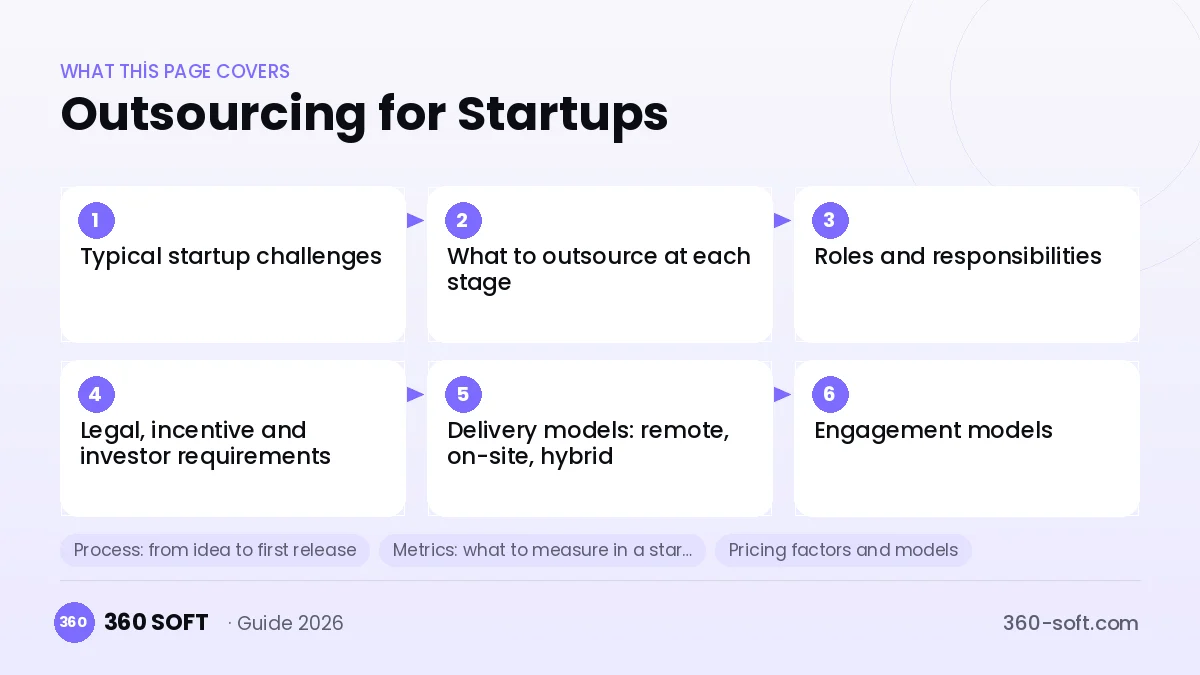
We cover typical startup problems, what to outsource at each stage, roles, investor and legal requirements, delivery and engagement models, the path from idea to first release, metrics, pricing models, how to keep product ownership, risks and a partner checklist.
Typical startup challenges
- Limited runway: every month of salary before product-market fit reduces the time left to find it.
- No technical co-founder, or only one: the founding team cannot cover backend, mobile, design, QA and infrastructure alone.
- Hiring takes too long: recruiting senior engineers can take months, while investors expect progress now.
- Changing priorities: after user feedback, the roadmap changes every few weeks and the team mix has to change with it.
- Due diligence later: investors will ask who owns the code, how it was built and whether it can scale.
What to outsource at each stage
| Stage | Priority | Can be outsourced | Recommended to keep in-house |
|---|---|---|---|
| Idea / pre-seed | Validate the problem | Clickable prototype, UX research support, technical feasibility | Customer discovery, vision, founder sales |
| MVP | Ship a usable first version | Development, UI/UX, QA, cloud set-up | Product decisions, backlog priorities, key user relationships |
| Seed / early traction | Iterate fast, stabilise | Feature teams, test automation, DevOps, L1 support | Product management, core architecture decisions |
| Series A and growth | Scale product and organisation | Additional squads, data, security monitoring, support shifts | Engineering leadership, hiring the core team, company culture |
Roles and responsibilities
| Role | Task in a startup | When it is needed |
|---|---|---|
| Fractional CTO / tech lead | Architecture, technology choices, technical roadmap | From day one if there is no technical founder |
| Product designer (UI/UX) | User flows, prototypes, design system | Before and during the MVP |
| Backend developer | APIs, data model, integrations | MVP onwards |
| Frontend / mobile developer | Web app, iOS/Android or cross-platform apps | MVP onwards |
| QA engineer | Test plans, regression, test automation | From the first release |
| DevOps engineer | Cloud, CI/CD, monitoring, cost control | Before launch |
| Data analyst | Product analytics, dashboards, funnel analysis | After first users |
| Support and growth team | Customer support, content, performance marketing | After launch |
Legal, incentive and investor requirements
| Topic | What it means for a startup | Counterpart in the outsourcing contract |
|---|---|---|
| IP ownership | Investors expect the company to own all code and designs | Full IP assignment on payment, no reuse of your code |
| Confidentiality | Ideas and data must stay protected | NDA before the first detailed briefing |
| Data protection (GDPR, KVKK, CCPA) | User data from day one | DPA with SCCs, privacy by design in the build |
| Open-source licences | Licence risks show up in due diligence | Licence list and approval rules for dependencies |
| Grants and technology-park incentives (e.g. Türkiye) | Rules on where and by whom R&D work is done | Scope reviewed with your adviser before using outsourcing |
| Investor due diligence | Code access, documentation, security posture | Repositories in your accounts, documentation as a deliverable |
The team works in Türkiye under Turkish rules; your own country’s rules on grants, employment and data apply as well.
Delivery models: remote, on-site, hybrid
| Model | Use in startups |
|---|---|
| Remote | The default: a remote team in Istanbul working in your time-zone overlap |
| On-site | Rarely needed; useful for workshops or investor demos |
| Hybrid | Kick-off and key workshops in person, development remote |
Engagement models
| Model | When it fits | What to watch |
|---|---|---|
| Dedicated product team | You have a roadmap and need a stable team for months | Keep product ownership and backlog priority with the founders |
| Staff augmentation | You have a tech lead and need extra developers | Your lead must have time to direct the work |
| Fixed-scope project | A clearly defined MVP or prototype | Scope changes are normal; agree how they are handled |
| Managed service | Support, QA or DevOps after launch | Clear SLAs and escalation |
Process: from idea to first release
| Step | Content | Typical duration |
|---|---|---|
| Discovery call | Problem, users, constraints, budget frame | Same week |
| Scoping workshop | Core user journeys, MVP feature list, technology choice | Several days |
| Team set-up | Selection of the right profiles | Typically 1–2 weeks |
| Design sprint | Prototype and user tests | 1–3 weeks |
| Build sprints | Two-week sprints with demos | Depends on scope |
| Launch | Store submission, monitoring, analytics | 1–2 weeks |
| Iterate | Feedback-driven sprints, scaling the team up or down | Ongoing |
Metrics: what to measure in a startup
| Indicator | Explanation |
|---|---|
| Sprint goal achievement | Did each sprint deliver what was agreed? |
| Lead time for changes | Time from idea to production |
| Release frequency | How often working software reaches users |
| Defect escape rate | Bugs found by users instead of QA |
| Uptime and incident response | Stability of the live product |
| Cloud cost per active user | Keeps infrastructure spend in line with traction |
| Documentation coverage | Readiness for new hires and due diligence |
Pricing factors and models
| Model | How it works | Pros and cons for a startup |
|---|---|---|
| Monthly per person | Fixed monthly fee per team member | Flexible and transparent; needs active product management |
| Fixed price | Price for a defined scope | Predictable budget; changes require renegotiation |
| Time and materials | Billed by actual effort | Maximum flexibility; needs close tracking |
| Milestone-based | Payments tied to deliverables | Aligns spend with progress |
Cost is driven by seniority, team size, platforms (web, iOS, Android), integrations, compliance needs and how fast you want to move. We give a quote after scoping, not a list price.
How to keep product ownership with an external team
- Repositories, cloud accounts, app store accounts and domains are opened in the startup’s name from day one.
- A founder or internal product owner owns the backlog and approves every sprint.
- Architecture decisions are recorded, and documentation is part of the definition of done.
- Code reviews are visible to you; if you hire a CTO later, they can review everything.
- The contract states full IP assignment and a handover plan.
In-house team, freelancers and an outsourcing partner
| Criterion | In-house team | Freelancer | Outsourcing partner |
|---|---|---|---|
| Speed to start | Months | Days | Typically 1–2 weeks |
| Skill coverage | Limited by budget | One person, one skill | Full team: design, dev, QA, DevOps |
| Flexibility | Low | High | Scale from 1 to 200+ people |
| Continuity | Good once hired | Risky | Replacement process for staff |
| Fixed cost | High | Low | Variable |
| Due diligence readiness | Depends | Often weak | Documented process and IP assignment |
Risks and safeguards
| Risk | Safeguard |
|---|---|
| Losing control of the code | Repositories in your accounts, IP assignment |
| Building the wrong thing | Short sprints, user tests, founder-owned backlog |
| Scope and budget creep | Prioritised backlog, monthly budget reviews |
| Knowledge leaving with the team | Documentation and handover plan |
| Technical debt | Code reviews, test coverage targets, architecture guidance |
| Security gaps | Security basics in the MVP: auth, encryption, backups |
Security, GDPR/KVKK, NDA and intellectual property
We sign an NDA before your detailed briefing. Source code, designs and documentation are assigned to your company. Personal data is processed under a DPA, and security basics are built in from the first release so they do not become a due diligence finding.
Contract note for EU, UK, US and MENA buyers: 360 Soft works under a B2B service agreement with your company. The standard package includes an NDA signed before any data is shared, assignment of intellectual property in deliverables and source code to the client on payment, and a data processing agreement (DPA) under the GDPR with the EU Standard Contractual Clauses for transfers to Türkiye (the UK IDTA or Addendum for UK data). As a Turkish company we also comply with KVKK, the Turkish Personal Data Protection Law. Team members are employed by 360 Soft under Turkish labour law; you direct the work through agreed channels, not as their employer. This is general information, not legal advice; have your own counsel review the contract.
Partner selection checklist for startups
- Does the partner challenge your scope and suggest a smaller first release?
- Will everything be built in your accounts with full IP assignment?
- Can you speak directly with the developers, not only with a salesperson?
- Can the team scale up after funding and down when needed?
- Is there a fractional CTO or tech lead role if you have no technical founder?
- Is support after launch available?
Illustrative scenario
Illustrative scenario, not a client case: a two-founder B2B SaaS startup without a technical co-founder engages a fractional CTO, a designer, two developers and a part-time QA engineer. After a scoping workshop and a design sprint, the team builds the first version in two-week sprints, with the founders owning the backlog. After a seed round the startup hires its own CTO, who reviews the documented codebase; the external team is reduced and later continues only with QA and DevOps support.
Frequently asked questions
We have no technical co-founder. Can we still build a product with outsourcing?
Yes. A fractional CTO or tech lead can guide architecture and technology choices while a team builds the product; the founders keep product decisions.
How long does an MVP take?
It depends on scope. A team typically starts in 1–2 weeks, and the timeline is agreed after the scoping workshop.
Should we choose fixed price or monthly per person?
Fixed price suits a clearly defined scope; a monthly team suits a roadmap that will change with user feedback.
Who owns the code?
Your company. The contract assigns all IP in code, designs and documentation to you, and repositories live in your accounts.
How do investors view working with an external team?
Investors mainly look for IP ownership, code quality and documentation; a well-documented outsourced build is usually acceptable.
Do you work for equity?
Paying part of the fee in equity is assessed case by case; because of valuation, tax and corporate law, it requires a written arrangement reviewed by lawyers.
Which technologies do you recommend?
We recommend mainstream, well-supported stacks that your future hires can maintain, chosen per product.
We are in a technology park or receive grants. Does outsourcing affect our incentives?
It can, because some programmes set rules on where R&D work is done. Check with your adviser before outsourcing incentive-related work.
Can we scale the team up and down?
Yes, the team size can follow your roadmap and funding.
Do you provide support after launch?
Yes, maintenance, DevOps, QA and customer support are available after launch.
How do we transition when we build our own team?
A handover plan with documentation, pairing and a gradual ramp-down lets your hires take over.
Will the team work as our employees?
No. The team members are employed by 360 Soft and deliver a service under a B2B agreement.
Talk to us
Planning an MVP or need extra hands after a funding round? Tell us your stage and goals and we will propose a lean team. Call or WhatsApp us on +90 850 335 10 87, email info@360-soft.com, message us directly on WhatsApp, or use the form on our contact page. 360 Soft Marketing Yazılım ve Danışmanlık Ltd. Şti., Nidakule Ataşehir Batı, Barbaros Mah. Begonya Sk. No:1 D:2, 34746 Ataşehir/İstanbul.
Related pages
- Outsourcing services (overview)
- CTO as a service
- UI/UX design outsourcing
- QA and test outsourcing
- DevOps and cloud operations
- Digital marketing team
- Call center and customer service
- SME outsourcing
- Hire developers
- Türkçe
Related services
- Payment Operations OutsourcingPayment operations outsourcing: daily reconciliation, chargebacks, refunds, merchant operations and payment…
- Pharma and Medical OutsourcingPharma and medical outsourcing: regulatory documentation, İTS/ÜTS traceability, PV intake, QA records and…
- PMO (Project Management Office) OutsourcingPMO outsourcing: set-up and operation of your project management office, tailored PMI, PRINCE2 and agile…
- Public Sector and Municipal OutsourcingPublic sector and municipal outsourcing from Istanbul: citizen contact centre, IT operations, software and…
- QA and Software Testing OutsourcingQA and software testing outsourcing from Türkiye: risk-based test strategy, Selenium, Playwright and Appium…
- Retail OutsourcingRetail and store chain outsourcing: customer service, store help desk, field service, pricing, catalogue and…