Hire Unity game developers in Turkey. Turkey has one of Europe’s most active mobile and casual game development scenes, and Unity is the engine behind much of it. Our Unity developers join your studio to add capacity for a launch, take over live-ops features or help with performance before release, working in your repositories, task boards and build pipelines with a large daily overlap with European working hours.
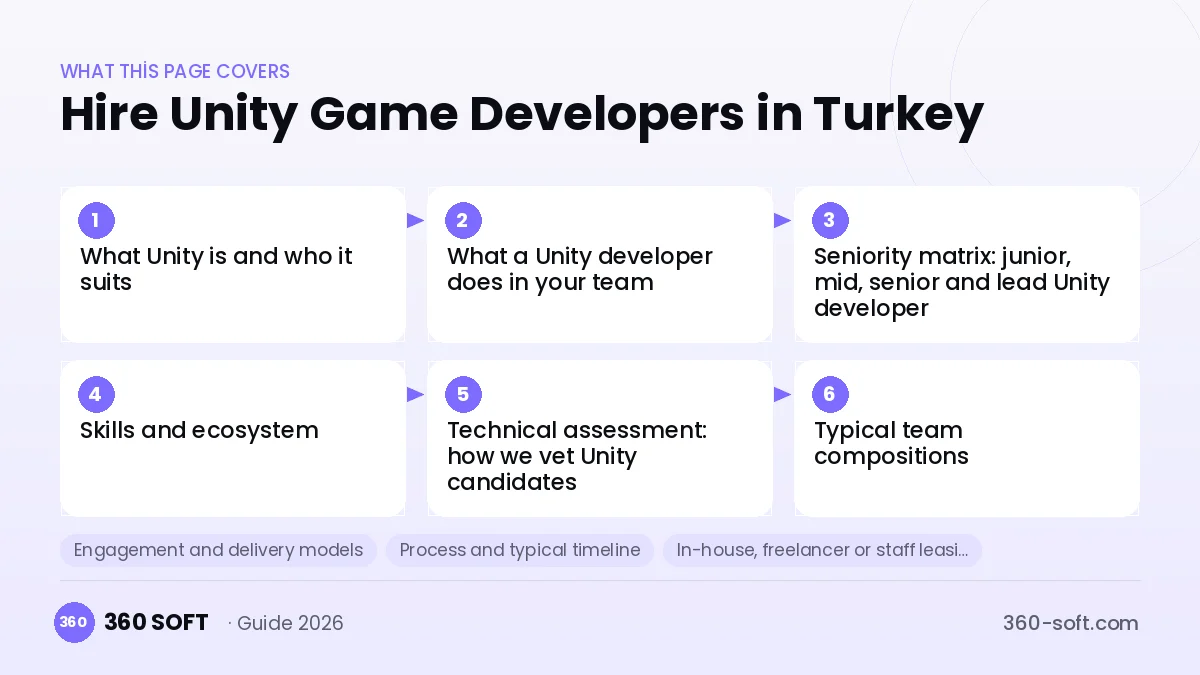
This page explains when Unity is the right choice, what a Unity developer does in your team, a seniority matrix, the ecosystem we work with, how we vet candidates, KPIs, pricing factors and models, and how the contract protects your game IP. For other roles, go back to hire developers in Turkey.
What Unity is and who it suits
Unity is a cross-platform game engine with C# scripting that targets iOS, Android, PC, consoles, WebGL and XR devices. It is the common choice for mobile, casual and hyper-casual games, mid-size PC and console titles, AR/VR applications and interactive simulations or training apps. Studios choose it for its large talent pool, asset ecosystem and fast iteration.
Typical Unity problems in studios
- Frame drops, long load times and memory crashes on lower-end devices
- Builds that grow too large for store limits or user patience
- Monolithic MonoBehaviour code that makes new features slow and risky
- Live-ops features (events, offers, A/B tests) that depend on one overloaded developer
- Shortage of senior Unity engineers ahead of a launch or soft launch
What a Unity developer does in your team
| Area | Typical tasks |
|---|---|
| Gameplay | Core mechanics, game feel, physics, AI behaviour, level logic |
| UI and meta game | Menus, progression, inventories, shops and event screens with UI Toolkit or uGUI |
| Live-ops and backend integration | Remote config, analytics events, in-app purchases, ads mediation, server APIs |
| Performance | Profiling CPU, GPU and memory, draw call batching, asset bundles and Addressables |
| Multiplayer | Netcode for GameObjects, Photon or Mirror, lobby and matchmaking integration |
| Tools and pipeline | Editor tools for designers, build automation, CI for mobile builds |
Seniority matrix: junior, mid, senior and lead Unity developer
| Level | Typical experience | Independence | Expected skills |
|---|---|---|---|
| Junior | 0–2 years | Implements defined features with review | C#, Unity editor, prefabs, basic UI and animation |
| Mid-level | 2–5 years | Owns features end to end | Clean C# architecture, ScriptableObjects, Addressables, profiling basics, SDK integrations |
| Senior | 5+ years | Owns systems, mentors others | Performance optimisation, multiplayer, rendering pipelines (URP/HDRP), shipping titles |
| Lead | 8+ years | Owns technical direction of a game | Architecture, tech planning, team leadership, platform certification and release management |
Skills and ecosystem
Engine and language
Unity LTS releases, C#, URP and HDRP, Shader Graph and HLSL, the Input System, Timeline and Cinemachine, plus DOTS/ECS where a project needs large-scale simulation.
Libraries and services
| Category | Examples |
|---|---|
| Architecture | Zenject or VContainer, UniRx or R3, UniTask, ScriptableObject-based architecture |
| Backend and live-ops | Unity Gaming Services, Firebase, PlayFab, Nakama, custom REST APIs |
| Monetisation and analytics | Unity IAP, ad mediation platforms, GameAnalytics, Firebase Analytics, attribution SDKs |
| Multiplayer | Netcode for GameObjects, Photon, Mirror, Fish-Net |
Tools
| Category | Examples |
|---|---|
| Version control | Git with LFS, Plastic SCM / Unity Version Control, Perforce |
| Builds | Unity Build Automation, Jenkins, GitHub Actions, Fastlane |
| Profiling | Unity Profiler, Memory Profiler, Frame Debugger, Xcode Instruments, Android GPU Inspector |
Technical assessment: how we vet Unity candidates
1. Technical interview topics
- MonoBehaviour lifecycle, coroutines versus async, garbage collection pitfalls
- Architecture for testable gameplay code
- Profiling a frame drop: where to look first
- Asset management with Addressables and memory budgets
- Shipped titles and their own concrete contribution
2. Practical task
Candidates extend a small Unity project with a feature and fix a deliberate performance issue, or build a mini-mechanic from a short design brief. We review game feel, code structure and profiling approach.
3. Code review criteria
| Criterion | What we look for |
|---|---|
| Structure | Separation of data, logic and presentation; no god objects |
| Performance | No allocations in hot loops, pooling, sensible Update usage |
| Editor friendliness | Serialised fields and tools that designers can use |
| Robustness | Null safety, scene independence, clear error logs |
Typical team compositions
| Scenario | Suggested composition |
|---|---|
| Extra capacity before launch | 1–2 mid-level or senior Unity developers in your existing team |
| Live-ops for a released game | 1 senior Unity developer, 1 Unity developer for features, QA support |
| New game with a co-development partner | 1 Unity lead, 2–4 Unity developers, technical artist, QA engineer, with your designers and artists |
Engagement and delivery models
Our Unity developers work remotely, on-site or in a hybrid setup. Remote collaboration is standard in game development; on-site or hybrid presence helps during milestone crunches, playtests or when hardware devkits are in your office.
- Dedicated specialist (staff augmentation): one or more Unity developers join your team full time, follow your processes and report to your lead.
- Dedicated team: a cross-functional team with a lead, sized from 1 to 200+ people, that owns a product area or a backlog.
- Project-based delivery: a defined scope with milestones and acceptance criteria, delivered by a team we manage.
- Extended coverage: 7/24 shift plans for support, monitoring or release windows where the work needs it.
Process and typical timeline
| Step | What happens | Typical duration |
|---|---|---|
| 1. Discovery call | We clarify scope, stack, seniority, time zone overlap and working model | 1–2 days |
| 2. Shortlist | We share pre-screened Unity profiles with our technical assessment notes | About 1 week |
| 3. Your interviews | You interview the candidates; a trial task can be added | A few days |
| 4. Contract and onboarding | Service agreement, NDA and DPA signed, access set up, equipment ready | Typical start in 1–2 weeks |
| 5. Ongoing delivery | Regular check-ins, performance reviews and a replacement process if the fit is not right | For the agreed term |
In-house, freelancer or staff leasing with 360 Soft
| Criterion | In-house hire | Freelancer | Staff leasing / outsourcing with 360 Soft |
|---|---|---|---|
| Time to start | Often months including notice periods | Fast, availability varies | Typical start in 1–2 weeks |
| Employment admin | On you | On the freelancer | Handled by 360 Soft in Turkey |
| Continuity | Depends on retention | Risk of sudden unavailability | Replacement process included |
| Scaling up or down | Slow | One person at a time | From 1 to 200+ people |
| IP and confidentiality | Employment contract | Needs careful drafting | IP assignment and NDA in the B2B agreement |
KPI and SLA: how we measure success
| Indicator | What it measures | How to set the target |
|---|---|---|
| Frame rate on target devices | Stable FPS on your reference low and mid-range devices | Agree device list and target per platform |
| Crash-free sessions | Share of sessions without crashes | Track via your crash reporting tool |
| Build size and load time | Download size and time to first interaction | Agree budgets before launch |
| Feature lead time | Time from design hand-off to playable build | Baseline in the first month |
| Live-ops delivery | Events and offers shipped on schedule | Agree with your live-ops calendar |
Factors that drive the price
| Factor | Effect |
|---|---|
| Seniority and shipped titles | Senior developers with shipped games cost more |
| Specialisation | Multiplayer, graphics programming, XR or console experience add to the rate |
| Working model | On-site presence and travel |
| Coverage | Extra shifts around launches or live events |
| Term and team size | Longer terms and larger teams are priced differently |
Pricing models
- Monthly rate per developer for staff augmentation
- Time and materials for flexible co-development
- Milestone-based pricing for well-defined scopes such as a port or a performance pass
We do not publish fixed prices; you receive a written quote based on your project.
Risks and mitigations
| Risk | Mitigation |
|---|---|
| Leaks of unreleased content | NDA, restricted repository access, no personal devices for builds where required |
| Performance issues discovered too late | Device budgets and profiling from the first milestone |
| Dependence on a single developer | Code reviews, documentation and shared ownership |
| Developer not the right fit | Replacement process in the contract |
Security, data protection, NDA and IP
You sign a B2B service agreement with 360 Soft; the specialists are engaged by us in Turkey. All work product is assigned to you under an IP assignment clause, and every team member signs confidentiality and IP undertakings before getting access. Where personal data is processed, we sign a GDPR data processing agreement (DPA) with Standard Contractual Clauses, or the UK IDTA for UK clients, and we comply with Turkey’s data protection law KVKK. All code, tools and game content produced for you are your IP, including work in your engine projects and stores. Player data handled through analytics or backend services is covered by the DPA; app store, age rating and consumer rules in your target markets also apply.
Legal note
This page is general information, not legal advice. Contract terms are agreed per project. Our team operates under Turkish law and Turkish sector rules; the local rules of your own country (for example on data protection, sector regulation or contractor classification) also apply, so we recommend a review by your own counsel.
Illustrative scenario: performance support before launch
Illustrative scenario, not a client case. A mobile studio’s puzzle game runs well on flagship phones but stutters on mid-range Android devices a few weeks before soft launch. A senior Unity developer profiles the game, reduces allocations in gameplay loops, moves assets to Addressables and simplifies a few shaders. The team agrees FPS and memory budgets and adds a performance check to every milestone build.
Checklist for choosing a Unity developer
- Have they shipped games on your target platforms?
- Can they explain their exact contribution to those titles?
- Do they profile and optimise, or only build features?
- Are they familiar with your SDKs, backend and monetisation stack?
- Do they work well with designers and artists?
- Are IP assignment and NDA signed before repository access?
Frequently asked questions
How quickly can a Unity developer join our team?
We typically share pre-screened profiles within about a week, and the developer usually starts in 1–2 weeks after your approval.
Do you also provide artists or game designers?
Our focus is engineering, including technical artists and QA. Tell us your needs and we will say openly whether we can staff them.
Can you staff developers for board and card games?
Yes. Turkey has a strong tradition of digital board and card games such as okey and backgammon, and we recruit Unity developers with turn-based and casual multiplayer experience for these projects.
Can you work on console titles?
Yes, where developers have the required platform experience. Devkit access and platform NDAs remain with your studio.
Can you help with multiplayer?
Yes, with Netcode for GameObjects, Photon, Mirror or custom servers, depending on your architecture.
Can you take over a game in live-ops?
Yes. We start with a code and pipeline review, then take over features and events step by step.
Do you work with AR and VR?
Yes. Unity developers can build for XR devices and mobile AR with AR Foundation.
Who owns the game code and assets?
You do. All work product is assigned to you under the service agreement, and every developer signs an NDA.
Can we start with one developer and grow?
Yes. Many studios start with one developer and scale to a team as the project grows.
What if the developer is not the right fit?
A replacement process is part of the agreement.
Hire Unity game developers with 360 Soft
Tell us about your project, your stack and when you need someone, and we will send matching profiles and a written quote. Use our contact page, call +90 850 335 10 87, message us on WhatsApp or email info@360-soft.com. For broader needs, see IT outsourcing services.
Need Unity game developers? Tell us what you need and we will share matching profiles and a written quote. WhatsApp · +90 850 335 10 87 · info@360-soft.com
Related
- Hire developers in Turkey: all technologies
- Hire a dedicated software development team
- Hire QA and test engineers
- Hire UI/UX designers
Related services
- Hire Vue.js DevelopersHire Vue.js and Nuxt developers from Istanbul for SaaS front ends, storefronts and Vue 2 migrations. Remote…
- Hire React Developers in TurkeyHire React developers in Turkey: vetted TypeScript and Next.js engineers, EU time zone overlap, IP assignment…
- Hire .NET Developers in TurkeyHire .NET developers in Turkey: vetted C# and ASP.NET Core engineers for APIs, enterprise apps and…
- Hire AI and ML Developers in TurkeyHire AI, ML and LLM developers in Turkey: RAG assistants, predictive models and MLOps, EU time overlap, data…
- Hire Android (Kotlin) Developers in TurkeyHire Android developers in Turkey: vetted Kotlin and Jetpack Compose engineers, EU time zone overlap, skills…
- Hire Angular DevelopersHire Angular and TypeScript developers from Istanbul for enterprise apps, portals and AngularJS migrations…