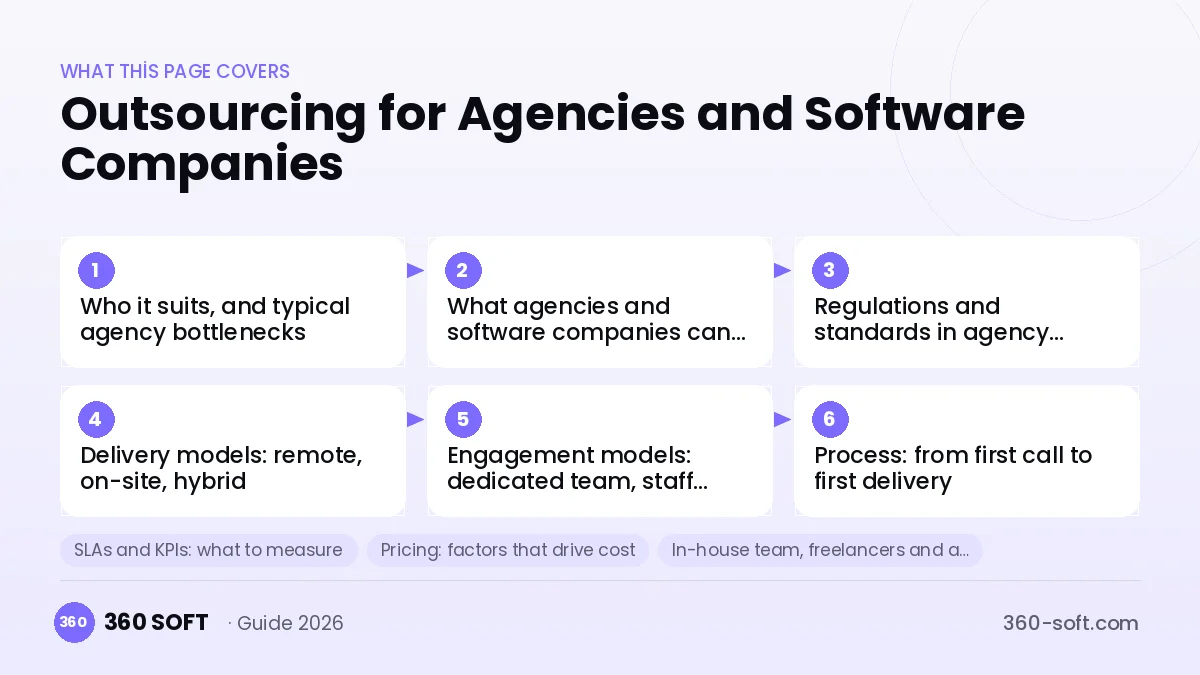
Outsourcing for agencies and software companies means adding external developers, designers, testers or DevOps engineers to your delivery capacity, often under your own brand (white label), so that you can win and deliver more projects without hiring for every peak. For an agency, outsourcing is a delivery decision: the client relationship, the quality promise and the margin all stay with you, so the partner has to fit your process, tools and standards. This page explains who it suits, typical bottlenecks, what can be outsourced, the rules of white-label work, regulations and standards in agency projects, delivery and engagement models, the process, KPIs, pricing, a comparison of options, risks and a partner checklist.
Who it suits, and typical agency bottlenecks
- Peaks and troughs: a large pitch is won and the team is suddenly too small; three months later it is idle.
- Missing skills: clients ask for mobile apps, headless commerce, AI features or accessibility audits that the core team does not cover.
- Maintenance eating capacity: support for old projects blocks senior developers from new, profitable work.
- Margin pressure: fixed salaries make every slow month expensive.
- Hiring risk: hiring permanently for a single project leaves the agency exposed when the project ends.
It suits digital agencies, software houses, product studios, system integrators and IT consultancies that already have clients and a delivery process but need flexible, reliable capacity.
What agencies and software companies can outsource
| Work package | Typical roles | Tasks | Technologies (examples) |
|---|---|---|---|
| Web development | Frontend and backend developers | Corporate sites, portals, headless builds | React, Next.js, Vue, PHP/Laravel, Node.js |
| E-commerce | E-commerce developers | Shop builds, integrations, performance | Shopify, WooCommerce, Magento |
| Mobile apps | iOS, Android, cross-platform developers | New apps, updates, store releases | Swift, Kotlin, Flutter, React Native |
| UI/UX design | Product and UI designers | Wireframes, prototypes, design systems | Figma |
| QA and testing | Manual and automation testers | Test plans, regression, automation | Playwright, Cypress, Appium |
| DevOps and cloud | DevOps engineers | CI/CD, hosting, monitoring | AWS, Azure, GCP, Docker, Kubernetes |
| Maintenance and support | Developers, support engineers | Bug fixes, updates, SLA-based support | Per project stack |
| Accessibility | Accessibility testers | WCAG audits and remediation support | Screen readers, audit tools |
Rules of white-label work
- The partner works under your brand: your email domain or neutral addresses, your templates, your processes.
- The partner does not approach your clients or present itself to them unless you decide so.
- A non-solicitation clause protects your clients and your staff.
- All code and designs are assigned to you, so you can assign them to your client.
- Confidentiality covers your client names and project details as well as the code.
What should stay in-house
Client relationship and account management, pricing and contracts, creative direction and final quality approval should stay with the agency. A technical lead on your side who reviews architecture and code keeps quality consistent across internal and external developers.
Regulations and standards in agency projects
| Topic | Why it matters | Reflection in the outsourcing contract |
|---|---|---|
| GDPR / KVKK | Agencies are often processors for clients, the partner becomes a sub-processor | Sub-processor DPA with SCCs, client approval where required |
| Accessibility (WCAG, European Accessibility Act) | Many clients must meet accessibility requirements | Acceptance criteria and testing in the scope |
| Cookies and ePrivacy | Tracking and consent must be implemented correctly | Consent management in the technical scope |
| Open-source licences | Clients expect clean licensing | Licence list and approval rules |
| App store policies | Store rejections delay launches | Release checklists |
| Employment rules | Staff augmentation must not become disguised temporary agency work | Service-based contract; partner manages its people |
The team works in Türkiye under Turkish law and KVKK; your clients’ local rules apply as well.
Delivery models: remote, on-site, hybrid
| Model | How it works | When it suits agencies |
|---|---|---|
| Remote | The team works from Istanbul in your tools and rituals | Most development, design and QA work |
| On-site | Team members at your office or the client’s site | Workshops, regulated clients, launches |
| Hybrid | Remote delivery, on-site for key moments | Large programmes with client workshops |
Engagement models: dedicated team, staff augmentation, managed service, project
| Model | Who manages | Where the risk sits | Typical agency use |
|---|---|---|---|
| Dedicated team | Your lead with our team lead | Shared | Long-term client accounts, product retainers |
| Staff augmentation | Your project managers | Mostly with you | Covering peaks in existing projects |
| Managed service | 360 Soft under SLA | With us for the service level | Maintenance and support of delivered projects |
| Project | 360 Soft within agreed scope | With us for the scope | White-label builds with clear specifications |
Process: from first call to first delivery
| Step | What happens | Typical duration |
|---|---|---|
| Intro call | Your clients, stack, process and capacity gaps | Same week |
| Requirements | Roles, seniority, tools, white-label rules | A few days |
| Proposal and contract | Team plan, NDA, DPA, non-solicitation | About 1 week |
| Candidate review | CVs and technical interviews by your lead | Within 1–2 weeks |
| Onboarding | Access to your repositories, boards and channels | A few days |
| Trial sprint | First tasks with close review | 1–2 weeks |
| Regular delivery | Sprints, demos, monthly review | Ongoing |
SLAs and KPIs: what to measure
| Indicator | What it measures | How it is tracked |
|---|---|---|
| Sprint delivery | Planned versus delivered story points or tasks | Your project tool |
| Code review findings | Quality of submitted code | Pull request statistics |
| Defects after release | Bugs found by the client | Issue tracker |
| Response time for support | Speed on maintenance tickets | SLA reports |
| Estimation accuracy | Estimate versus actual effort | Time tracking |
| Team stability | Changes in team members | Monthly review |
Pricing: factors that drive cost
| Pricing method | How it is calculated | When it suits agencies |
|---|---|---|
| Monthly per person | Fixed monthly fee per team member | Dedicated teams, steady workload |
| Hourly or daily rate | Billed by time used | Irregular, smaller tasks |
| Fixed project price | Price for a defined scope | White-label builds with clear specs |
| Maintenance retainer | Monthly fee for a pool of hours and SLA | Support for delivered projects |
The main cost drivers are seniority, technology stack, team size, time-zone overlap, on-site needs and SLA levels. We quote per request and do not publish prices.
In-house team, freelancers and an outsourcing partner
| Criterion | In-house (employed) | Freelancer | Outsourcing partner |
|---|---|---|---|
| Speed to add capacity | Slow | Fast | Typically 1–2 weeks |
| Scaling down | Hard | Easy | Agreed notice periods |
| Skill range | Limited | One skill per person | Many roles from one partner |
| Continuity | Good | Risky | Replacement process for staff |
| White-label discipline | Native | Varies | Contractual |
| Team size | Fixed | Individual | From 1 to 200+ people |
| Fixed cost | High | Low | Variable |
Risks and how they are managed
| Risk | Symptom | Safeguard |
|---|---|---|
| Quality gap | More bugs in external code | Code reviews by your lead, shared coding standards |
| Communication gap | Misunderstood tickets | Clear acceptance criteria, daily stand-ups |
| Client poaching | Partner contacts your client | Non-solicitation and white-label clauses |
| Team turnover | Lost project knowledge | Documentation, overlap during replacement |
| Margin erosion | Overruns on fixed projects | Change control and weekly burn reports |
| Security incident | Leaked credentials or data | Named accounts, MFA, least privilege |
Security, GDPR/KVKK, NDA and intellectual property
We sign the NDA and the sub-processor DPA before we see client material. Work happens in your repositories and tools with named accounts. All IP is assigned to your company so you can transfer it to your clients under your own contracts.
Contract note for EU, UK, US and MENA buyers: 360 Soft works under a B2B service agreement with your company. The standard package includes an NDA signed before any data is shared, assignment of intellectual property in deliverables and source code to the client on payment, and a data processing agreement (DPA) under the GDPR with the EU Standard Contractual Clauses for transfers to Türkiye (the UK IDTA or Addendum for UK data). As a Turkish company we also comply with KVKK, the Turkish Personal Data Protection Law. Team members are employed by 360 Soft under Turkish labour law; you direct the work through agreed channels, not as their employer. This is general information, not legal advice; have your own counsel review the contract.
Partner selection checklist
- Will the partner work white label, with non-solicitation and confidentiality for your client names?
- Can your technical lead interview and approve each team member?
- Does the team work in your tools: Jira, GitHub/GitLab, Slack or Teams?
- Is IP fully assigned to you so you can pass it on to clients?
- Can it act as a sub-processor under GDPR/KVKK with an appropriate DPA?
- Is there a replacement process and a reasonable notice period?
- Can it cover adjacent skills such as QA, DevOps, design and accessibility?
Illustrative scenario
Illustrative scenario, not a client case: a digital agency wins a portal project for a retailer while its own developers are busy with two other launches. Its tech lead interviews and selects two backend developers, a frontend developer and a QA engineer from the partner. They join the agency’s boards and stand-ups under the agency brand. After the launch, the frontend developer moves to a maintenance retainer for the agency’s older projects, and the rest of the team is scaled down at the end of the notice period.
Frequently asked questions
Does our client need to know we work with an external team?
That depends on your contract with the client. Many agencies work white label; if the client contract or data protection rules require disclosure of sub-processors, you inform the client.
Who owns the source code?
You do. The contract assigns all IP to your company so you can pass it on to your client.
How do we verify the team’s technical skills?
Your technical lead reviews CVs, runs interviews and can set a trial sprint before full commitment.
What is the minimum engagement period?
It depends on the model; we agree minimum terms and notice periods per engagement.
Which technologies do you support?
Common web, mobile, e-commerce, cloud and testing stacks; the exact profiles are confirmed per request.
How do you price maintenance work?
Usually as a monthly retainer with a pool of hours and SLA, or per hour for irregular tasks.
Can the team use our project management tools?
Yes. The team works in your tools and follows your rituals.
Is on-site work possible?
Yes, on-site and hybrid models are available when needed.
Will you communicate directly with our client?
Only if you want us to. In white-label work we stay in the background, or appear under your brand.
Is staff augmentation the same as temporary agency work?
No. We deliver a service under a B2B contract and manage our own staff; temporary agency work is a different legal structure.
Can we outsource only QA and testing?
Yes, QA and test automation can be outsourced on their own.
What happens if we want to end the engagement?
After the notice period we hand over documentation, access and open tasks in an orderly way.
Talk to us
Need extra delivery capacity under your own brand? Tell us your stack and timelines and we will propose a team. Call or WhatsApp us on +90 850 335 10 87, email info@360-soft.com, message us directly on WhatsApp, or use the form on our contact page. 360 Soft Marketing Yazılım ve Danışmanlık Ltd. Şti., Nidakule Ataşehir Batı, Barbaros Mah. Begonya Sk. No:1 D:2, 34746 Ataşehir/İstanbul.
Related pages
- Outsourcing services (overview)
- White-label software development
- UI/UX design outsourcing
- QA and test outsourcing
- Software maintenance and support (AMS)
- Mobile app maintenance
- WCAG accessibility audit
- DevOps and cloud operations
- Hire developers
- Türkçe
Related services
- Outsourcing for Crypto Exchanges and Digital Asset PlatformsCrypto exchange outsourcing: KYC/AML operations, transaction monitoring, fraud, SOC and 24/7 support with…
- Outsourcing for Holdings and Corporate GroupsOutsourcing for holdings and corporate groups: SAP, PMO, SOC, finance and HR operations under one governance…
- Outsourcing for SMEsSME outsourcing: IT support, website management, digital marketing, back office, ERP support and automation…
- Outsourcing for StartupsStartup outsourcing: MVP development, fractional CTO, design, QA, DevOps and support teams with full IP…
- Payment Operations OutsourcingPayment operations outsourcing: daily reconciliation, chargebacks, refunds, merchant operations and payment…
- Pharma and Medical OutsourcingPharma and medical outsourcing: regulatory documentation, İTS/ÜTS traceability, PV intake, QA records and…