Invoices waiting for approval, bank lines that do not reconcile, supplier statements that never match and a month-end close that slips every month: the finance back office absorbs time that finance managers would rather spend on analysis and planning. 360 Soft builds dedicated finance back office teams in Istanbul that take over accounts payable, accounts receivable, reconciliations, expense processing, e-invoice and e-ledger routines and month-end close support, inside your ERP and under your approval rules. This page covers who the service suits, the typical problems, which processes can be handed over, the team structure, the standards the team works by, working models, the legal set-up, process steps, KPIs, pricing factors, a comparison of options, risks, security and a vendor checklist.
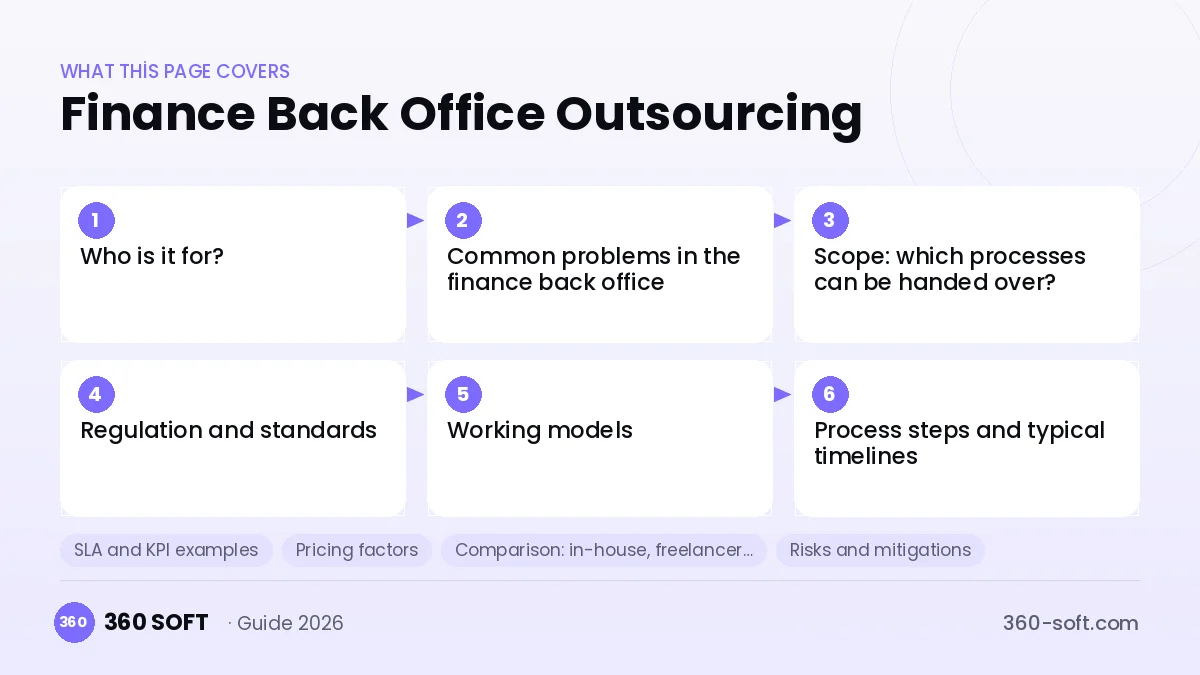
Who is it for?
The service fits organisations whose transaction volume has outgrown their finance team, or which want a documented, controlled process instead of key-person dependency:
- Growing SMEs and scale-ups whose CFO or finance manager still does the bookkeeping routine personally.
- Groups with several legal entities that need intercompany reconciliations and a consistent close calendar.
- International companies with a Turkish subsidiary that need local e-invoice, e-ledger and VUK compliance alongside group reporting.
- Shared service centres that want extra capacity or a nearshore team for EMEA processes.
- E-commerce and subscription businesses with high volumes of small transactions and payment provider settlements.
Common problems in the finance back office
The same issues come up in almost every discovery call:
- Supplier invoices sit in inboxes, approvals are chased by email and early-payment discounts are missed.
- Receivables are followed up irregularly, so days sales outstanding creeps up.
- Bank, card and payment provider reconciliations are done in spreadsheets and fall behind.
- Current-account (cari) reconciliations with suppliers and customers are left until audit time.
- The month-end close depends on one or two people and takes too long.
- Expense claims arrive without receipts or policy checks.
Scope: which processes can be handed over?
You can outsource a single process, such as accounts payable, or a complete transactional finance function. Judgement-heavy tasks (tax positions, final sign-off, statutory filings) remain with you or your accountant.
| Process | Typical tasks | Technology / tools |
|---|---|---|
| Accounts payable (AP) | Invoice capture and coding, three-way match, approval routing, payment proposals | SAP, Oracle NetSuite, Microsoft Dynamics, Logo, Mikro, OCR tools |
| Accounts receivable (AR) | Customer invoicing, cash application, dunning, credit notes | ERP, CRM, banking portals |
| Bank and payment reconciliation | Bank, POS, card and payment provider statements matched to ledger | ERP bank modules, Excel, reconciliation tools |
| Current-account reconciliation | Supplier and customer balance confirmations, BA/BS form support in Turkey | ERP, statement templates |
| Expense management | Receipt checks, policy compliance, posting, reimbursements | Expensify, SAP Concur, ERP |
| E-invoice, e-archive and e-ledger | Issuing and receiving e-documents, e-ledger preparation support in Turkey | Integrator portals, ERP e-document modules |
| Month-end close support | Accruals, prepayments, fixed-asset postings, checklists, trial balance review | ERP, close checklists |
| Reporting | Aged AP/AR, cash position, management report packs | Excel, Power BI |
Typical team structure by role
| Role | Responsibility | Note |
|---|---|---|
| AP specialist | Invoice processing, matching, payment runs | Volume-driven role |
| AR specialist | Invoicing, cash application, collections follow-up | Customer-facing tone matters |
| Reconciliation specialist | Bank, card, payment provider and intercompany reconciliations | Detail-oriented, ERP experience |
| General ledger accountant | Accruals, close checklists, trial balance review | Supports your controller |
| E-document specialist | E-invoice, e-archive, e-ledger routines in Turkey | Knows integrator portals |
| Team lead | Planning, quality control, escalations, reporting | Single point of contact |
| Finance analyst (optional) | Management reports, variance analysis | Added as volume grows |
Regulation and standards
For Turkish entities the team works to the Tax Procedure Law (VUK), the Turkish Commercial Code (TTK), e-invoice, e-archive and e-ledger rules of the Revenue Administration (GİB), and TFRS/BOBİ FRS where applicable. Bookkeeping that must be certified by a licensed Turkish accountant (SMMM) stays with your accountant; we prepare the work and the documentation. For entities in other countries we follow your group accounting manual (IFRS, UK GAAP, US GAAP or HGB, for example) and the local invoicing and VAT rules you confirm, such as e-invoicing mandates in the EU or ZATCA e-invoicing in Saudi Arabia. Local rules in your country always apply; statutory responsibility stays with your company and its advisers.
Internal control is built into every process: segregation of duties (the team prepares, your people approve and release payments), maker-checker reviews, documented close checklists and an audit trail that your auditors can follow.
Working models
| Model | How it works | When it fits in finance back office |
|---|---|---|
| Remote | The team works from our Istanbul office or secure home setups with access to your systems via VPN or VDI | AP, AR, reconciliations and reporting |
| On-site | Team members work at your premises under our supervision | Paper-based processes, sensitive approvals, audit periods |
| Hybrid | Remote day-to-day work with scheduled on-site days | Initial transition and month-end weeks |
| Service model | Definition | Example |
|---|---|---|
| Dedicated team | Named people working only for you, led by our team lead | A three-person AP and reconciliation team in your ERP |
| Managed service | We own an agreed output with SLAs and reporting | All supplier invoices processed within an agreed number of days |
| Project | Defined scope, deliverables and deadline | Clean-up of a reconciliation backlog before year-end |
| Capacity extension | Additional people for a defined period | Extra support during audit or ERP migration |
Legal note for staffed engagements
Contract note for international buyers. We work under a B2B service agreement governed by a clear statement of work: the output, the SLA, the reporting cadence and the exit terms are written down before the team starts. The agreement includes an NDA, an IP assignment clause (all work product, templates, data and documentation created for you belong to you), and, wherever personal data is processed, a GDPR data processing agreement (Art. 28) with the EU Standard Contractual Clauses for transfers to Turkey, or the UK IDTA/Addendum for UK controllers. On the Turkish side processing also follows KVKK (Law No. 6698), including its cross-border transfer rules. Payment release rights stay with your authorised signatories; our team never holds the final bank approval. Our people are employed by 360 Soft in Turkey, so payroll, social security and Turkish labour-law obligations stay with us; you buy a service, not employees.
Under Turkish law (Labour Law No. 4857) a service purchase has to be distinguished from subcontracting of core activities and from temporary agency work. We define the scope as an outcome-based service under our own supervision; for your side, local outsourcing and staffing rules apply and should be checked by your counsel.
Process steps and typical timelines
| Step | Content | Typical duration |
|---|---|---|
| Discovery | Processes, volumes, systems, pain points | 1–2 weeks |
| Process mapping | Current-state flows, controls, approval matrix | 1–2 weeks |
| Proposal and contract | Scope, SLA, pricing, NDA, DPA | 1 week |
| Team selection | Accounting and ERP tests, interviews | Typically 1–2 weeks |
| Access and set-up | ERP roles, VPN or VDI, documentation | 1 week |
| Parallel run | Team works alongside your staff, every output reviewed | 2–4 weeks |
| Steady state | Full handover, KPI reporting, monthly review | Ongoing |
SLA and KPI examples
| Area | KPI | Note |
|---|---|---|
| Accounts payable | Invoice processing time, first-time-right rate | Measured from invoice receipt |
| Accounts receivable | Cash application time, overdue follow-up rate | DSO is shared with your sales team |
| Reconciliation | Share of accounts reconciled by working day X | Unreconciled items aged and explained |
| Month-end close | Close tasks completed on schedule | Based on your close calendar |
| Quality | Error rate found in reviews or audit | Root-cause log kept |
| Service | Response time to internal queries | Agreed per channel |
Targets are agreed after a baseline period on your own data; we do not promise numbers before we have seen your processes.
Pricing factors
We do not publish standard prices. A quote is prepared after a discovery call, usually as a monthly fee per dedicated team member, an output-based fee, a hybrid model or a project fee. These factors drive it:
| Factor | Effect |
|---|---|
| Transaction volume | Number of invoices, payments and bank lines per month |
| Number of entities and currencies | More entities mean more reconciliations and close tasks |
| Systems | Single ERP vs. several systems and manual tools |
| Scope | Transactional only vs. close support and reporting |
| Languages and time zones | English, German or Arabic communication, overlap hours |
| Work location | Remote, on-site or hybrid |
Comparison: in-house, freelancer, outsourcing
| Criterion | Your own staff | Freelancer | Outsourcing (360 Soft) |
|---|---|---|---|
| Time to start | Weeks to months of recruiting | Fast, availability varies | Typically 1–2 weeks |
| Scaling | Slow, fixed headcount | Possible, uneven quality | From 1 to 200+ people within one structure |
| Continuity | Depends on retention | Single point of failure | Replacement process included |
| Process documentation | Often informal | Rarely | SOPs and playbooks are part of the service |
| Management effort | All yours | High coordination effort | Team lead and reporting included |
| Data protection and control | Your own controls | Hard to enforce | NDA, DPA, access controls, audit trail |
Risks and mitigations
| Risk | Mitigation |
|---|---|
| Errors in postings | Maker-checker review, checklists, sampling |
| Fraud risk | Segregation of duties; payment release stays with you |
| Key-person dependency | Documented SOPs, backup person, replacement process |
| Data leakage | Least-privilege ERP roles, managed devices, no local files |
| Delays at month end | Close calendar, early warnings, buffer capacity |
| Regulatory change | Updates tracked and agreed with your accountant or advisers |
Security, GDPR/KVKK, NDA and intellectual property
Financial data is confidential and often contains personal data of employees, customers and suppliers. Access is role-based and logged, payment approval rights remain with you, work happens on company-managed devices through VPN or VDI, and access is removed the same day someone leaves the team. Templates, reports and documentation produced for you are assigned to you, and confidentiality obligations continue after the contract ends.
Vendor selection checklist
- Does the vendor separate preparation from approval and payment release?
- Can it show sample SOPs, close checklists and KPI reports?
- Is ERP experience proven in your system?
- Is a GDPR DPA with SCCs (or UK IDTA) offered, and is KVKK covered?
- Is IP and documentation ownership assigned to you?
- Is there a parallel-run phase before full handover?
- Is there a replacement process and backup coverage?
- Are audit support and access for your auditors agreed?
- Is there a clear exit and handover clause?
Illustrative scenario: month-end close in a group of three companies
Illustrative scenario – not a client case. A group with three legal entities closes its books on working day 12, and intercompany balances rarely match. A possible setup: one AP specialist and one reconciliation specialist take over invoice processing and bank, payment provider and intercompany reconciliations, a general ledger accountant prepares accruals against a shared close checklist, and the team lead reports open items daily during close week. The group controller keeps review and sign-off, and the statutory accountant receives clean, documented working papers.
Frequently asked questions
Which tasks can be handed over in a finance back office?
Accounts payable, accounts receivable, bank and payment reconciliations, current-account reconciliations, expense processing, e-document routines and month-end close support.
Does it replace our certified accountant?
No. Statutory bookkeeping certification, tax filings and final sign-off stay with your accountant or finance team. We prepare the work and documentation.
How do you support e-ledger processes in Turkey?
The team prepares postings, checks completeness and coordinates with your integrator and accountant so that e-ledger files can be created and submitted on time.
Who approves payments?
Your authorised signatories. Our team prepares payment proposals but never holds final bank release rights.
Which ERP systems do you work with?
We select people with experience in your system, for example SAP, Oracle NetSuite, Microsoft Dynamics, Logo or Mikro.
Can you work for several group companies?
Yes. Multi-entity work, intercompany reconciliations and consolidated close calendars are common scopes.
How do you handle confidentiality?
Through an NDA, a GDPR DPA where personal data is involved, role-based ERP access, managed devices and logged access.
How long does the transition take?
A typical start is 1–2 weeks after the scope is agreed, followed by a parallel run of a few weeks before full handover.
Can you help during audits?
Yes. The team prepares reconciliations, schedules and supporting documents for your auditors.
How is pricing calculated?
Based on volumes, entities, systems, scope, languages and work location. We quote after a discovery call.
Let us review your finance back office
Tell us your entities, systems and monthly volumes and we will propose a team structure, controls and a pricing model. Call or WhatsApp us on +90 850 335 10 87, write to info@360-soft.com, message us directly on WhatsApp, or use the form on our contact page. 360 Soft Marketing Yazılım ve Danışmanlık Ltd. Şti., Nidakule Ataşehir Batı, Barbaros Mah. Begonya Sk. No:1 D:2, 34746 Ataşehir/İstanbul.
Related pages
- All outsourcing services (hub)
- E-commerce operations outsourcing
- Content, design and moderation outsourcing
- E-commerce sector outsourcing
- Logistics outsourcing
- Healthcare outsourcing
- Financial services outsourcing
- IT staff leasing
- Hire developers in Turkey
- Türkçe
Related services
- Financial Services OutsourcingFinancial services outsourcing: customer support, KYC checks, AML alert pre-review, disputes, collections and…
- Food and Beverage OutsourcingFood and beverage outsourcing: cold-chain monitoring, warehouse, traceability, QA documentation and field…
- Fraud Monitoring OutsourcingFraud monitoring outsourcing: 24/7 alert review, rule and threshold tuning, customer verification, chargeback…
- Game Testing and Live Ops OutsourcingGame testing and live ops outsourcing from Istanbul: QA, compatibility, localisation testing, events, economy…
- Gaming Industry OutsourcingGaming industry outsourcing: art, animation, Unity and Unreal development, QA, live ops and player support…
- Healthcare OutsourcingHealthcare outsourcing for non-clinical work: appointment lines, patient communication, billing and…