Factories run on shifts, and so do their problems. A line stops at 3 a.m. because a terminal on the shop floor cannot reach the MES, a quality audit needs updated documentation next week, and the Industry 4.0 project has been waiting months for a data engineer. Most manufacturers cannot hire specialists for every one of these needs. 360 Soft builds outsourced teams for manufacturing and industrial companies from Istanbul: factory IT and OT support, MES and ERP support, Industry 4.0 and data, software development, quality documentation, warehouse teams and maintenance planning support, from a single specialist to teams of 200+ people.
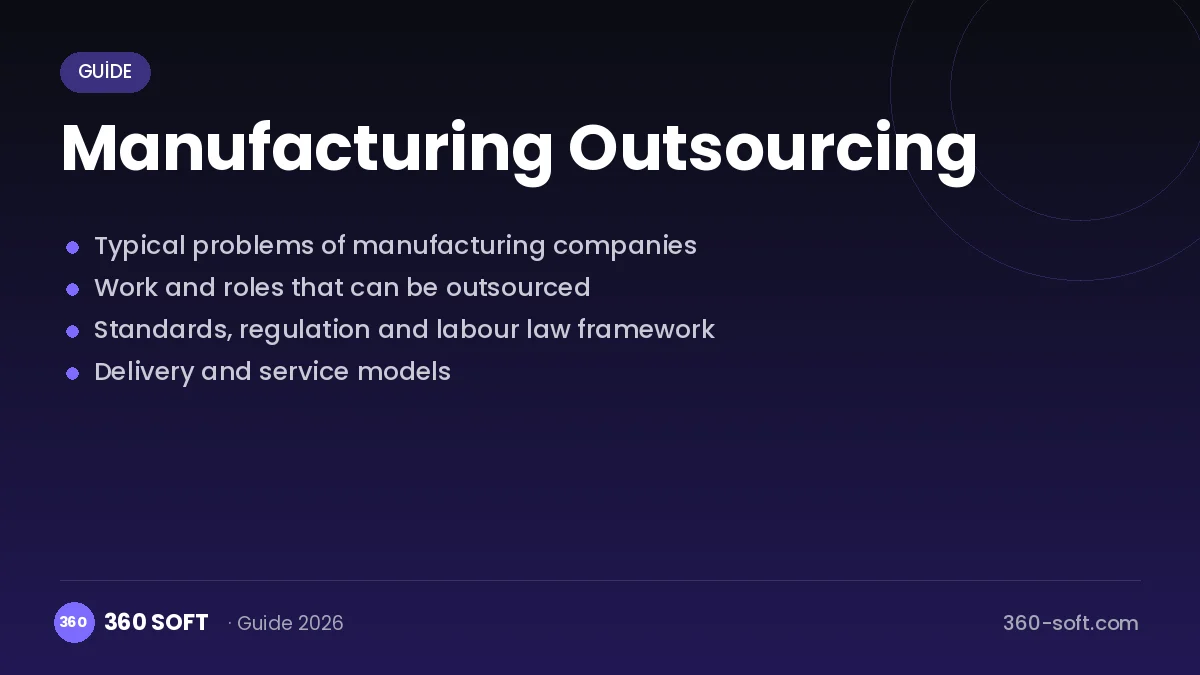
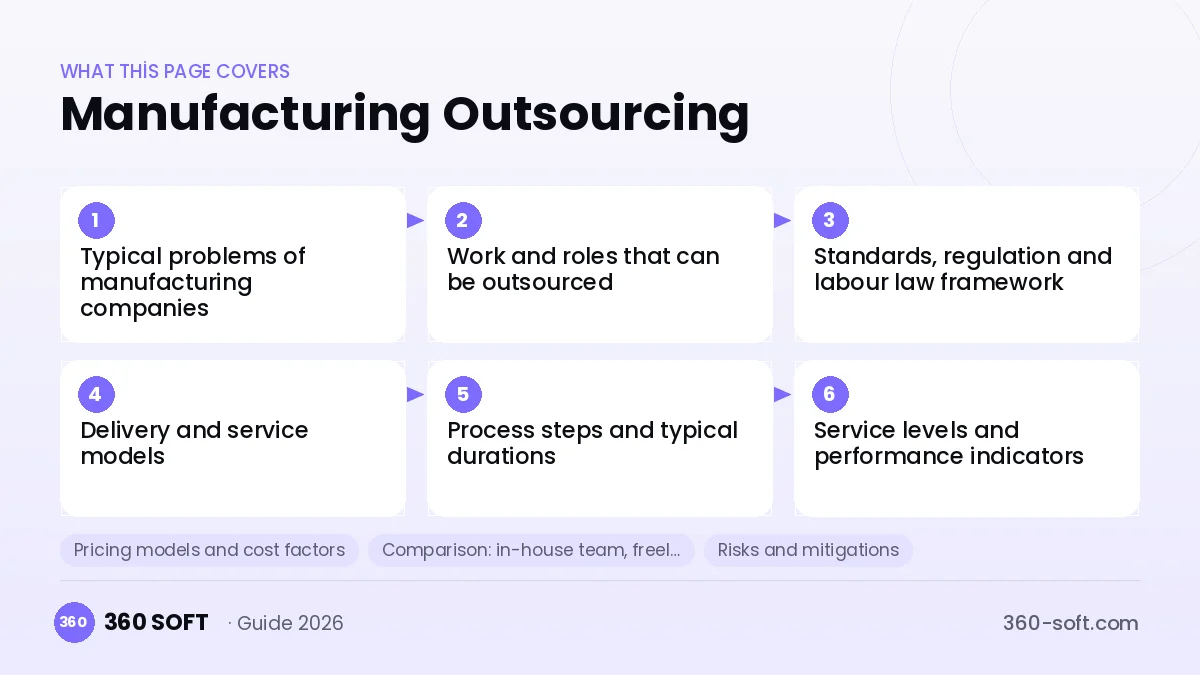
This page covers the typical problems of manufacturers, which work and roles can be outsourced, the standards and labour law framework, delivery models, process steps, SLA and KPI examples, pricing factors, a comparison, risks, security, the role of outsourcing in an Industry 4.0 roadmap and a vendor checklist. For all services, see the outsourcing services hub.
Typical problems of manufacturing companies
- Shift coverage: IT problems do not wait for office hours, but a small IT team cannot cover three shifts and weekends.
- IT and OT convergence: production networks, PLCs, SCADA, MES and ERP are increasingly connected, and few people understand both worlds.
- Scarce specialists: MES, ERP, data and automation profiles are hard to find, especially outside large cities.
- Audit pressure: customers and certification bodies expect up-to-date procedures, records and traceability.
- Stalled digital projects: Industry 4.0 pilots often stop because nobody has time to scale them.
- Warehouse peaks: raw material and finished goods flows fluctuate with orders and seasons.
Work and roles that can be outsourced
| Area | Typical tasks | Typical roles |
|---|---|---|
| Factory IT and OT support | Shift help desk, shop floor terminals, printers and scanners, network, OT asset inventory, patch coordination | Help desk specialist, system and network administrator, OT support engineer |
| MES and ERP support | User support, master data, production order issues, interface monitoring, reports, small enhancements | MES/ERP consultant, application support specialist |
| Industry 4.0 and data | Machine data collection, OEE dashboards, data pipelines, predictive maintenance pilots | Data engineer, BI developer, IoT developer |
| Software development | Integrations between machines, MES and ERP, internal apps, traceability and label systems | Backend, frontend and mobile developers, QA |
| Quality and compliance documentation | Procedures, work instructions, records, translation of documents, audit preparation support | Quality documentation specialist, technical writer |
| Warehouse and logistics | Receiving, picking, shipping preparation, inventory counts, WMS data | Warehouse operator, team leader, WMS specialist |
| Maintenance planning support | CMMS data, work order planning, spare parts records, reporting | Maintenance planner, data specialist |
Standards, regulation and labour law framework
Outsourcing in manufacturing touches both quality and information security standards and labour law. The framework below is general and should be confirmed with your quality department and legal advisers. Our teams operate under Turkish law; local rules in your own country apply to your business as well.
- Quality management systems: ISO 9001 and, in automotive, IATF 16949 require outsourced processes to be controlled. Procedures, competence records and performance measures for the outsourced team become part of your quality system.
- Environment, energy and safety: in plants with ISO 14001, ISO 50001 and ISO 45001, outsourced staff follow the training and record requirements of these systems. Under Turkish Occupational Health and Safety Law No. 6331, training, risk assessment and coordination are mandatory for everyone working on site.
- Information security and OT: ISO/IEC 27001 for corporate information security and the IEC 62443 series for industrial automation guide access rules, segmentation and change management.
- Labour law and subcontracting: Turkish Labour Law No. 4857 limits subcontracting of core production work. We therefore outsource supporting functions (IT, data, documentation, warehouse, planning support), not your core production itself. Team members are employed by 360 Soft.
- Data protection: employee and customer personal data are covered by KVKK (Law No. 6698) in Türkiye and GDPR for EU and UK data subjects.
Contract note for international buyers
We work under a B2B service agreement with a defined scope, SLAs and acceptance criteria. Standard documents include a mutual NDA, an IP assignment clause so that all work product, scripts, knowledge base articles and code belong to you, and a data processing agreement (DPA). For EU and UK clients the DPA covers GDPR, with Standard Contractual Clauses (and the UK IDTA or Addendum) for transfers to Türkiye; personal data processed in Türkiye is also subject to KVKK (Law No. 6698). Team members are employed by 360 Soft under Turkish labour law, so you do not take on employer obligations in Türkiye. Local rules in your own country continue to apply to your business and should be reviewed with your legal advisers.
Delivery and service models
| Model | Best for | Notes |
|---|---|---|
| Remote | Shift help desk, MES and ERP support, data, software, documentation | Secure remote access with approval and logging |
| On site | Warehouse teams, shop floor support, OT inventory in Türkiye | Safety induction and site rules apply |
| Hybrid | Remote support with planned site visits | Common for plants that want 7/24 cover with local presence |
Engagement types: dedicated team, staff augmentation (specialists join your team, see staff augmentation), managed service against SLAs, or project-based delivery for a defined Industry 4.0 or integration project.
Process steps and typical durations
- Discovery: plants, shifts, systems, ticket history and audit requirements.
- Scope and architecture: roles, service catalogue, escalation paths and access design.
- Security and safety preparation: accounts, remote access rules, OT change procedure and safety training for on-site staff.
- Pilot: one plant, one shift or one system first.
- Rollout: extending to other shifts, plants or systems.
- Continuous improvement: monthly reviews, automation of recurring tickets, knowledge base growth.
Remote support teams typically start in 1 to 2 weeks. Multi-plant or OT scopes are phased over several weeks. Our replacement process covers leavers, so knowledge and coverage are kept.
Service levels and performance indicators
| Service | Example KPIs |
|---|---|
| Shift IT support | Response time by priority, resolution time, tickets resolved within the shift |
| IT/OT infrastructure | Availability of critical systems, patch compliance, changes without incident |
| MES and ERP | Interface error backlog, master data accuracy, ticket ageing |
| Industry 4.0 | Data completeness, dashboard availability, milestones delivered |
| Warehouse | Picking accuracy, on-time shipment preparation, count variance |
| Documentation | Documents updated on schedule, audit findings related to documentation |
| Software | Sprint delivery, defect rate, deployment frequency |
Values are agreed per contract based on your baseline.
Pricing models and cost factors
Common models are a monthly per-person fee, hourly rates, a fixed price for a defined project or outcome-based pricing for mature services. We do not publish prices; cost depends on these factors:
| Factor | Effect |
|---|---|
| Number of shifts | Three-shift and weekend coverage require more people |
| Diversity of machinery | More vendors and control systems need broader expertise |
| Number of systems and integrations | More systems mean longer onboarding |
| Number and location of plants | Drives travel and on-site presence |
| Security requirements | Strict OT access rules add process steps |
| Audit and customer requirements | Industry-specific documentation adds effort |
Comparison: in-house team, freelancers and outsourcing
| Criterion | In-house | Freelancers | Outsourcing |
|---|---|---|---|
| Shift coverage | Expensive to staff | Rarely available | Planned shifts, 7/24 possible |
| Industry 4.0 expertise | Hard to hire | Project by project | Team with mixed skills |
| Fit with quality system | Native | Weak | Documented procedures and records |
| Scalability | Slow | Limited | Scale up or down by agreement |
| Knowledge continuity | Depends on turnover | Weak | Documentation and replacement process |
| Management effort | High | High | One accountable partner |
Risks and mitigations
- Subcontracting risk for core work: we limit scope to supporting functions and document the division of work.
- An OT change stopping production: approved change windows, four-eyes approval and rollback plans.
- Accidents on site: safety induction, PPE and coordination with your OHS team.
- Leakage of recipes, processes or customer drawings: least-privilege access, NDAs and logging.
- Wrong decisions from poor data: data quality checks before dashboards go live.
- Vendor lock-in: documentation, shared repositories and an exit plan.
Security, data protection, confidentiality and IP
Remote access to plant systems is granted per person, time-limited where possible and logged. OT networks are reached only through approved jump hosts. Process data, recipes and drawings are treated as confidential, every team member signs confidentiality undertakings and all code, documents and configurations are assigned to you.
Where outsourcing fits in an Industry 4.0 roadmap
Industry 4.0 projects usually fail on capacity, not ideas. An outsourced team can take on the steady work that keeps a roadmap moving: connecting machines, cleaning data, building OEE and energy dashboards, integrating MES with ERP and maintaining what has been built. Your engineers keep ownership of priorities and process knowledge, while the external team delivers and documents. Where software is needed, our developer teams and data engineers can join the same engagement.
Illustrative scenario. A mid-sized component manufacturer runs three shifts but has IT staff only during the day. A remote help desk team covers nights and weekends with a clear escalation path to on-call engineers, while a data engineer connects key machines to an OEE dashboard over three months. This is an example of how the model can work, not a description of a specific client.
Vendor checklist
- Does the vendor understand both IT and OT, and respect production priorities?
- Can it cover your shifts, including nights and weekends?
- Will its procedures fit into your ISO 9001 or IATF 16949 quality system?
- Are safety training and site rules part of the plan?
- Is the scope clearly limited to supporting functions?
- Are access, logging and change management defined?
- Is there a replacement process and an exit plan?
- Can operations support and software development be combined?
Frequently asked questions
Which manufacturing functions can be outsourced?
Supporting functions such as factory IT and OT support, MES and ERP support, data and Industry 4.0 work, software, quality documentation, warehouse operations and maintenance planning support. Core production stays with you.
Can you provide 7/24 shift support?
Yes. Teams can be organised in shifts to cover nights, weekends and holidays, with escalation to your on-call staff where needed.
Do you work on OT networks and SCADA systems?
Yes, under your change management rules, through approved remote access and with four-eyes approval for changes.
How do you fit into our quality system?
We document procedures, competence records and KPIs for the outsourced team so they can be included in your ISO 9001 or IATF 16949 system.
Does subcontracting create labour law risk?
We limit scope to supporting functions and document the division of work. Team members are employed by 360 Soft. We recommend a legal review for your specific setup.
Which contract model applies?
A B2B service agreement with SLAs, an NDA, IP assignment and a DPA covering GDPR with SCCs and KVKK.
How is pricing calculated?
By number of shifts, systems, plants, machinery diversity and security and audit requirements. Monthly, hourly, fixed or outcome-based models are possible.
How fast can a team start?
Remote support teams typically start in 1 to 2 weeks; multi-plant scopes are phased.
Can staff work on site in our plant?
Yes, in Türkiye, after safety induction and in line with your site rules.
Who owns code and documentation?
You do. IP assignment is part of the contract.
What happens if a team member leaves?
Our replacement process provides a trained substitute, supported by documentation, so service continues.
Your first step for the factory
Tell us your plants, shifts, systems and priorities, and we will propose a team, SLAs and a pricing model. Call or WhatsApp us on +90 850 335 10 87, write to info@360-soft.com, message us directly on WhatsApp, or use the form on our contact page. 360 Soft Marketing Yazılım ve Danışmanlık Ltd. Şti., Nidakule Ataşehir Batı, Barbaros Mah. Begonya Sk. No:1 D:2, 34746 Ataşehir/İstanbul.
Related pages
- All outsourcing services (hub)
- Warehouse and logistics outsourcing
- Field and technical service outsourcing
- Logistics sector outsourcing
- IT staff leasing
- System and network administrators
- Cyber security specialists
- Hire developers
- Türkçe version of this page
Related services
- Media and Publishing OutsourcingMedia and publishing outsourcing: subtitling, archive metadata, 7/24 moderation, CMS, ad ops, reader support…
- Mobile App Maintenance and Development OutsourcingMobile app maintenance outsourcing: iOS and Android OS compatibility, store policy updates, crash monitoring…
- NOC and Network Monitoring OutsourcingNOC outsourcing: 24/7 monitoring of networks, links, servers and services, first response and carrier…
- Outsourcing for Agencies and Software CompaniesOutsourcing for agencies and software companies: white-label developers, designers, QA and DevOps that work…
- Outsourcing for Crypto Exchanges and Digital Asset PlatformsCrypto exchange outsourcing: KYC/AML operations, transaction monitoring, fraud, SOC and 24/7 support with…
- Outsourcing for Holdings and Corporate GroupsOutsourcing for holdings and corporate groups: SAP, PMO, SOC, finance and HR operations under one governance…