Fraud does not keep office hours. A card-testing attack that starts at midnight, customer accounts taken over on a weekend or a wave of fake orders during a campaign can turn into real losses and a chargeback spike if nobody looks until the morning. With fraud monitoring outsourcing, 360 Soft analysts review suspicious transaction and account alerts, tune rule and score thresholds, call customers for verification, handle chargeback disputes and report on results, always within the decision limits you define. The team works from Istanbul, remotely, on-site or hybrid, with 24/7 shift coverage where you need it. For the wider service catalogue, see all outsourcing services.
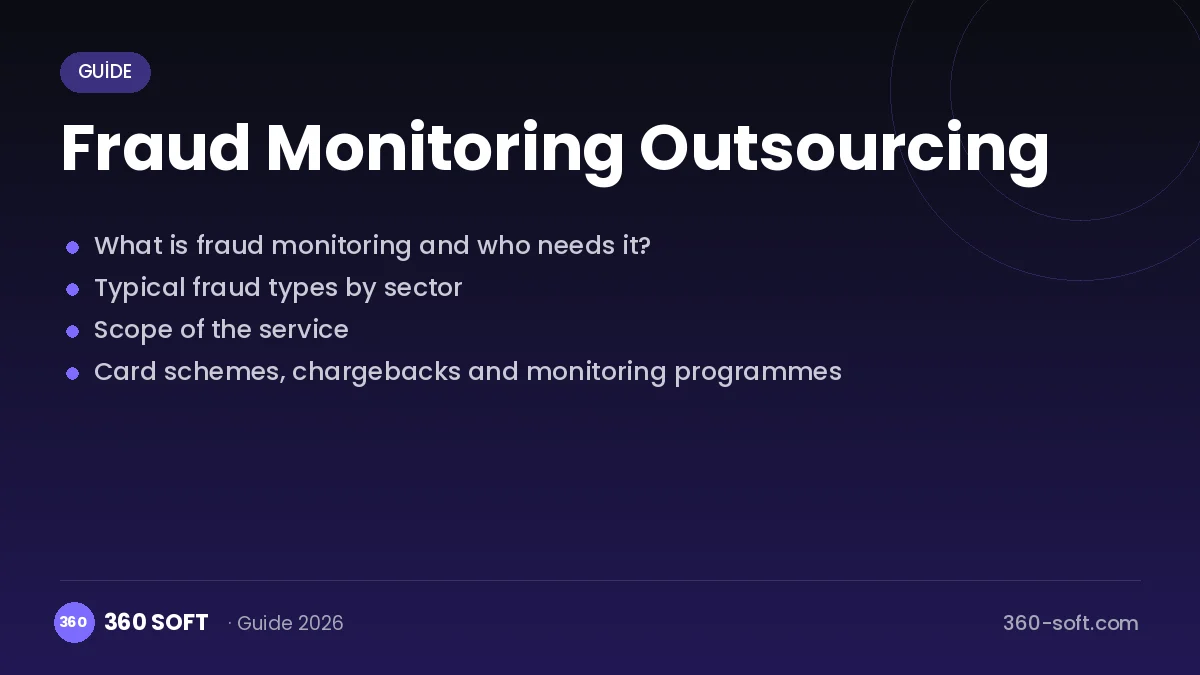
What is fraud monitoring and who needs it?
Fraud monitoring is the human layer on top of your rule engines and risk-scoring models. Automated systems flag transactions, logins, account changes and orders; trained analysts then decide quickly whether an alert is genuine fraud, a false positive or something that needs more information. Good monitoring protects revenue without blocking good customers, and it feeds back into the rules so the system gets sharper every week.
Typical clients include payment and e-money institutions, PSPs and acquirers, e-commerce marketplaces and online retailers, digital banks and lenders, crypto and trading platforms, travel and ticketing sellers, gaming and subscription businesses, and telecoms. The service fits companies that already have a fraud tool but lack the people to work its queues, as well as fast-growing businesses that need coverage at night and on weekends without building a full in-house team.
Typical fraud types by sector
| Sector | Common fraud patterns | What analysts check |
|---|---|---|
| Payments / PSP | Card testing, stolen card use, merchant collusion, refund abuse | Velocity, BIN patterns, device and IP signals, merchant behaviour |
| E-commerce | Fake orders, account takeover, promo and coupon abuse, friendly fraud | Order history, address and device match, basket anomalies |
| Digital banking / lending | Account takeover, mule accounts, synthetic identities, loan stacking | Login anomalies, beneficiary changes, KYC data consistency |
| Crypto / trading | Stolen identity onboarding, bonus abuse, rapid in-out flows | Onboarding data, wallet and withdrawal patterns, linked accounts |
| Travel / ticketing | High-value bookings with stolen cards, last-minute fraud | Booking lead time, passenger vs cardholder data, route risk |
| Telecom / subscriptions | SIM swap, subscription fraud, trial abuse | Identity checks, device reuse, usage spikes |
Scope of the service
- Real-time and near-real-time alert review in your fraud tool or back office
- Approve, hold, decline or escalate decisions within agreed authority limits
- Customer verification calls, emails and document checks
- Rule and threshold tuning proposals backed by data, false-positive analysis
- Chargeback handling: reason-code analysis, evidence packs and representment
- Blocklist and allowlist maintenance, case notes and audit trail
- Daily, weekly and monthly reporting on fraud rate, losses, approvals and chargebacks
- Escalation of potential money-laundering cases to your AML/compliance team
Roles
| Role | Responsibility |
|---|---|
| Fraud analyst (L1) | Queue review, standard decisions, customer verification |
| Senior fraud analyst (L2) | Complex cases, chargebacks, pattern detection, escalations |
| Fraud rules / data analyst | Rule performance, threshold tuning, SQL analysis, dashboards |
| Team lead | Shift planning, quality control, SLA reporting, client communication |
Technologies and tools
Our analysts work inside your stack: commercial fraud platforms (for example Sift, Riskified, SEON, Kount, Featurespace or Feedzai), PSP-native tools such as Stripe Radar or Adyen RevenueProtect, in-house rule engines, ticketing systems, CRMs and BI tools. Access is granted with named, least-privilege accounts and full logging.
Card schemes, chargebacks and monitoring programmes
Card schemes watch merchants’ fraud and dispute ratios closely. Exceeding scheme thresholds can lead to monitoring programmes, fines or the loss of acquiring relationships. A monitoring team keeps an eye on these ratios daily, reacts to emerging patterns before they hit the numbers and prepares well-documented dispute responses. We work with the reason codes and evidence rules of the major schemes and with 3-D Secure / strong customer authentication flows, so that liability shift and exemptions are used correctly.
Regulation: Turkish framework and international rules
Our team operates in Turkey, so internal processes follow Turkish rules: KVKK for personal data, and for financial clients the relevant MASAK (financial crime), CBRT (payment services) and BRSA (banking) requirements on record keeping, outsourcing and information security. For international clients, we align with the frameworks that apply to you, such as PSD2 strong customer authentication in the EU and UK, PCI DSS rules on card data handling, and scheme dispute rules. Local regulations in your country always apply, and regulated decisions such as suspicious activity reports remain with your compliance officer.
Delivery and service models
| Model | How it works | Best for |
|---|---|---|
| Dedicated team | Named analysts working only on your queues, managed by a 360 Soft lead | Steady volumes, need for deep product knowledge |
| Shift coverage | Nights, weekends and holidays on top of your daytime team | In-house teams that cannot staff 24/7 |
| Peak support | Extra analysts for campaigns, launches or attack periods | Seasonal or event-driven volume spikes |
| Managed service | We own queue SLAs, reporting and rule recommendations | Companies without a fraud operations function |
Teams range from one analyst to 200+ people, delivered remotely, on-site or in a hybrid setup.
Process steps and typical timelines
- Discovery (2–5 days): current tools, alert volumes, decision rules, authority limits and KPIs.
- Playbook design (about 1 week): decision trees, escalation paths, verification scripts and quality criteria.
- Team selection and onboarding (1–2 weeks): analyst selection, tool access, training on your products and policies.
- Shadow and go-live: analysts work side by side with your team, then take over queues step by step.
- Continuous improvement: weekly reviews, rule-tuning proposals and monthly performance reports.
Illustrative scenario
Illustrative scenario: an online marketplace has a fraud tool but only a daytime team, and orders flagged at night wait until 9 a.m., delaying good customers and letting some fraud through. A 360 Soft night and weekend shift takes over the queue with clear approve/decline limits, calls high-value customers for verification and hands over a summary each morning. After a month, the shared data is used to propose threshold changes. This is an example of how the service can be set up, not a reported client result.
SLA and KPI table
| KPI | What it measures | How targets are set |
|---|---|---|
| Alert review time | Time from alert to decision | Agreed per queue and risk level |
| Queue backlog | Open alerts at shift end | Defined maximum per shift |
| Fraud rate (bps or %) | Fraud losses vs volume | Baseline measured in the first weeks |
| False positive / decline rate | Good customers wrongly blocked | Balanced against fraud rate |
| Chargeback ratio | Disputes vs transactions | Kept below scheme thresholds |
| Dispute win rate | Chargebacks successfully represented | Tracked by reason code |
| Quality score | Sampled decisions meeting the playbook | Monthly QA sampling |
Pricing factors
We do not publish fixed prices because cost depends on scope. The main factors are:
| Factor | Impact on cost |
|---|---|
| Coverage hours | 24/7 needs more analysts than business hours |
| Alert volume and complexity | More or more complex cases mean larger teams |
| Languages | Customer calls in several languages require specific profiles |
| Seniority mix | Rules analysts and L2 specialists cost more than L1 |
| Tools and access | Working in several systems lengthens onboarding |
| Model | Dedicated team, shift coverage or managed service |
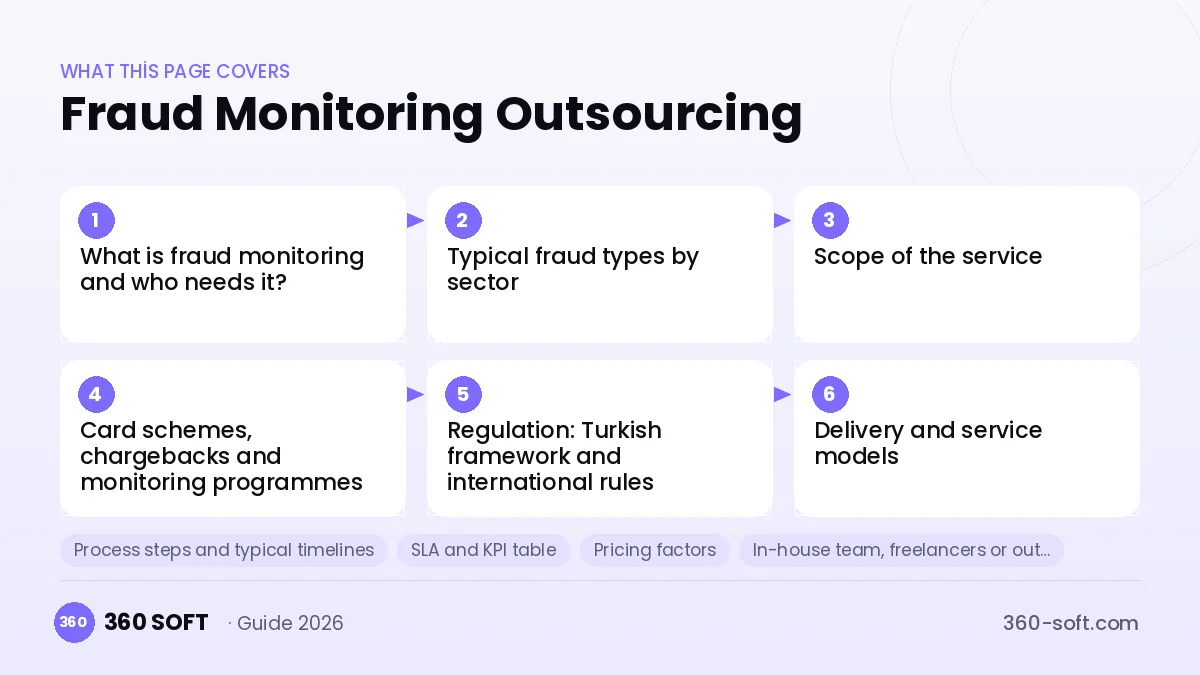
In-house team, freelancers or outsourcing?
| Criteria | In-house | Freelancers | Outsourcing (360 Soft) |
|---|---|---|---|
| 24/7 coverage | Expensive, hard to staff | Unreliable | Shift plans included |
| Ramp-up time | Months of hiring | Fast but inconsistent | Typically 1–2 weeks |
| Data security | Full control | Hard to control | NDA, DPA, logged access |
| Continuity | Turnover risk | High risk | Replacement process for staff |
| Management effort | High | High | Team lead provided |
Risks and mitigations
- Over-blocking good customers: clear authority limits, second review for high-value declines, false-positive tracking.
- Missed fraud at peak times: volume forecasting, peak staffing and escalation alerts.
- Data leakage: least-privilege access, no local data storage, monitored sessions.
- Knowledge loss: written playbooks, case notes and documented handovers.
- Insider risk: background checks where legally permitted, four-eyes principle on sensitive actions.
Security, data protection, NDA and IP
Analysts access your systems via named accounts, VPN or VDI, with MFA and full logging. Card data is handled only in PCI DSS-compliant environments you control; we do not copy data to local devices. Every team member signs confidentiality undertakings, and rules, reports and playbooks created for you belong to you.
A note on the contract model
We work under a B2B service agreement with a statement of work, SLA annex and change procedure. Intellectual property in deliverables (rules, reports, code, designs, documentation) is assigned to you on payment, and a mutual NDA is signed before any data is shared. Where we process personal data on your behalf, we sign a GDPR-compliant data processing agreement (DPA) with Standard Contractual Clauses, or the UK IDTA/Addendum for UK clients, and we operate under Turkey’s KVKK. Team members are employed by 360 Soft under Turkish labour law; we remain responsible for their management and replacement. Decisions with regulatory consequences, such as filing suspicious activity reports, remain with your designated compliance officer. This is general information, not legal advice; please have your counsel review the final contract.
Vendor selection checklist
- Can the vendor show a written playbook and QA process?
- Are authority limits and escalation paths documented?
- Is 24/7 shift coverage available and realistic?
- How is access granted, logged and revoked?
- Is there a GDPR DPA with SCCs and a KVKK-compliant setup?
- How fast can analysts be replaced, and how is knowledge transferred?
- What reporting is provided, and how often?
Frequently asked questions
Is fraud monitoring the same as AML monitoring?
No. Fraud monitoring protects you and your customers from losses such as stolen cards or account takeover. AML monitoring detects money laundering and terrorist financing. The teams share signals, and we escalate potential AML cases to your compliance team.
Do you file suspicious activity reports for us?
No. Reports to authorities such as MASAK or your local financial intelligence unit are filed by your compliance officer. Our analysts prepare the case notes and evidence.
Which fraud tools can you work with?
We work inside your existing stack, whether that is a commercial fraud platform, a PSP-native tool or an in-house rule engine, plus your ticketing and CRM systems.
Do you cover nights and weekends?
Yes. 24/7 shift coverage is possible, either as a full service or on top of your daytime team.
Can analysts decline transactions on their own?
Only within the authority limits you set. High-value or unusual cases follow an escalation path to a senior analyst or your team.
Do you prepare chargeback disputes?
Yes. We analyse reason codes, compile evidence packs and submit representments through your PSP or acquirer portal.
How do you help avoid card scheme monitoring programmes?
By tracking fraud and dispute ratios daily, reacting to new patterns quickly, recommending rule changes and improving dispute documentation.
How do you avoid losing good customers to false declines?
Through clear decision rules, verification contacts before declining borderline cases, second reviews and regular false-positive analysis.
Do you make customer verification calls?
Yes, in the agreed languages and scripts, with call notes recorded in your system.
How quickly can a team start?
Typically within 1–2 weeks after scope and access are agreed.
Let us review your fraud operations
Tell us about your fraud monitoring needs and we will come back with a scoped proposal, a team plan and a realistic start date (typically 1–2 weeks). Call +90 850 335 10 87, message us on WhatsApp, email info@360-soft.com or use the contact page. 360 Soft Marketing Yazılım ve Danışmanlık Ltd. Şti., Nidakule Ataşehir Batı, Barbaros Mah. Begonya Sk. No:1 D:2, 34746 Ataşehir/İstanbul.
Related pages
- All outsourcing services
- KYC/AML operations
- Finance sector outsourcing
- Finance back office
- Call center and customer service
- KYC/AML compliance software
- Türkçe
Related services
- Game Testing and Live Ops OutsourcingGame testing and live ops outsourcing from Istanbul: QA, compatibility, localisation testing, events, economy…
- Gaming Industry OutsourcingGaming industry outsourcing: art, animation, Unity and Unreal development, QA, live ops and player support…
- Healthcare OutsourcingHealthcare outsourcing for non-clinical work: appointment lines, patient communication, billing and…
- HR and Payroll Operations OutsourcingHR and payroll operations outsourcing: payroll for teams in Türkiye, personnel files, onboarding, leave…
- Insurance Sector OutsourcingInsurance outsourcing for insurers, agencies and brokers: policy back office, first-stage claims, renewals…
- KVKK and Data Protection Compliance Operations OutsourcingKVKK and GDPR compliance operations: data inventory, VERBIS, data subject requests, transfers, retention and…