Game testing and live ops outsourcing means handing a studio’s quality assurance, compatibility testing, localisation checks and post-launch live operations to an external team: the event calendar, in-game economy monitoring, player support and release coordination. Games are no longer products that ship once and are finished; they are services updated every week or two. That makes it hard for a studio to protect quality without spending its scarcest resource, developer time, on testing and operations. 360 Soft builds testing and live ops teams for mobile, PC and browser games from Istanbul. This page explains the scope, the types of testing, live ops processes, the metrics we track and the platform rules you need to keep in mind.
Who this service is for
The model fits studios and publishers whose release cadence has outgrown their internal QA capacity, or who need an operations team that can cover evenings, weekends and holiday events without burning out the core developers.
- Indie and mid-size studios preparing a soft launch or a global launch
- Free-to-play mobile games with weekly content drops, seasonal passes and limited-time events
- Publishers that need consistent QA across several titles or external development partners
- PC and browser games entering early access or moving to a live service model
- Studios localising into several languages and needing linguistic and cultural checks
Common problems studios face
- Developers test their own features and regression gaps appear in older systems
- Device fragmentation on Android means crashes are discovered by players first
- Event configuration errors (wrong rewards, wrong dates, broken offers) reach production
- Player support tickets pile up after every update and nobody owns the trend analysis
- Store submissions are rejected because of policy or age-rating details
Game testing scope
| Test type | What it covers | When it matters most |
|---|---|---|
| Functional testing | Gameplay flows, UI, menus, progression, saves, purchases | Every build and every content update |
| Regression testing | Re-checking existing features after changes, smoke and sanity suites | Before each release candidate |
| Compatibility testing | Device, OS version, GPU, screen ratio and browser matrix | Before launch and after engine or SDK upgrades |
| Performance testing | Frame rate, load times, memory, battery, heat, network conditions | Before launch and after large content drops |
| Localisation testing | Text fit, truncation, fonts, cultural fit, date and currency formats | When adding languages or markets |
| Compliance and certification checks | Store guidelines, platform requirements, age ratings | Before each store submission |
| Multiplayer and server testing | Matchmaking, latency, desync, reconnection, load scenarios | Before events and feature launches |
| Monetisation testing | Store, offers, receipts, restore purchases, sandbox payments | Every offer and pricing change |
Testing is planned from a risk-based test plan: critical paths such as onboarding, progression and payments are covered on every build, while lower-risk areas rotate. Where it is worthwhile, we automate smoke tests and repetitive checks, but exploratory human testing stays at the centre because fun, feel and balance cannot be fully scripted.
Live ops scope
| Area | Typical tasks |
|---|---|
| Event operations | Configuring and checking events, rewards, offers and schedules in the admin tools; pre-flight checklists |
| Economy monitoring | Tracking currency sinks and sources, unusual spending or reward patterns, exploit signals |
| Player support | Ticket handling, FAQ maintenance, refund and account requests within your policies |
| Community moderation | Discord, forums and social channels, escalation of bugs and sentiment trends |
| Release coordination | Release notes, store metadata updates, phased rollout monitoring, hotfix follow-up |
| Reporting | Daily and weekly live health reports, incident logs, top player issues |
Roles in the team
- QA lead / test manager: test strategy, planning, reporting
- QA testers: manual functional, regression and exploratory testing
- Test automation engineer: smoke suites and tooling where it pays off
- Localisation testers: native or near-native checks per language
- Live ops specialist: event configuration, calendar and pre-flight checks
- Player support and community agents
- Data analyst (optional): KPI dashboards and economy monitoring
Platform rules and regulations
Store and platform rules change often, and many live ops mistakes are really policy mistakes. Our testers work from checklists based on the current guidelines of each platform you ship on, and flag anything that needs a decision from your producer or legal team.
- Apple App Store and Google Play: review guidelines, in-app purchase rules, disclosure of loot box odds, data safety and privacy labels, age ratings
- Age ratings: IARC, PEGI and ESRB questionnaires must match actual content, including user-generated content and chat
- Children and privacy: GDPR rules on consent for minors, COPPA for US audiences, and platform family policies
- Loot boxes and gacha: odds disclosure is required by the stores, and some countries regulate or restrict paid random items; your legal team decides which markets need adjustments
- Consumer protection: clear pricing, honest timers and offers, and fair refund handling
Because the team operates in Türkiye, Turkish rules on personal data (KVKK) and consumer protection apply to our operations. Local rules in the countries where your players live still apply to your game, and we treat them as requirements in the test plan.
Engagement models
| Model | How it works | Best for |
|---|---|---|
| Dedicated team | A fixed QA and live ops team working only on your titles, with your tools and rituals | Live games with continuous updates |
| Managed service | We own delivery against agreed SLAs and scope, and report on outcomes | Studios that want results, not headcount management |
| On-demand test cycles | Planned test sprints before milestones, launches or certification | Premium titles and milestone-driven projects |
| Hybrid | A small core team plus extra testers for peaks such as season launches | Games with strong seasonality |
Teams can be remote, on-site or hybrid, and 24/7 shift coverage is possible for live operations. Team size can range from a single tester to large multi-shift teams of 200+ people, and if a team member is not the right fit, we run a replacement process. A typical start takes 1–2 weeks.
Process
- Discovery: we review the game, builds, platforms, release calendar, current bug flow and live ops tools.
- Test and operations plan: device matrix, test types, coverage priorities, event pre-flight checklists and escalation paths.
- Onboarding: access to builds, bug tracker, admin panels and communication channels under least-privilege rules.
- Pilot cycle: one release or event is run together, and processes are adjusted.
- Steady state: regular test cycles, live monitoring, daily and weekly reports.
- Continuous improvement: monthly reviews of escaped defects, incidents and support trends.
KPIs and service levels
| Metric | What it shows |
|---|---|
| Escaped defects | Bugs found by players after release, by severity |
| Defect report quality | Share of bug reports that are reproducible and complete on first submission |
| Test coverage | Share of critical paths and devices covered per build |
| Crash-free sessions trend | Stability after each release, tracked with your analytics tools |
| Event incident count | Configuration errors reaching production |
| First response and resolution time | Speed of player support on each channel |
| Regression cycle time | Time needed to validate a release candidate |
Targets for each metric are agreed together during the pilot and written into the service agreement; we do not promise figures before seeing your game and data.
Pricing: what drives the cost
We do not publish fixed prices because the cost depends on scope. The main factors are:
| Factor | Effect on cost |
|---|---|
| Team size and seniority | Number of testers, leads, automation engineers and live ops specialists |
| Coverage hours | Business hours versus extended or 24/7 shifts and holiday cover |
| Device and platform matrix | Number of physical devices, consoles or browsers to test on |
| Languages | Number of languages for localisation testing and player support |
| Engagement model | Dedicated team, managed service or on-demand cycles |
| Tooling | Use of your tools versus tools we provide, automation set-up effort |
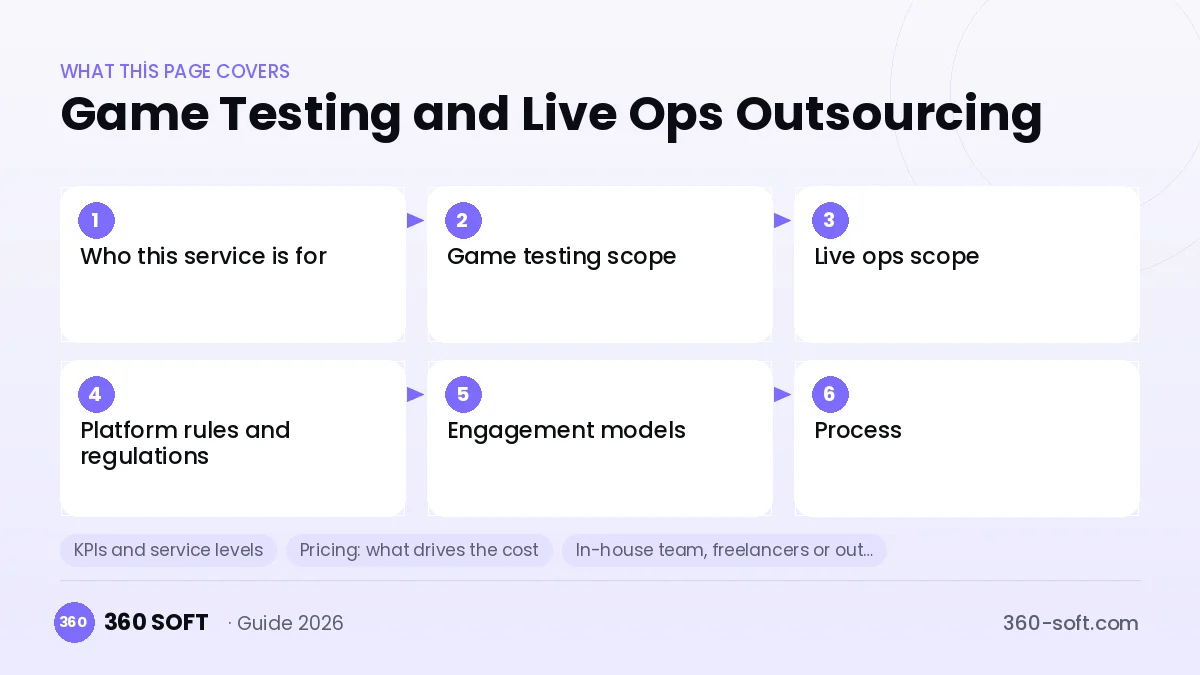
In-house team, freelancers or outsourcing
| Criterion | In-house team | Freelancers | Outsourcing |
|---|---|---|---|
| Speed to start | Slow (recruiting) | Fast for individuals | Typically 1–2 weeks |
| Scalability for peaks | Limited | Hard to coordinate | Flexible team size |
| Process and reporting | You build it | Varies | Included |
| Continuity | Depends on retention | Low | Replacement process |
| Control | Highest | Low | High, with agreed SLAs |
Risks and how we reduce them
- Build leaks: NDAs, restricted access, watermarked builds where needed, no personal devices for confidential builds
- Knowledge loss: documented test cases, checklists and runbooks kept in your systems
- Communication gaps: fixed daily touchpoints, shared bug triage and a named lead
- Event mistakes: four-eyes rule for event configuration and pre-flight checklists
- Quality drift: monthly escaped-defect reviews and bug report quality audits
Security, data protection, NDA and IP
Testers access only the builds and tools they need, with MFA and individual accounts. Player data handled in support is processed under your instructions and minimised. Contract note: We work under a B2B service agreement with a defined statement of work, not as an employer of record or staffing agency. The agreement includes an NDA, assignment to you of intellectual property in all deliverables created for you, and, where personal data is processed, a GDPR data processing agreement (DPA) with Standard Contractual Clauses (or the UK IDTA for UK data). Because the team operates in Türkiye, the Turkish Personal Data Protection Law (KVKK) also applies to our side of the processing. Local rules in your own country continue to apply to your business, so we recommend your legal team reviews the final contract.
Illustrative scenario: testing and live ops before a season update
Illustrative scenario: a mid-size studio runs a free-to-play mobile game with a new season every eight weeks. Its developers currently do their own regression testing, and the last two seasons launched with reward configuration errors. A dedicated team of a QA lead, four testers and two live ops specialists is set up. The team builds a device matrix, a regression suite for the season pass and a pre-flight checklist for every event. During the season launch window, live ops staff cover evenings and weekends, monitor the economy and escalate anomalies. The studio reviews escaped defects and event incidents in a monthly meeting. This is an example of how such an engagement can be structured, not a report of a real client.
Checklist for choosing a testing and live ops partner
- Do they understand your genre, platforms and monetisation model?
- Can they show sample test plans, bug reports and live ops checklists?
- How do they protect unreleased builds?
- Can they cover your launch windows and time zones?
- How quickly can the team scale up and down?
- Who owns test cases, documentation and IP?
- Which KPIs will be reported and how often?
Frequently asked questions
What is game testing outsourcing?
An external team takes over functional, regression, compatibility, performance and localisation testing of your game under an agreed plan.
What is live ops?
Running a game after launch: events, offers, economy monitoring, player support, community and release coordination.
Which platforms do you test on?
Mobile (iOS and Android), PC and browser games. The device matrix is agreed per project.
Does test automation work for games?
For smoke tests, builds and repetitive checks, yes. Gameplay feel and balance still need exploratory human testing.
Will our unreleased game leak?
We use NDAs, individual accounts, MFA and restricted build access, and can add watermarking where needed.
Do you also handle player support?
Yes, ticket handling and community moderation can be part of the live ops scope, within your policies.
How do you prevent event configuration errors?
With pre-flight checklists, a four-eyes review of every configuration and post-launch checks.
How is the price determined?
By team size, coverage hours, device matrix, languages and engagement model. We send a proposal after discovery.
Under which contract do you work?
A B2B service agreement with NDA, IP assignment and a GDPR DPA with SCCs (UK IDTA where relevant); KVKK applies on our side.
How fast can you start?
Typically within 1–2 weeks after scope approval and access set-up.
Contact us
Tell us about your game, platforms, release cadence and live ops needs, and we will propose a team and a test plan. Call or WhatsApp us on +90 850 335 10 87, write to info@360-soft.com, message us directly on WhatsApp, or use the form on our contact page. 360 Soft Marketing Yazılım ve Danışmanlık Ltd. Şti., Nidakule Ataşehir Batı, Barbaros Mah. Begonya Sk. No:1 D:2, 34746 Ataşehir/İstanbul.
Türkçe: Türkçe sürüm
Related pages
- Outsourcing services (overview)
- QA and test outsourcing
- Mobile app maintenance
- Call center and customer service
- Content, design and moderation
- Hire Unity game developers
Related services
- Gaming Industry OutsourcingGaming industry outsourcing: art, animation, Unity and Unreal development, QA, live ops and player support…
- Healthcare OutsourcingHealthcare outsourcing for non-clinical work: appointment lines, patient communication, billing and…
- HR and Payroll Operations OutsourcingHR and payroll operations outsourcing: payroll for teams in Türkiye, personnel files, onboarding, leave…
- Insurance Sector OutsourcingInsurance outsourcing for insurers, agencies and brokers: policy back office, first-stage claims, renewals…
- KVKK and Data Protection Compliance Operations OutsourcingKVKK and GDPR compliance operations: data inventory, VERBIS, data subject requests, transfers, retention and…
- KYC/AML Operations OutsourcingKYC/AML operations outsourcing: onboarding checks, KYB, sanctions and PEP screening, transaction monitoring…