Outsourcing for holdings and corporate groups means running shared functions across several subsidiaries, such as SAP and ERP support, project management offices, security monitoring, finance and HR operations or software development, with an external partner under one governance model. For a group, the question is rarely whether a single task can be done cheaper; it is how to standardise service quality across companies, keep control and audit trails, and allocate costs fairly between subsidiaries. This page explains the typical problems of groups, how outsourcing relates to a shared service centre, which functions can be outsourced, relevant rules and standards, delivery and engagement models, the transition process, SLAs and KPIs, pricing factors, M&A situations, risks and a vendor checklist.
Typical challenges of holdings and corporate groups
- Fragmented processes: each subsidiary runs its own tools, vendors and ways of working, which makes reporting and control difficult.
- Duplicated cost: the same roles, licences and support contracts are paid several times across the group.
- Uneven service quality: large companies in the group get good support, smaller ones are left behind.
- Talent competition: SAP consultants, security analysts and experienced project managers are hard to hire and retain in every company.
- Change pressure: acquisitions, carve-outs, ERP migrations and new regulations arrive faster than internal teams can absorb.
Shared service centre, outsourcing, or both?
| Approach | Strength | Weakness | When it fits |
|---|---|---|---|
| Internal shared service centre (SSC) | Full control, group know-how | High fixed cost, slow to scale, long set-up | Large, stable volumes and a strong internal management team |
| Full outsourcing | Fast start, variable cost, access to specialists | Requires strong vendor governance | Non-core functions with clear service definitions |
| Hybrid (SSC plus partner) | SSC keeps decisions, partner adds capacity and specialist skills | Interfaces must be well designed | Most groups: core in the SSC, peaks and specialist work with the partner |
| Build-operate-transfer | Partner builds and runs a team, later transferred | Transfer terms must be agreed up front | Groups that want their own centre in the long run |
Scope: functions that can be outsourced
| Function | Typical roles | Scope examples |
|---|---|---|
| SAP / ERP | SAP functional and technical consultants, ABAP developers | AMS support, change requests, roll-outs to subsidiaries |
| PMO | Project and programme managers, PMO analysts | Portfolio reporting, group-wide programmes, migration projects |
| Software development | Developers, QA, DevOps | Group portals, integrations, internal applications |
| IT operations | Service desk, system and network engineers | L1/L2 support, monitoring, end-user support |
| Security | SOC analysts, vulnerability management | 24/7 monitoring, patch and vulnerability follow-up |
| Finance back office | Accounting and reconciliation specialists | Accounts payable, reconciliations, month-end support |
| HR and payroll operations | HR operations specialists | Personnel files, payroll inputs, onboarding administration |
Rules and standards in corporate groups
| Topic | Who it affects | What it means for outsourcing |
|---|---|---|
| Turkish Labour Law No. 4857 (subcontracting rules) | Groups with Turkish subsidiaries | Outsourcing must be a genuine service, not disguised hiring of the group’s core workforce |
| Turkish Commercial Code (group companies) | Turkish holdings and subsidiaries | Intra-group services and cost sharing should be documented |
| Transfer pricing rules | Groups allocating costs across companies and countries | Allocation keys and service evidence must be defensible |
| KVKK and GDPR | All companies processing personal data | DPAs per controller, rules for intra-group and cross-border transfers |
| Sector supervision (e.g. BDDK, SPK, insurance) | Banks, brokers and insurers in the group | Additional outsourcing notification and control rules may apply |
| Listed company and SOX-type controls | Listed groups or subsidiaries of listed parents | Controls over financial reporting must cover outsourced steps |
| ISO 27001-style security frameworks | Groups with security policies | Vendor controls aligned with your policy and audit plan |
These are general points. The team operates in Türkiye under the Turkish rules above; local rules in the country of each subsidiary apply as well and should be reviewed by your legal advisers.
Delivery models: remote, on-site, hybrid
| Model | Typical use in a group |
|---|---|
| Remote | SAP AMS, development, SOC and back-office work from Istanbul |
| On-site | Service desk or project managers at headquarters or plants |
| Hybrid | Workshops and go-lives on-site, daily operations remote |
Engagement models
| Model | Corporate use | Governance note |
|---|---|---|
| Dedicated team | A permanent team serving several subsidiaries | Steering committee with group IT and business owners |
| Staff augmentation | Specialists joining internal teams for programmes | Your managers lead; clear role descriptions avoid disguised employment |
| Managed service | SLA-based operations such as AMS, service desk or SOC | Monthly service reviews and service credits |
| Project-based | Roll-outs, migrations, integration after an acquisition | Stage gates and change control |
Process: corporate transition steps
| Step | Content | Typical duration |
|---|---|---|
| Assessment | Current processes, volumes, tools and costs per subsidiary | 1–3 weeks |
| Service design | Scope, service catalogue, SLAs, cost allocation model | 1–2 weeks |
| Contracting | Framework agreement, call-offs per company, NDA, DPA | Depends on your approval process |
| Team set-up | Selection and onboarding of the team | Typically 1–2 weeks |
| Knowledge transfer | Shadowing of current staff or vendor, documentation | 2–6 weeks |
| Pilot | One or two subsidiaries first | 1–2 months |
| Roll-out | Remaining companies in waves, steady-state reviews | Per plan |
SLA and KPI structure
| Area | Indicator | Explanation |
|---|---|---|
| Support | Response and resolution time | By priority and by subsidiary |
| Support | Backlog age | Open tickets older than the agreed threshold |
| Projects | Milestone adherence | Planned versus achieved milestones |
| Finance operations | Close-cycle support | Tasks completed by the agreed day of the month close |
| Security | Time to triage | From alert to first analyst action |
| Quality | Error rate in sampled work | Back-office and data tasks |
| Satisfaction | Internal customer survey | Per subsidiary, quarterly |
Pricing factors
| Method | How it works | Corporate use |
|---|---|---|
| Monthly per person | Fixed fee per team member | Dedicated teams and long programmes |
| Managed service fee | Fixed fee for a defined service and SLA | AMS, service desk, SOC |
| Unit price | Per ticket, transaction or document | Back-office volumes |
| Fixed project | Fixed price per scope | Roll-outs and migrations |
| Framework with call-offs | Group framework, each company orders what it needs | Cost allocation to subsidiaries |
Costs depend on seniority, SAP modules, languages, shift coverage, on-site share and reporting needs. We quote after an assessment and do not publish prices.
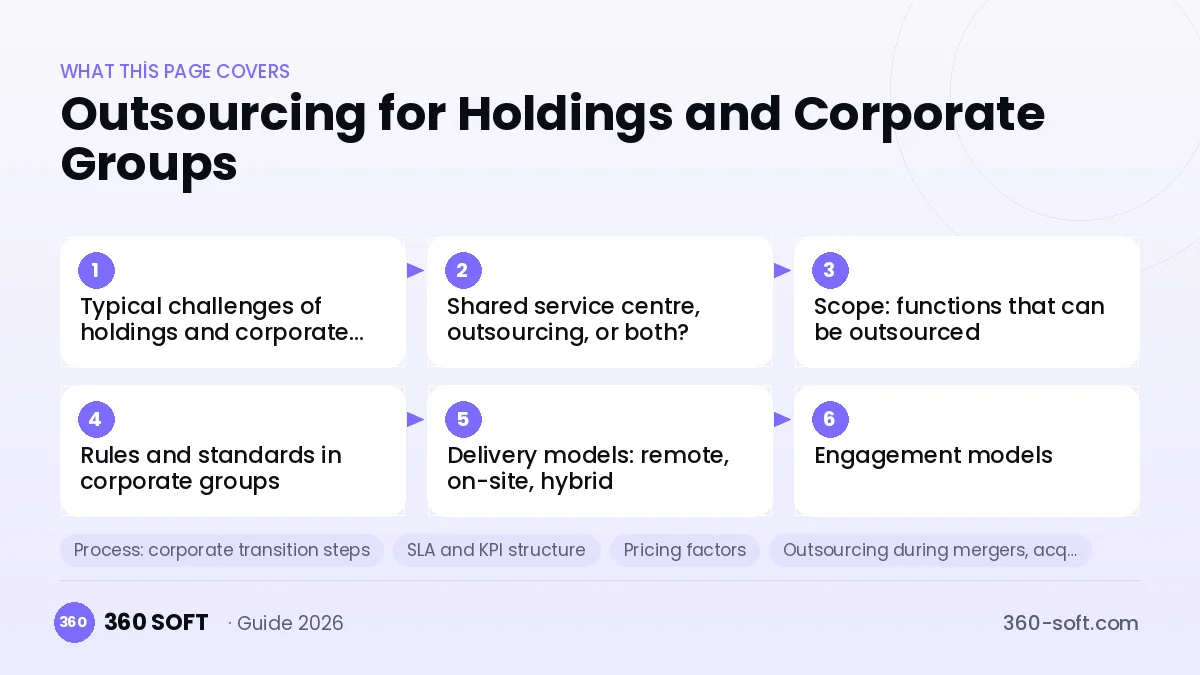
Outsourcing during mergers, acquisitions and carve-outs
Transactions create temporary peaks: data migrations, ERP integration, transitional service agreements (TSAs) and duplicate systems that must be run until cut-over. An external team can run legacy systems while internal staff focus on the target model, provide a PMO for the integration programme, and later be scaled down when the TSA ends. In a carve-out, the partner can help the separated company stand up its own IT and back-office operations quickly.
In-house team, freelancers and an outsourcing partner
| Criterion | In-house team / SSC | Individual freelancer | Outsourcing partner |
|---|---|---|---|
| Control | Highest | Low | Contractual, with reporting |
| Speed to scale | Slow | Fast for one role | Teams from 1 to 200+ people |
| Continuity | Depends on retention | Weak | Replacement process for staff |
| Specialist breadth | Limited to hires | Single skill | Many roles from one partner |
| Fixed cost | High | Low | Variable |
| Audit support | Internal | Hard | Logs, reports, audit rights |
Risks and safeguards
| Risk | Safeguard |
|---|---|
| Disguised employment of outsourced staff | Clear service scope, vendor management of people, legal review |
| Loss of know-how | Documentation, runbooks, shared knowledge base |
| Unclear cost allocation | Allocation keys and reporting per subsidiary |
| Data protection breaches | DPAs, least-privilege access, logging |
| Vendor lock-in | Exit plan, handover period, ownership of documentation |
| Resistance in subsidiaries | Pilot, communication plan, local service owners |
Security, GDPR/KVKK, NDA and intellectual property
Team members use named accounts in your systems, follow your security policies and lose access on their last working day. Work products, code and documentation belong to the group. Security monitoring and access reviews can be reported to your internal audit.
Contract note for EU, UK, US and MENA buyers: 360 Soft works under a B2B service agreement with your company. The standard package includes an NDA signed before any data is shared, assignment of intellectual property in deliverables and source code to the client on payment, and a data processing agreement (DPA) under the GDPR with the EU Standard Contractual Clauses for transfers to Türkiye (the UK IDTA or Addendum for UK data). As a Turkish company we also comply with KVKK, the Turkish Personal Data Protection Law. Team members are employed by 360 Soft under Turkish labour law; you direct the work through agreed channels, not as their employer. This is general information, not legal advice; have your own counsel review the contract.
Vendor selection checklist
- Can the vendor serve several subsidiaries under one framework with separate call-offs?
- Does it have the specialist roles you need (SAP, PMO, SOC, finance operations) in one place?
- Will it accept your audit rights, security policy and reporting format?
- Is there a documented knowledge transfer, replacement and exit process?
- Can it work remote, on-site and hybrid, including 7/24 shifts where needed?
- Will it sign the NDA, DPA with SCCs and IP assignment before starting?
Illustrative scenario
Illustrative scenario, not a client case: a group with companies in manufacturing, retail and logistics runs SAP in each company with different support vendors. It keeps its internal SSC for finance decisions and architecture, and engages an external team for SAP AMS, a group PMO and 24/7 security monitoring. Two subsidiaries go first as a pilot; after the review, the remaining companies join in waves. Each company receives its own monthly report and cost allocation, while group IT sees one consolidated dashboard.
Frequently asked questions
Can one contract cover all subsidiaries?
Yes. A group framework agreement with call-offs or service schedules per company is a common structure; each company can receive its own invoice and reporting.
We have a shared service centre. Do we still need outsourcing?
Often yes, as a complement: the SSC keeps decisions and core processes, while a partner covers specialist skills, peaks and 24/7 coverage.
How do you manage the risk of disguised employment?
We deliver a defined service, manage our own staff and document the scope. For Turkish subsidiaries the subcontracting rules of the Labour Law should be reviewed by your counsel.
Can you serve a bank or brokerage subsidiary?
Yes, within the outsourcing rules of the relevant supervisor; the scope and controls are designed with your compliance team.
How long does the transition take?
It depends on scope; a typical team starts in 1–2 weeks, and knowledge transfer and a pilot usually follow over several weeks.
How do we allocate costs to subsidiaries?
We report effort or units per company so that you can apply your allocation keys and transfer pricing documentation.
Which SAP modules can you support?
We staff SAP functional and technical roles according to your landscape; module coverage is confirmed in the proposal.
Can our auditors audit the vendor?
Yes, audit rights and evidence requirements are written into the contract.
What happens if team members change?
A replacement process with overlap and documentation keeps the service running.
Is on-site work possible?
Yes, on-site and hybrid models are available.
What if we want to end the contract?
The contract includes an exit plan and a handover period so the service can move back in-house or to another provider.
Can the staff work as if they were on our payroll?
No. They remain 360 Soft employees delivering a service; you set requirements and priorities through agreed channels.
Talk to us
Planning to consolidate support, projects or back-office work across your group? Share your structure and we will propose a governance model and team. Call or WhatsApp us on +90 850 335 10 87, email info@360-soft.com, message us directly on WhatsApp, or use the form on our contact page. 360 Soft Marketing Yazılım ve Danışmanlık Ltd. Şti., Nidakule Ataşehir Batı, Barbaros Mah. Begonya Sk. No:1 D:2, 34746 Ataşehir/İstanbul.
Related pages
- Outsourcing services (overview)
- SAP outsourcing
- PMO project management office
- ERP support outsourcing
- Finance back office
- HR and payroll operations
- SOC security monitoring
- Crypto exchange outsourcing
- IT staff leasing
- Hire developers
- Türkçe
Related services
- Outsourcing for SMEsSME outsourcing: IT support, website management, digital marketing, back office, ERP support and automation…
- Outsourcing for StartupsStartup outsourcing: MVP development, fractional CTO, design, QA, DevOps and support teams with full IP…
- Payment Operations OutsourcingPayment operations outsourcing: daily reconciliation, chargebacks, refunds, merchant operations and payment…
- Pharma and Medical OutsourcingPharma and medical outsourcing: regulatory documentation, İTS/ÜTS traceability, PV intake, QA records and…
- PMO (Project Management Office) OutsourcingPMO outsourcing: set-up and operation of your project management office, tailored PMI, PRINCE2 and agile…
- Public Sector and Municipal OutsourcingPublic sector and municipal outsourcing from Istanbul: citizen contact centre, IT operations, software and…