In most software companies documentation is the last and most rushed task of a release: the API reference lags behind the code, the user guide still shows screenshots from two versions ago, and help-centre articles say different things in English and in other languages. When the product goes international the problem multiplies, because UI strings, emails, contracts and support content must be updated in several languages, with consistent terminology, fast enough to keep up with the release calendar. With technical documentation and translation outsourcing you hand all or part of this workflow to 360 Soft: technical writing, documentation tooling, terminology management, translation and localization, quality control and release synchronisation.
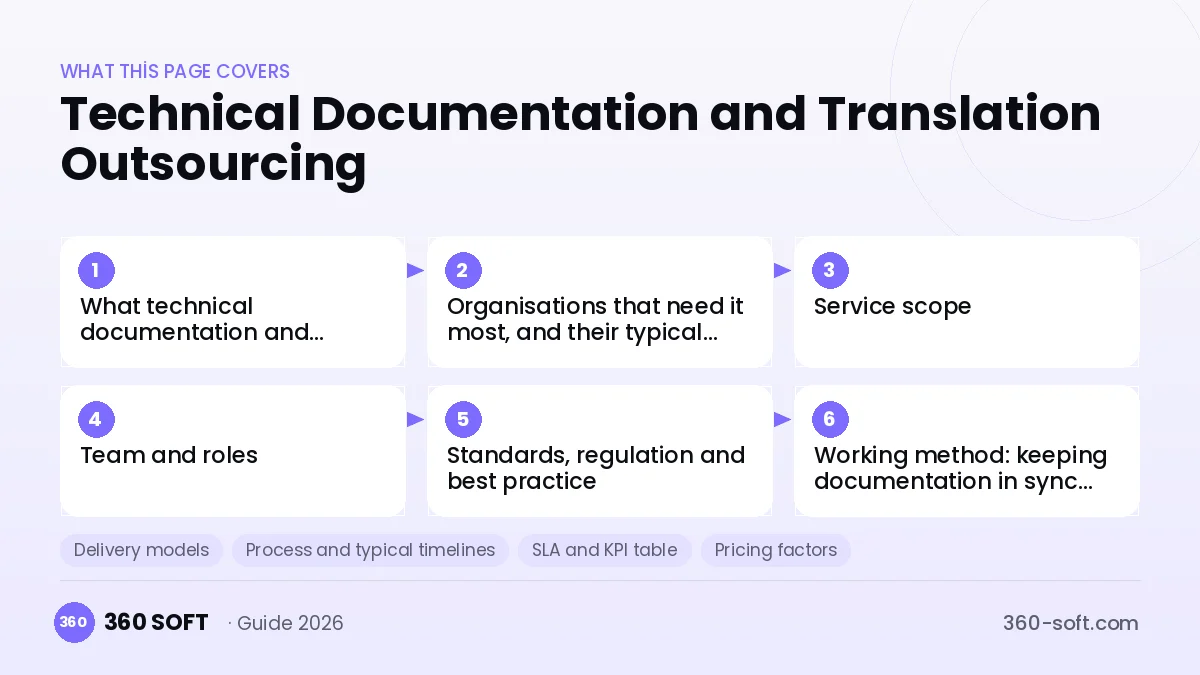
This page explains who the service suits, which document types we cover, the roles involved, the standards and tools we use, delivery models, service levels, pricing factors and what to check when you choose a provider.
What technical documentation and translation outsourcing is, and who needs it
Technical documentation outsourcing means a dedicated team writes, maintains and localizes the content that explains how your product works: user guides, administrator manuals, API references, release notes, help-centre articles, training material and in-product text. Translation and localization is part of the same flow, not a separate afterthought, so that every language version stays aligned with the source and with the current release.
Organisations that need it most, and their typical problems
| Organisation type | Typical problem | What outsourcing changes |
|---|---|---|
| SaaS and software product companies | Docs lag behind releases; developers write docs in spare time | Doc tasks linked to every user-facing ticket and shipped with the release |
| API-first and platform companies | Incomplete reference, no getting-started guides, outdated code samples | Reference generated from OpenAPI, curated guides and tested samples |
| Industrial and medical device makers | Manuals in many languages, strict terminology, regulatory review | Structured content, termbase and independent review before publication |
| Companies expanding abroad | UI, emails and help centre only partly translated | Localization pipeline with translation memory and in-context review |
| Enterprises with internal systems | Undocumented processes, knowledge held by a few people | Runbooks, SOPs and knowledge-base articles maintained on a schedule |
Service scope
- Technical writing: user guides, admin and installation manuals, quick-start guides, FAQs and troubleshooting articles.
- API and developer documentation: OpenAPI-based reference, getting-started tutorials, code samples, SDK docs and changelogs.
- Help centre and knowledge base: article architecture, templates, search-friendly titles and periodic review of outdated content.
- Release notes and in-product text: UI microcopy, error messages, onboarding text and email templates.
- Translation and localization: documentation, software strings (JSON, XLIFF, PO, RESX and similar), marketing support content and contracts for internal use.
- Terminology management: glossary, termbase, style guide and do-not-translate lists per language.
- Independent review and QA: second-linguist revision, technical accuracy checks, link and screenshot checks, in-context review in staging.
- Docs tooling: setting up docs-as-code pipelines or structured authoring and connecting them to your translation management system.
Team and roles
| Role | Responsibility |
|---|---|
| Documentation lead | Owns the content plan, priorities, style guide and alignment with product management |
| Technical writer | Writes and updates guides, articles and release notes from tickets, demos and SME interviews |
| API / developer documentation writer | Maintains reference, tutorials and code samples together with engineers |
| Translator | Translates into the target language using translation memory and termbase |
| Reviser (independent reviewer) | Checks each translation against the source for accuracy, terminology and style |
| Localization engineer | Handles file formats, string extraction, placeholders, builds and TMS integration |
| Terminologist / QA specialist | Maintains the termbase and runs automated and manual quality checks |
Team size follows your volume: a single writer for a small product, or a combined writing and localization team for several products and languages. We provide teams from 1 to 200+ people, remote, on-site or hybrid.
Standards, regulation and best practice
We structure work around widely used references: ISO 17100 logic for translation followed by independent revision, ISO/IEC/IEEE 26514 principles for designing user documentation, the Microsoft and Google developer documentation style guides as starting points for English, and DITA or Markdown-based docs-as-code where structured reuse is needed. For regulated products such as machinery or medical devices, manuals must reflect the applicable product rules; in Türkiye and the EU this includes requirements on instructions for use in the official languages of the market. Local rules in the buyer’s country always apply, and your regulatory or legal team approves regulated content before release.
Working method: keeping documentation in sync with releases
- Every user-facing development ticket gets a linked documentation task, so nothing ships undocumented.
- Writers join sprint reviews or demos and work from staging environments, not from finished screenshots.
- Documentation is versioned with the product (docs-as-code in Git or a structured CMS), with review through pull requests.
- Source text is frozen at an agreed point and pushed to translation memory and termbase automatically.
- Translations are revised by a second linguist and checked in context before the release goes live.
- After release, analytics, search terms and support tickets show which articles need improvement.
Delivery models
| Model | Best for | How it works |
|---|---|---|
| Dedicated documentation team | Continuous product development | Named writers and linguists work in your tools and sprint rhythm |
| Managed service with SLA | Predictable volume across several products | We own planning, delivery and QA against agreed service levels |
| Project-based | Launches, migrations, one-off manual sets | Fixed scope, timeline and acceptance criteria |
| Capacity extension | Peaks before major releases or new markets | Additional writers or translators join your existing team |
Process and typical timelines
| Phase | Activities | Typical duration |
|---|---|---|
| Discovery | Content inventory, audience, tools, languages, volume | 1 week |
| Set-up | Style guide, glossary, templates, access, TMS and repo connection | 1–2 weeks |
| Pilot | A defined set of articles or one language end-to-end | 2–4 weeks |
| Steady operation | Sprint-aligned writing, translation, review and reporting | Ongoing |
| Continuous improvement | Content audits, analytics review, retirement of outdated pages | Quarterly |
A team typically starts within 1–2 weeks after the scope is agreed.
SLA and KPI table
| KPI | What it measures | How it is reported |
|---|---|---|
| Release coverage | Share of user-facing changes documented at release | Per release |
| Translation turnaround | Time from source freeze to approved translation | Per batch, against agreed target |
| Revision error rate | Errors found by the reviser per volume | Monthly, by category |
| Terminology consistency | Termbase compliance in automated QA | Per batch |
| Content freshness | Articles reviewed within the agreed review cycle | Monthly |
| Support deflection signals | Search success, article feedback, related ticket volume | Monthly trend |
Target values are set together during the pilot, based on your volume and baseline; we do not quote generic success figures.
Pricing factors
| Factor | Effect on cost |
|---|---|
| Volume and content type | API docs and regulated manuals need more SME time than help articles |
| Number of languages and language pairs | Each pair adds translation and revision effort |
| Reuse and translation memory leverage | Higher reuse lowers the effort per release |
| Tooling | Working in an existing pipeline is faster than building a new one |
| Turnaround requirements | Same-day or weekend delivery needs extra capacity |
| Delivery model | Dedicated team, managed service or project scope |
We prepare a proposal after a short discovery; we do not publish list prices.
In-house team, freelancers or outsourcing
| Criterion | In-house team | Freelancers | Outsourcing to 360 Soft |
|---|---|---|---|
| Ramp-up time | Months of hiring | Fast, but per person | Typically 1–2 weeks |
| Continuity | Depends on retention | Low; availability varies | Replacement process for staff |
| Terminology and style control | Good if a lead exists | Fragmented | Central termbase and style guide |
| Independent revision | Often skipped | Rarely included | Built into the process |
| Scalability | Slow | Limited | Scales with release peaks and new languages |
| Management effort | High | High | One accountable lead and reporting |
Risks and mitigations
- Writers lack product knowledge: structured onboarding, access to staging and regular SME sessions.
- Inconsistent terminology: termbase approved by your product owners and enforced by automated QA.
- Machine translation errors: MT is used only where you allow it, always followed by full human post-editing and revision.
- Release delays: agreed source-freeze points and a fast track for critical fixes.
- Knowledge loss: all memories, glossaries and source files remain in your repositories.
Security, GDPR, KVKK, confidentiality and intellectual property
Unreleased product information is confidential. Team members sign NDAs, work with least-privilege access to repositories and staging, and do not upload your content to public machine translation or AI services without written approval. Personal data in screenshots or sample data is masked. Translation memories, termbases and all deliverables belong to you and are handed over at the end of the contract.
Legal note on the contract model
For international clients we work under a B2B service agreement with a clear statement of work. The agreement includes IP assignment of all deliverables, an NDA, and, where personal data is processed, a GDPR data processing agreement with Standard Contractual Clauses (or the UK IDTA for UK clients); KVKK requirements apply on the Turkish side. Team members are employed by 360 Soft under Turkish labour law, so you do not take on employer obligations. This is general information, not legal advice; have your counsel review the final contract.
Provider selection checklist
- Can they show a documented process for linking docs to releases?
- Is independent revision by a second linguist part of the standard flow?
- Do they work in your tools (Git, CMS, TMS, Jira) rather than email attachments?
- Who owns translation memories and termbases? (It should be you.)
- How do they control machine translation and AI use?
- Which KPIs will be reported and how often?
- What happens when a writer or translator leaves?
- Is the contract clear on IP, NDA and data protection?
Frequently asked questions
What does technical documentation outsourcing cover?
User guides, administrator manuals, API and developer documentation, help-centre articles, release notes, in-product text, and their translation and localization.
Which languages do you translate into?
Turkish and English are the core pairs. Other languages are covered with qualified translators and revisers per language, agreed during the proposal.
Do you use machine translation?
Only if you approve it. Machine output is always fully post-edited and then revised by a second linguist; confidential content is never sent to public tools.
Do you provide sworn or notarised translation?
No. 360 Soft does not provide sworn or notarised translation. For documents submitted to authorities we recommend an authorised translation office.
Are you ISO 17100 certified?
We do not claim ISO 17100 certification. Our translation process follows the standard’s logic of translation plus independent revision; if you require a certificate, please tell us at the proposal stage.
How do you keep documentation in sync with software releases?
Documentation is versioned with the product, every user-facing ticket has a linked doc task, and a pre-release check confirms coverage.
Can you produce API documentation?
Yes. We generate reference from OpenAPI definitions and write getting-started guides, code samples, SDK documentation and changelogs.
Who owns the translation memory and termbase?
You do. All memories, termbases and source files are handed over at the end of the contract.
Do you localize software user interfaces?
Yes. We handle string files, placeholders and plural rules, and review the result in context in your staging environment.
How is pricing determined?
By volume, content type, number of languages, reuse level, tooling and turnaround requirements. We prepare a proposal after a short discovery.
How much time will you need from our product team?
Mainly during onboarding. After that, short regular SME sessions and access to tickets and staging are usually enough.
Which contract model is used?
A B2B service agreement with statement of work, IP assignment, NDA and, where needed, a GDPR DPA with SCCs or UK IDTA; KVKK applies on the Turkish side.
Next step
Tell us which products, document types and languages you need to cover, and we will propose a team and pilot scope. Call or WhatsApp +90 850 335 10 87, write to info@360-soft.com, message us on WhatsApp or use our contact page. 360 Soft Marketing Yazılım ve Danışmanlık Ltd. Şti., Nidakule Ataşehir Batı, Barbaros Mah. Begonya Sk. No:1 D:2, 34746 Ataşehir/İstanbul.
Related pages
- All outsourcing services
- Software maintenance and support (AMS)
- QA and test outsourcing
- Content, design and moderation
- Website management
- IT staff leasing
- Türkçe
Related services
- Telecom OutsourcingTelecom outsourcing from Istanbul: 24/7 NOC, OSS/BSS support, billing testing, software development and…
- Textile and Apparel OutsourcingTextile and apparel outsourcing: tech packs, order follow-up, buyer compliance files, marketplaces, content…
- Tourism and Hospitality Sector OutsourcingTourism and hotel outsourcing: multilingual reservation centre, channel management, reputation, night audit…
- UI/UX Design OutsourcingUI/UX design outsourcing: user research, wireframes, prototypes, UI design, design systems, usability and…
- Vulnerability Management OutsourcingVulnerability management outsourcing: continuous scanning, risk-based prioritisation with CVSS and EPSS…
- Warehouse and Logistics Operations OutsourcingWarehouse and logistics operations outsourcing: managed teams for receiving, picking, packing, returns and…