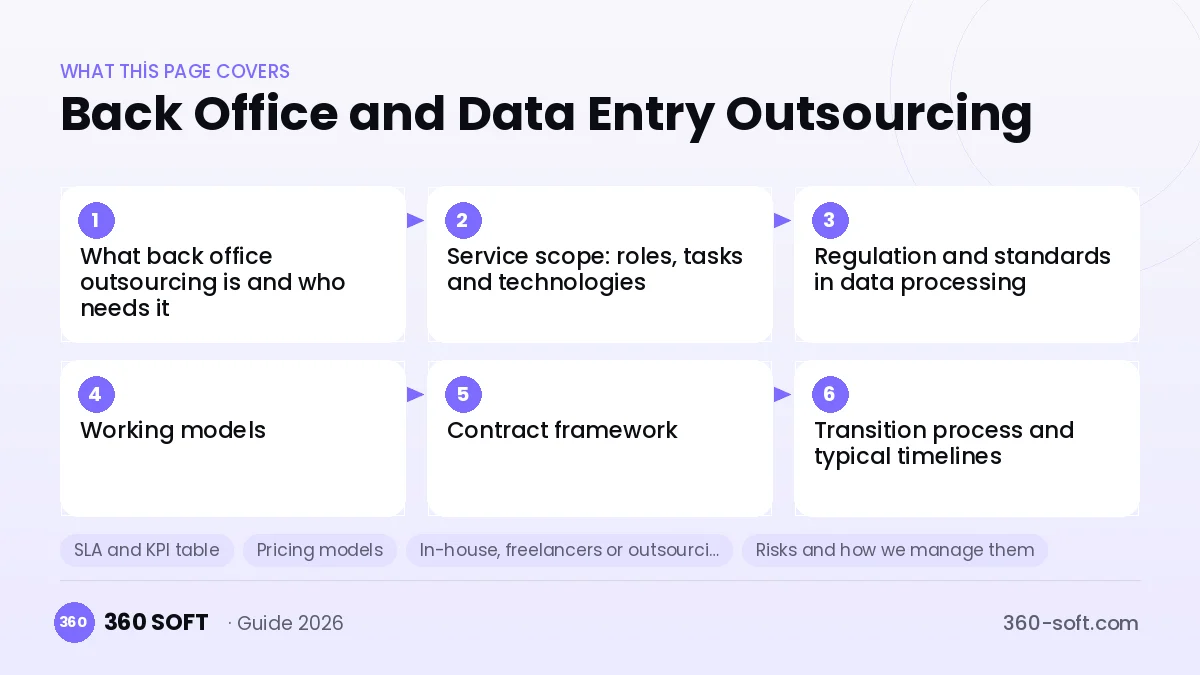
Back office and data entry outsourcing moves document processing, data entry, master data maintenance and reconciliation work to a dedicated team with defined accuracy and turnaround targets. 360 Soft combines trained operators with OCR and AI-assisted validation, so routine documents flow quickly and exceptions reach a person who knows your rules. On this page you will find what can be outsourced, how people and automation work together, the regulatory points that matter for data processing, working and contract models, the transition process, an SLA and KPI table, pricing factors, a comparison with in-house and freelance options, risks and a provider checklist.
What back office outsourcing is and who needs it
Back office work keeps a company running but rarely differentiates it: entering orders and invoices, updating customer and supplier records, checking documents, matching payments and keeping systems consistent. When this work is done by expensive specialists or by whoever has time, backlogs and errors follow. Typical reasons to outsource:
- Backlogs at month-end, after campaigns or during system migrations.
- Specialists in finance, sales or operations spending hours on manual entry.
- Paper archives that need to be digitised and indexed.
- Inconsistent master data causing billing, delivery or reporting errors.
- A need for extended hours or a second site for continuity.
Service scope: roles, tasks and technologies
| Area | Typical tasks |
|---|---|
| Data entry | Orders, invoices, delivery notes, forms, applications, survey results |
| Document processing | Classification, indexing, OCR verification, scanning and archive digitisation |
| Master data | Customer, supplier, product and price records; duplicate clean-up and enrichment |
| Reconciliation | Bank and payment matching, account statements, open-item follow-up |
| E-commerce back office | Product listings, catalogue updates, order and return processing |
| System updates | ERP and CRM records, ticket updates, migration data checks |
| Roles | Operators, senior operators, quality controllers, team leader, process analyst |
We work in your ERP, CRM, document management or e-commerce platforms through controlled user accounts, or in a staging environment that you then import.
People and automation together
OCR and AI extraction read structured fields from invoices, forms and delivery notes. Operators verify low-confidence fields, handle handwriting and unusual layouts, and apply your business rules. Where volumes justify it, simple robotic process automation moves validated data between systems. The goal is fewer keystrokes per document, not removing the human check.
Exception management
Every process gets a written exception list: missing data, conflicting amounts, unreadable documents, records that fail validation. Each exception type has an owner, a deadline and an escalation path, and exceptions are reported separately so root causes can be fixed at the source.
Regulation and standards in data processing
The team operates in Türkiye, so KVKK (Law No. 6698) applies to all personal data it processes, including the rules on special categories of personal data. Electronic invoices and archives follow Turkish tax procedure rules (e-Fatura, e-Arşiv) where Turkish documents are involved. Banks and other regulated institutions in Türkiye have their own rules on outsourcing support services, which may require additional controls and audits. For EU and UK clients, GDPR obligations are covered in the data processing agreement. Local rules in your country also apply, and we adapt controls to them.
Working models
- Dedicated team (FTE): operators reserved for your processes, suited to steady volumes.
- Transaction-based: priced per document, record or case, suited to measurable, repeatable work.
- Project-based: archive digitisation, data clean-up or migration support with a defined end.
- Remote, on-site or hybrid: most back office work runs remotely from Istanbul; on-site support is possible for paper archives in Türkiye.
Contract framework
The service runs under a B2B service agreement with scope, SLAs and acceptance rules. It includes an NDA, assignment of any work results and IP to you, and a data processing agreement: KVKK for processing in Türkiye, and a GDPR DPA with Standard Contractual Clauses (UK IDTA for UK clients) where EU or UK personal data is involved. Operators are employed by 360 Soft under Turkish labour law.
Transition process and typical timelines
- Process discovery: document types, volumes, systems, rules and current error rates.
- Procedure writing: step-by-step work instructions, exception list, quality checks.
- Access and security set-up: accounts, permissions, devices, data transfer method.
- Training and pilot: a sample batch processed in parallel and checked against your results.
- Go-live: full volume with daily quality reporting during the first weeks.
- Optimisation: automation candidates and root-cause fixes reviewed monthly.
Small teams typically start in 1–2 weeks; complex multi-system processes take longer because of access and procedure work.
SLA and KPI table
| KPI | Definition |
|---|---|
| Accuracy rate | Share of records or fields without errors in quality sampling |
| Turnaround time | Time from document receipt to completed entry |
| Backlog | Items waiting beyond the agreed time |
| Throughput | Documents or records processed per period |
| Exception rate | Share of items that could not be completed under the standard rules |
| Rework rate | Items returned for correction |
Targets are set after the pilot, based on your real documents.
Pricing models
We do not publish prices. Cost depends on the model (FTE, per transaction or per project), document complexity, language, required turnaround, service hours, the share of work that can be automated and which tools and licences are needed.
In-house, freelancers or outsourcing
| Criterion | In-house | Freelancers | Outsourcing |
|---|---|---|---|
| Peak capacity | Overtime or temporary hires | Variable availability | Planned capacity increase |
| Quality control | Often informal | Self-checked | Sampling, KPIs and team leader |
| Data security | Your controls | Hard to enforce | Contractual and technical controls |
| Continuity | Depends on individuals | Low | Replacement process included |
Illustrative scenario: delivery documents at a logistics company
Illustrative scenario: a logistics company receives signed delivery notes as photos and scans from drivers. Invoicing waits until each delivery is confirmed in the system, so cash comes in late. A back office team verifies OCR-extracted fields, matches each document to the shipment, flags missing signatures as exceptions and confirms deliveries the same day. Finance then invoices from confirmed data. This shows how such a process can be designed; it is not a reported client result.
Risks and how we manage them
- Errors: double checks on critical fields, sampling and rework tracking.
- Knowledge concentrated in one person: written procedures and cross-training.
- Data leakage: least-privilege access, controlled devices, no local storage, audit logs.
- Volume spikes: agreed capacity buffers and advance notice rules.
Security, KVKK/GDPR, NDA and IP
Access is role-based and logged. Documents are processed in your systems or in agreed secure storage and deleted according to the retention rules you set. Every operator signs confidentiality commitments, and the NDA and IP assignment are part of the contract.
Provider selection checklist
- Do they measure accuracy with documented sampling?
- Is there a written exception process with owners?
- Where are documents stored, and who can access them?
- Can they increase capacity at month-end?
- How is knowledge kept when operators change?
Frequently asked questions
Which systems can you enter data into?
Your ERP, CRM, document management, accounting and e-commerce platforms through controlled user accounts, or a staging file that you import.
Does our data leave our systems?
Only if agreed. Where possible the team works directly in your systems with role-based access, and documents are deleted according to your retention rules.
How do you ensure accuracy?
With written procedures, validation rules, double checks on critical fields, quality sampling and rework tracking against an agreed accuracy target.
Can you digitise our paper archive?
Yes. Archive scanning, indexing and OCR verification can be run as a project, remotely or on-site in Türkiye.
Do you use OCR or AI?
Yes, where it helps. OCR and AI extract fields, and operators verify low-confidence fields and handle exceptions.
Can capacity increase at month-end?
Yes. Peak periods are planned in advance with capacity buffers agreed in the contract.
Can you process special categories of personal data?
Yes, with additional controls defined together with you, in line with KVKK, GDPR and the rules that apply in your country.
How long does the transition take?
Small teams typically start in 1 to 2 weeks. Complex multi-system processes take longer because of access and procedure work.
How is the work priced?
Per FTE, per transaction or per project, depending on volume stability, complexity, turnaround and automation potential. We quote after discovery.
What contract applies?
A B2B service agreement with SLAs, an NDA, IP assignment and a data processing agreement covering KVKK and, where relevant, GDPR with SCCs or the UK IDTA.
Talk to us about your back office processes
Tell us what you want to hand over, which channels or systems are involved, the volumes and the service hours you need. We will come back with a proposed team structure, a transition plan and the KPIs we suggest measuring. Call or WhatsApp us on +90 850 335 10 87, email info@360-soft.com or use the contact page.
360 Soft Marketing Yazılım ve Danışmanlık Ltd. Şti., Nidakule Ataşehir Batı, Barbaros Mah. Begonya Sk. No:1 D:2, 34746 Ataşehir/İstanbul.
Related outsourcing services
- Call centre and customer service outsourcing
- Warehouse and logistics operations outsourcing
- Sales and telesales outsourcing
- Digital marketing team outsourcing
- HR and payroll operations outsourcing
- Field and technical service outsourcing
- All outsourcing services: the full catalogue
- Business process outsourcing in Türkiye
- Staff augmentation in Türkiye
- Why Türkiye for outsourcing
Türkçe: Back Office ve Veri Girişi Outsourcing
Related services
- Banking OutsourcingBanking outsourcing from Istanbul: back office, KYC support, contact center, development and testing teams…
- Call Centre and Customer Service OutsourcingCall centre and customer service outsourcing from Istanbul: phone, WhatsApp, chat and email agents, AI first…
- Carbon Data Management OutsourcingCarbon data management outsourcing: Scope 1-3 data, CBAM embedded emissions packages, TSRS and CSRD-aligned…
- Chatbot and AI Assistant Management OutsourcingChatbot management outsourcing: conversation review, intent and knowledge base updates, LLM guardrails…
- Construction and Real Estate Sector OutsourcingConstruction and real estate outsourcing: telesales, sales back office, post-handover service, project…
- Content, Design and Moderation OutsourcingDedicated teams for content production, graphic design and content moderation: scope, SLAs, pricing models…