Defense industry outsourcing means bringing in external engineering, software, testing and documentation capacity for defense, aerospace and security projects, within the limits set by security rules, contracts and export controls. Prime contractors and their subcontractors work with long programmes, strict quality requirements and peaks driven by milestones, qualification tests and deliveries. Not every task can be outsourced, and those that can must be organised carefully. 360 Soft provides engineering and support teams to the defense ecosystem from Istanbul. This page explains which work is suitable, the security and quality frameworks that shape it, engagement models, service levels and how to choose a supplier. Because the field is sensitive, information here is general; each project’s requirements follow its contract, classification level and the instructions of the competent authorities.
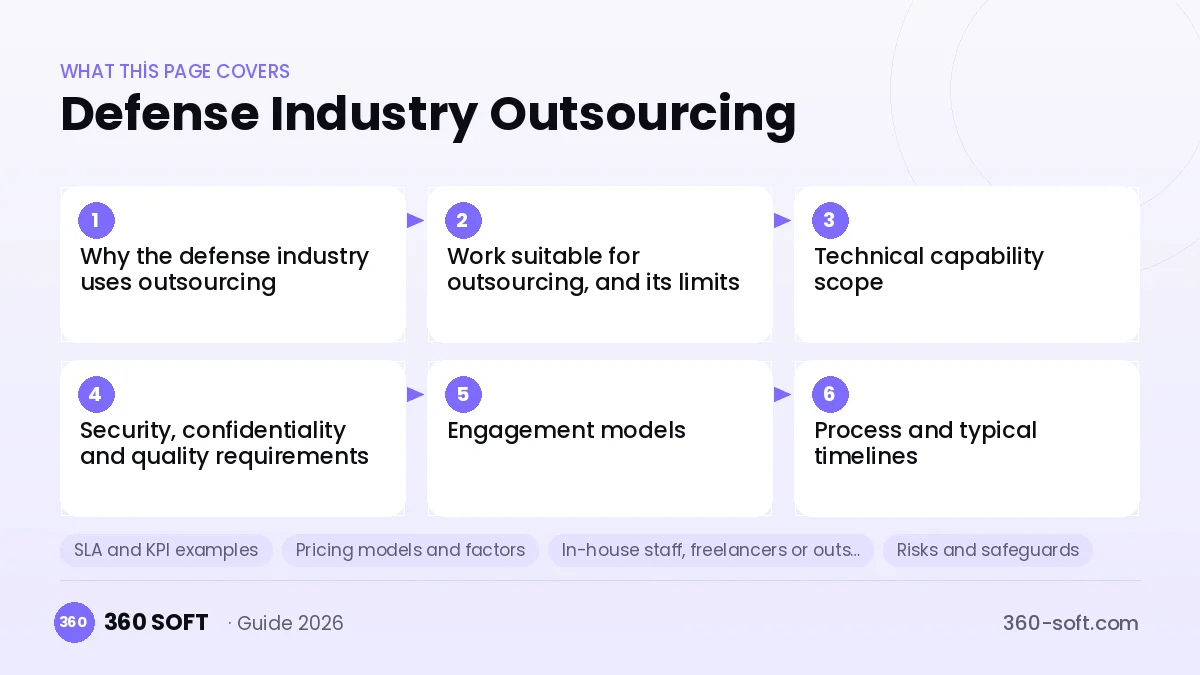
Why the defense industry uses outsourcing
- Programme milestones create temporary peaks in software, test and documentation work
- Subcontractors and SMEs need specialist skills for single projects
- Unclassified engineering and support work can free cleared staff for sensitive tasks
- Documentation, configuration management and verification effort grows with every qualification step
- Hiring experienced engineers is slow in a competitive market
Work suitable for outsourcing, and its limits
| Usually suitable | Requires special conditions or stays in-house |
|---|---|
| Unclassified software development and tooling | Work on classified information or material |
| Test automation and test execution on unclassified systems | Access to closed networks and secure areas without authorisation |
| Technical documentation, manuals and translation of unclassified content | Export-controlled technology without the required licences |
| Configuration and requirements management support | Tasks reserved for nationally cleared personnel |
| IT, DevOps and application support for corporate systems | Final design authority and acceptance decisions |
360 Soft does not take on work that requires facility or personnel security clearances without the necessary authorisations being in place. The suitable model is decided together with your project security officer.
Technical capability scope
| Area | Examples |
|---|---|
| Software | C, C++, Java,.NET, Python, embedded and desktop applications, simulation and test tools |
| Verification and validation | Test planning, test procedures, automation, requirements traceability |
| Systems and documentation | Requirements, interface documents, user and maintenance manuals, technical publications |
| Quality and configuration | Configuration management support, change records, document control within your procedures |
| IT and DevOps | Development environments, CI/CD on unclassified networks, application support |
Security, confidentiality and quality requirements
- Facility and personnel security clearances: access to classified information depends on authorisations issued by the competent authorities. These take time and cannot be obtained quickly.
- NATO and international classified information: handled through separate authorisation processes via national security authorities.
- Need-to-know: even authorised people access only the information they need; outsourced team access is designed on this principle.
- Quality requirements: NATO AQAP publications (for example AQAP 2110, and AQAP 2210 for software) and AS9100 in aerospace are often referenced in contracts. Our team works within your quality plan and configuration management procedures.
- Export controls: transfers of defense technology abroad require permits, and foreign-origin technology may bring its own export rules (such as ITAR or EAR in the US, or EU dual-use rules). Foreign nationals or cross-border access must be assessed per project.
- Closed networks and physical security: much work runs on isolated networks in secure areas, where remote work is not possible.
Engagement models
| Model | How it works | Best for |
|---|---|---|
| Work package | A defined deliverable, such as a test suite or a documentation set, delivered under your quality plan | Unclassified, well-defined tasks |
| Dedicated team | Engineers working only on your programme, remotely, on-site or hybrid as security allows | Long programmes with steady workload |
| On-site support | Our staff work at your premises, on your devices and networks, subject to your security rules | Work that cannot leave your facility |
| Peak capacity | Temporary extra capacity around milestones and qualification tests | Milestone-driven peaks |
Process and typical timelines
- Scoping with your security officer: classification, export control and access constraints are clarified first.
- Proposal: work packages, team profile, location model and quality interfaces.
- Contract and NDA: including security, IP and export control clauses.
- Staffing: typical start in 1–2 weeks for unclassified roles; roles needing clearances follow the authorities’ timelines.
- Onboarding: training on your procedures, tools and configuration management.
- Delivery and reviews: milestone reviews, quality records, monthly reporting.
SLA and KPI examples
| Metric | What it shows |
|---|---|
| On-time deliverables | Share of work packages delivered on schedule |
| First-pass acceptance | Deliverables accepted without rework |
| Requirements traceability | Share of requirements linked to tests and results |
| Defect leakage | Defects found after delivery to the next stage |
| Documentation review cycles | Number of review rounds per document |
Pricing models and factors
| Factor | Effect on cost |
|---|---|
| Pricing model | Per FTE, per work package or fixed project price |
| Skills and seniority | Software, test, systems, documentation, quality |
| Location model | Remote, on-site or hybrid; secure-area requirements |
| Security and compliance effort | Clearance needs, export control assessments, audits |
| Duration | Short peak support versus multi-year programmes |
In-house staff, freelancers or outsourcing
| Criterion | In-house | Freelancers | Outsourcing |
|---|---|---|---|
| Security control | Highest | Weak | Contracted controls |
| Speed to scale | Slow | Fast but risky | Typically 1–2 weeks for unclassified roles |
| Continuity | Depends on retention | Low | Replacement process |
| Quality integration | Native | Variable | Within your quality plan |
Risks and safeguards
- Information leakage: need-to-know access, NDAs, device controls, no personal devices
- Export control breaches: per-project assessment of nationality and access location
- Quality non-conformance: work within your procedures, with review and audit trails
- Dependency: documentation and deliverables stored in your configuration management system
Data security, KVKK, NDA and IP
Work is performed on systems and accounts you approve. Unclassified data is handled under least-privilege access and logging.
Contract note: We work under a B2B service agreement with a defined statement of work, not as an employer of record or staffing agency. The agreement includes an NDA, assignment to you of intellectual property in all deliverables created for you, and, where personal data is processed, a GDPR data processing agreement (DPA) with Standard Contractual Clauses (or the UK IDTA for UK data). Because the team operates in Türkiye, the Turkish Personal Data Protection Law (KVKK) also applies to our side of the processing. Export control and security clauses are added according to your programme. Local rules in your own country continue to apply to your business, so we recommend your legal team reviews the final contract.
Legal note: staffing arrangements
We deliver work under a service agreement with defined deliverables and our own supervision; we do not operate as a temporary employment agency. Where our staff work on-site, responsibilities and instructions are set out in the contract to keep the arrangement compliant with labour law in Türkiye and the rules of your country.
Illustrative scenario: test and documentation capacity for a subcontractor SME
Illustrative scenario: an SME supplying a subsystem to a prime contractor faces a qualification milestone, and its engineers are fully booked with design work. Together with its security officer, it separates unclassified tasks: writing test procedures, automating regression tests on a development rig, and preparing user and maintenance manuals. A team of two test engineers and a technical writer works on-site under the SME’s quality plan and configuration management. Classified elements stay with the SME’s cleared staff. This example illustrates a possible arrangement; it is not a real client case.
Supplier selection checklist
- Does the supplier refuse work it is not authorised for?
- Can they work within your quality plan and AQAP or AS9100 requirements?
- How do they handle export control and nationality questions?
- Can staff work on-site, on your devices and networks?
- Are NDA, IP and security clauses detailed enough for your programme?
- Can they scale for milestones and provide a replacement process?
Selected projects
Related reference: T.C. Presidency of Defence Industries (SSB) OSTİM Cluster case study.
Frequently asked questions
Can defense work be outsourced?
Unclassified engineering, test, documentation and support work often can. Classified work requires the proper authorisations.
Does 360 Soft work with classified information?
We do not take on work that requires security clearances without the necessary authorisations in place.
Which quality standards do you work to?
We work within your quality plan, including contract requirements such as AQAP or AS9100.
How is export control handled?
We assess nationality and access location per project together with your export control function.
Can your team work on-site?
Yes. Many tasks must be done at your premises on closed networks, and we support that.
Which technical skills do you provide?
Software development, test and V and V, systems documentation, configuration management support and IT/DevOps.
How fast can you start?
Typically 1–2 weeks for unclassified roles; roles needing clearances follow the authorities’ timelines.
How is pricing structured?
Per FTE, per work package or fixed price, depending on skills, location, security effort and duration.
Who owns the deliverables?
You do. IP in all deliverables is assigned to you under the contract.
Under which contract do you work?
A B2B service agreement with NDA, IP assignment, security and export control clauses, and a GDPR DPA with SCCs where personal data is involved.
Contact us
Tell us about your programme, work packages and security constraints, and we will propose a suitable model together with your security officer. Call or WhatsApp us on +90 850 335 10 87, write to info@360-soft.com, message us directly on WhatsApp, or use the form on our contact page. 360 Soft Marketing Yazılım ve Danışmanlık Ltd. Şti., Nidakule Ataşehir Batı, Barbaros Mah. Begonya Sk. No:1 D:2, 34746 Ataşehir/İstanbul.
Türkçe: Türkçe sürüm
Related pages
- Outsourcing services (overview)
- Manufacturing outsourcing
- QA and test outsourcing
- Vulnerability management
- Public sector outsourcing
- Hire developers
Related services
- DevOps and Cloud Operations OutsourcingDevOps and cloud operations outsourcing: CI/CD, Kubernetes, Terraform, monitoring, FinOps and 24/7 on-call…
- Digital Marketing Team OutsourcingOutsource a dedicated digital marketing team: paid media, SEO, content, social, email and analytics in your…
- E-commerce Operations OutsourcingE-commerce operations outsourcing for web shops and marketplaces: catalog, orders, returns, customer…
- E-commerce OutsourcingE-commerce outsourcing: marketplace and catalog management, orders and returns, customer service, content and…
- E-Invoice Integration Operations OutsourcingE-invoice integration operations in Türkiye: e-Invoice, e-Archive, e-Waybill and e-Ledger monitoring…
- Education Sector OutsourcingEducation outsourcing: admissions and parent communication, LMS support, content production and IT teams…