Vulnerability management outsourcing gives you a team that continuously finds, prioritises and tracks the remediation of security weaknesses across your servers, endpoints, network devices, cloud accounts, containers and web applications. Rather than producing a 400-page scan report once a year, we run an ongoing programme: regular scans, risk-based prioritisation, tickets assigned to the right owners and verification that fixes actually worked. It works best together with SOC security monitoring.
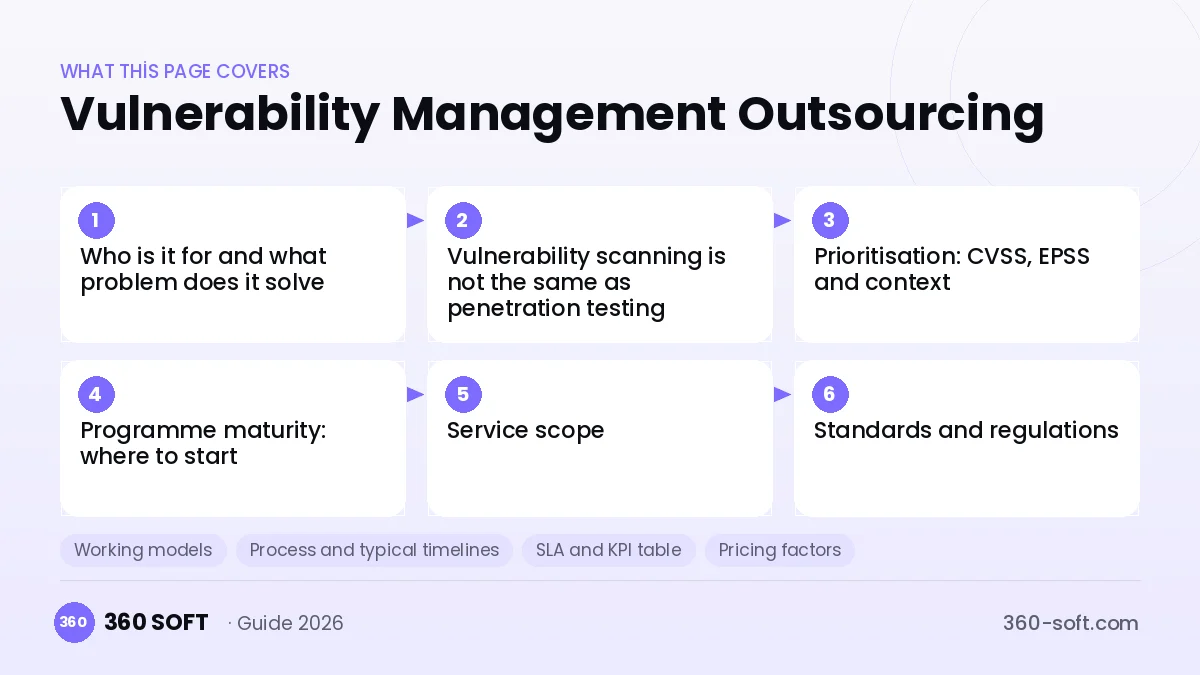
Who is it for and what problem does it solve
Most organisations already run a scanner. The problem is what happens afterwards: thousands of findings, no clear owner, the same critical vulnerabilities reappearing every quarter, and auditors asking for evidence of remediation that nobody can produce. Security teams spend their time exporting spreadsheets instead of reducing risk.
Outsourced vulnerability management suits companies preparing for ISO 27001, PCI DSS or customer security audits, organisations with large or fast-changing infrastructure, and IT teams that have the tools but not the people to run a disciplined programme.
Vulnerability scanning is not the same as penetration testing
| Vulnerability management | Penetration testing | |
|---|---|---|
| Goal | Continuously find and reduce known weaknesses | Show how an attacker could chain weaknesses to reach a target |
| Frequency | Continuous or weekly/monthly cycles | Periodic, often annual or before major releases |
| Method | Automated scanning plus analyst validation | Manual, creative testing by specialists |
| Output | Prioritised, tracked remediation backlog | Narrative report with exploited attack paths |
Both are needed. A good vulnerability management programme makes penetration tests more valuable, because testers no longer spend their time on issues a scanner would have found.
Prioritisation: CVSS, EPSS and context
A CVSS score alone is a poor guide; in a typical environment far too many findings are rated high or critical. We combine several signals to decide what really needs to be fixed first:
- CVSS for technical severity
- EPSS for the likelihood of exploitation in the near term
- CISA KEV and threat intelligence for vulnerabilities known to be exploited
- Asset context: internet exposure, business criticality, data sensitivity
- Compensating controls such as segmentation or WAF rules
The result is a short list that your teams can act on this week, rather than a long list nobody reads.
Programme maturity: where to start
| Stage | Characteristics | Next step |
|---|---|---|
| 1. Ad hoc | Occasional scans, no owners | Asset inventory and regular authenticated scans |
| 2. Repeatable | Regular scans, manual reporting | Risk-based prioritisation and ticket integration |
| 3. Managed | SLAs per severity, owners, tracking | Metrics, exceptions process, cloud and container coverage |
| 4. Optimised | Automated, integrated with CI/CD and patching | Continuous validation and attack surface management |
Service scope
- Asset discovery and inventory reconciliation, including external attack surface
- Authenticated infrastructure scanning (servers, endpoints, network devices)
- Web application and API scanning (DAST)
- Cloud configuration and container image scanning
- Validation of findings to remove false positives
- Risk-based prioritisation and remediation guidance
- Ticket creation and tracking in your ITSM or DevOps tool
- Re-scans to verify fixes, and an exception process for accepted risks
- Monthly reporting and audit evidence
Typical tools include Tenable Nessus and Tenable.io, Qualys, Rapid7 InsightVM, OpenVAS/Greenbone, Microsoft Defender Vulnerability Management, Burp Suite, OWASP ZAP, Trivy and cloud-native posture tools.
Standards and regulations
Vulnerability management is required or expected by ISO/IEC 27001 (technical vulnerability management control), PCI DSS (quarterly internal and external scans), NIST CSF and CIS Controls. In Turkey, where the team operates, KVKK technical measures, the Information and Communication Security Guide, and BDDK rules for financial institutions are relevant. Local rules in your country, such as NIS2 and DORA in the EU, also apply, and we align scan frequency, remediation timelines and evidence with them.
Working models
| Model | How it works | Best for |
|---|---|---|
| Fully managed programme | We operate scanning, prioritisation, tracking and reporting | Companies without a dedicated team |
| Co-managed | You own tools and decisions, we run cycles and analysis | Security teams short on capacity |
| Dedicated analyst | A named analyst works inside your tools and processes | Large or complex environments |
| Project-based | Programme set-up or a backlog clean-up project | Building the foundation first |
Process and typical timelines
- Week 1: scope, asset inventory, access and scanner configuration.
- Weeks 2–3: baseline scans, validation and first prioritised report.
- Week 4: remediation SLAs, owners and ticket workflow agreed.
- Ongoing: recurring scan cycles, re-tests, monthly reporting and quarterly programme reviews.
A team typically starts within 1–2 weeks of agreement.
SLA and KPI table
| KPI | What it measures |
|---|---|
| Scan coverage | Share of known assets scanned in the cycle |
| Authenticated scan rate | Share of scans with valid credentials |
| Mean time to remediate | Average days to fix per severity |
| SLA compliance | Share of findings fixed within agreed timelines |
| Recurrence rate | Fixed vulnerabilities that reappear |
| Exception backlog | Accepted risks and their expiry dates |
Remediation timelines per severity are agreed with you; we do not quote generic figures.
Pricing factors
| Factor | Effect on cost |
|---|---|
| Number and type of assets | Servers, endpoints, network devices, web apps, cloud accounts |
| Scan frequency | Monthly, weekly or continuous |
| Scope of validation | Automated only, or manual validation of high-risk findings |
| Tool licences | Your licences or tools we provide |
| Remediation support | Tracking only, or hands-on fix guidance and patching assistance |
| Reporting needs | Audit evidence, executive dashboards, languages |
In-house, freelancer or outsourcing
| Criterion | In-house | Freelancer | Outsourcing |
|---|---|---|---|
| Continuity | Depends on retention | Irregular | Ongoing programme with replacement process |
| Time to start | Hiring takes months | Fast but limited | Typically 1–2 weeks |
| Process and reporting | Must be built | Rarely included | Included |
Risks and mitigations
- Scans disrupting production: agreed scan windows, safe settings and gradual onboarding of fragile systems.
- Scanner credentials misuse: dedicated least-privilege accounts, vaulting and rotation.
- Findings without owners: asset-to-owner mapping and ticket integration.
- Permanent exceptions: time-limited risk acceptance with sign-off.
Security, data protection, NDA and intellectual property
Vulnerability data is sensitive: it is effectively a map of how to attack you. We store it only in agreed systems, restrict access to named team members and delete it according to the contract.
Contract framework: we work under a B2B service agreement with a clear statement of work. An NDA is signed before any access is granted, and all deliverables, reports, dashboards, scan policies and documentation created for you are assigned to you as intellectual property. Where we process personal data on your behalf, we sign a GDPR-compliant data processing agreement (DPA) with Standard Contractual Clauses (for UK clients, the IDTA or UK Addendum); on the Turkish side the team also complies with KVKK (Law No. 6698). Team members are employed by 360 Soft under Turkish labour law, so there is no employment relationship between them and your company.
Illustrative scenario
Illustrative scenario: a mid-sized e-commerce company runs monthly scans but has a backlog of thousands of open findings. The outsourced team validates the backlog, groups findings by fix (for example one patch closing hundreds of findings), prioritises internet-facing systems with known exploited vulnerabilities, and creates tickets per owner. This example is for illustration only.
Selection checklist
- Do they use authenticated scans?
- Is prioritisation based on exploitability and context, not CVSS alone?
- Are fixes verified with re-scans?
- Is there an exception process with expiry dates?
- Do they integrate with your ticketing tool?
- Can they provide audit evidence?
- Are NDA, DPA and IP assignment in the contract?
Frequently asked questions
Is vulnerability scanning the same as penetration testing?
No. Vulnerability management is a continuous programme to find and fix known weaknesses; penetration testing is a periodic manual exercise showing how weaknesses can be exploited. Both are needed.
Which scanners do you use?
We use your existing tools or common platforms such as Tenable, Qualys, Rapid7, Greenbone, Microsoft Defender Vulnerability Management, Burp Suite, OWASP ZAP and Trivy.
Will scanning affect production systems?
We agree scan windows and safe settings, and onboard fragile systems gradually to avoid disruption.
How do you prioritise findings?
We combine CVSS, EPSS, known exploited vulnerability lists, asset exposure, business criticality and compensating controls.
Do you fix the vulnerabilities?
Remediation is usually done by your system owners. We provide guidance and tracking, and hands-on patching support can be added to the scope.
Do you cover cloud and containers?
Yes. Cloud configuration and container image scanning can be part of the programme.
Can you help with PCI DSS scans?
We run internal scans and help with remediation evidence. External PCI scans must be performed by an Approved Scanning Vendor, which we can coordinate with.
How often should we scan?
At least monthly for most environments, weekly or continuously for internet-facing and critical systems, depending on your risk profile and regulations.
How quickly can you start?
Typically within 1–2 weeks of agreement.
Who owns the reports?
You do. All reports and documentation are assigned to you under the contract.
Talk to us
Tell us about your vulnerability management needs and we will come back with a scoped proposal, a team plan and a realistic start date (typically 1–2 weeks). Call +90 850 335 10 87, message us on WhatsApp, email info@360-soft.com or use the contact page. 360 Soft Marketing Yazılım ve Danışmanlık Ltd. Şti., Nidakule Ataşehir Batı, Barbaros Mah. Begonya Sk. No:1 D:2, 34746 Ataşehir/İstanbul.
Related pages
- All outsourcing services
- SOC security monitoring outsourcing
- Data protection compliance operations
- DevOps and cloud operations outsourcing
- Türkçe
Related services
- Warehouse and Logistics Operations OutsourcingWarehouse and logistics operations outsourcing: managed teams for receiving, picking, packing, returns and…
- WCAG Accessibility AuditWCAG 2.2 accessibility audit: manual and screen reader testing, EN 301 549 and European Accessibility Act…
- Website Management OutsourcingWebsite management outsourcing: updates, security, backups, Core Web Vitals, SEO hygiene and content…
- White-Label Software DevelopmentWhite-label software development for agencies and IT firms: web, mobile and custom software built under your…
- ASO and App Store Management OutsourcingASO and app store management outsourcing: keyword research, metadata, screenshots, review replies and A/B…
- Automotive OutsourcingAutomotive outsourcing for OEM suppliers and aftermarket: EDI desks, warehouse, parts data, dealer support…