Food and beverage outsourcing means that food manufacturers, beverage producers, packaging and ingredient suppliers, distributors and food retail or restaurant chains hand over defined operations to an external team: warehouse and cold-chain support, quality documentation, traceability data, field sales and merchandising data collection, customer and consumer lines, ERP support, e-commerce operations and sustainability reporting. Food safety cannot be outsourced as a responsibility, but much of the work around it can be run by a well-trained team with clear procedures. 360 Soft provides these teams from Istanbul, remotely, at your plants and warehouses, or in a hybrid model. Below you will find the typical pressures in the sector, the work that can be handed over, the role of food safety standards, engagement models, SLAs and pricing factors.
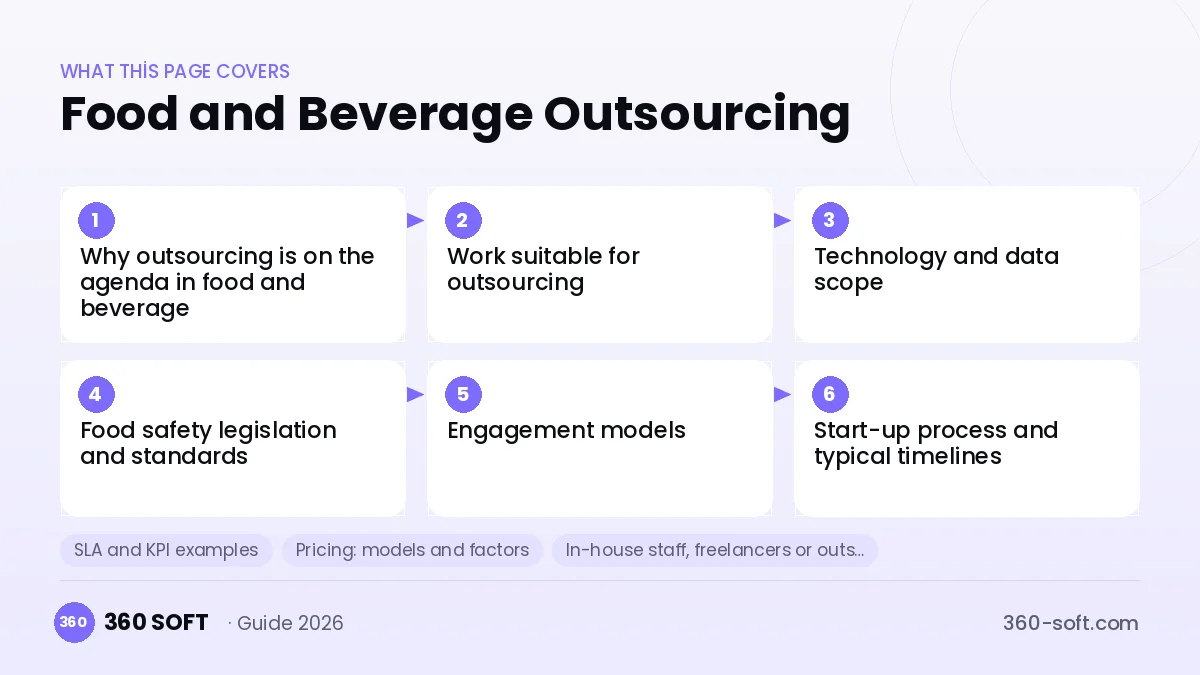
Why outsourcing is on the agenda in food and beverage
- Seasonality and campaigns: harvest seasons, Ramadan, summer beverages and retail promotions create sharp peaks.
- Traceability and recalls: one step back, one step forward traceability must work at any time, and recall readiness must be proven.
- Documentation load: HACCP plans, supplier approvals, certificates, specifications and audit evidence keep growing.
- Retail and marketplace pressure: listings, product data, shelf checks and promotions need constant attention.
- Sustainability questions: retailers and export customers ask for carbon, packaging and water data.
Work suitable for outsourcing
| Area | Typical tasks | Roles |
|---|---|---|
| Warehouse and cold chain | Receiving, FEFO picking, temperature log checks, alarm monitoring | Warehouse operators, cold-chain monitoring operators |
| Quality documentation | Supplier certificate tracking, specification management, HACCP record administration | QA documentation assistant |
| Traceability data | Lot and batch master data, mock recall preparation, label data checks | Traceability data specialist |
| Field data collection | Shelf audits, price and stock checks, merchandising photos | Field data collectors, merchandisers |
| Customer and consumer lines | Order desk for retailers and HoReCa, consumer complaint intake | Support agents |
| E-commerce and marketplaces | Product content, listings, order operations | E-commerce operations specialists |
| IT and reporting | ERP support, dashboards, carbon and packaging data | ERP consultants, BI and sustainability analysts |
Technology and data scope
We work with your ERP (SAP, Logo, Netsis, Microsoft Dynamics), warehouse management systems, temperature monitoring platforms, label and traceability software, retail portals and marketplaces, CRM and ticketing tools. Where you have gaps, such as a mobile shelf-audit form or a recall readiness dashboard, we can build and run the software as part of the service.
Food safety legislation and standards
In Turkey, the Veterinary Services, Plant Health, Food and Feed Law No. 5996 and the rules of the Ministry of Agriculture and Forestry govern food business operators, including registration, hygiene, labelling and traceability. For export, EU Regulation (EC) No 178/2002 and the hygiene package set the main principles. Common voluntary standards are ISO 22000, FSSC 22000, BRCGS, IFS and halal certification schemes.
Using an outsourced team does not affect these certificates as long as the work is under your food safety management system: our team follows your hygiene rules, GMP and GHP instructions, and training requirements, and your food safety team keeps decision-making authority, for example on product release or recalls. Local rules in your country, such as importer obligations, also apply.
Engagement models
| Model | How it works | Best for |
|---|---|---|
| Dedicated team | Named team members work only for you, managed by our team lead | QA documentation, traceability data, order desk |
| Managed service with SLA | We own an outcome, such as alarm response time or shelf-audit coverage | Cold-chain monitoring, field data, support lines |
| Seasonal capacity | Team size follows your campaign and harvest calendar | Warehouse, field, customer lines |
| Project-based | Fixed scope, such as a certificate library or a new ERP rollout | Audits, migrations, launches |
Start-up process and typical timelines
- Discovery: sites, processes, volumes, hygiene rules and systems are reviewed.
- Contract: scope, KPIs, team structure and pricing model are agreed.
- Recruitment and training (typical start 1–2 weeks): hygiene, GMP and system training is given and recorded.
- Handover (2–4 weeks): the team works alongside your staff.
- Stable operation: monthly KPI reports and seasonal planning.
SLA and KPI examples
| KPI | What it measures | Example target type |
|---|---|---|
| Alarm response time | Time from temperature alarm to action | Minutes, per escalation plan |
| Picking accuracy and FEFO compliance | Correct lots shipped in the right order | Percentage agreed in SLA |
| Mock recall time | Time to trace a lot forward and back | Hours, per your procedure |
| Certificate validity | Approved suppliers with valid documents | Percentage of active suppliers |
| Shelf-audit coverage | Planned store visits completed | Percentage per period |
| Complaint intake time | Consumer complaint logged and forwarded | Hours, by channel |
Pricing: models and factors
There is no single price; we quote per scope. Typical models are a monthly fee per FTE, a managed-service fee linked to volume and SLA, a seasonal capacity agreement, or a fixed project price.
| Factor | Effect on cost |
|---|---|
| Shifts and coverage | 7/24 cold-chain monitoring or night picking adds headcount |
| Seasonality | Flexible capacity needs planning and backup staff |
| Field geography | Number of cities and stores affects travel |
| Hygiene and site rules | Training, health checks and equipment |
| Languages | Export customers may need English, German or Arabic |
In-house staff, freelancers or outsourcing
| Criterion | In-house | Freelancer | Outsourcing (360 Soft) |
|---|---|---|---|
| Seasonal flexibility | Low | Medium | High, from 1 to 200+ people |
| Hygiene and training records | Full control | Hard to manage | Managed and recorded |
| Speed to start | Slow | Fast | Typically 1–2 weeks |
| Continuity | Depends on retention | Low | Replacement process included |
Priority work by sub-sector
| Sub-sector | Priority work |
|---|---|
| Dairy and meat | Cold chain monitoring, traceability, field sales data |
| Bakery and confectionery | Seasonal warehouse capacity, retail listings, allergen label checks |
| Beverages | Summer peak logistics, merchandising audits, deposit and packaging data |
| Ingredients and B2B | Specification management, customer portals, export documentation |
| Restaurant and retail chains | Supplier certificates, ordering desk, customer service |
Risks and safeguards
- Hygiene breaches: induction, health rules and supervisor checks on site.
- Missed alarms: written escalation plans and 7/24 shifts where needed.
- Traceability gaps: daily data checks and regular mock recalls.
- Seasonal staff shortages: backup pools planned ahead of peaks.
- Data leakage: recipes and supplier prices are confidential and access is restricted.
Data security, GDPR, KVKK, NDA and IP
Recipes, formulations, supplier terms and consumer data are confidential. Access is role-based and removed at the end of the engagement; consumer complaint data is processed only on your instructions.
Contract and legal note
We work under a B2B service agreement that defines scope, service levels, deliverables and acceptance. It comes with a mutual NDA and a clause that assigns intellectual property in all work products (documents, data sets, code, designs) to you. Where our team processes personal data on your behalf, we sign a GDPR data processing agreement (DPA) with the EU Standard Contractual Clauses, or the UK IDTA/Addendum for UK data; our own processing in Turkey follows KVKK (Law No. 6698). Recipes and formulations are covered by specific confidentiality clauses.
360 Soft employs its team members under Turkish labour law and remains responsible for their payroll, social security and supervision. The engagement is a service, not the hiring-out of workers: you define the outcomes and priorities, and we manage the people. Local rules in your country, such as worker classification or agency-work rules, should be checked with your own legal adviser before signing.
Illustrative scenario: field and cold chain at a dairy producer
Illustrative scenario. This is not a client case; it shows how such an engagement could be set up. A regional dairy producer sells through supermarkets and traditional stores. Products have short shelf lives, and store refrigeration problems lead to returns. The producer sets up two outsourced services: a cold-chain monitoring desk that watches warehouse and vehicle temperature data in shifts and follows a written escalation plan, and a field team that visits stores on a weekly route to check shelf placement, expiry dates and cabinet temperatures, uploading photos and data through a mobile form. The producer’s quality team receives a daily summary and decides on withdrawals; sales managers use the store data to plan replenishment.
Supplier selection checklist
- Does the supplier follow your hygiene rules and food safety procedures?
- Are training and health records kept for every team member?
- Can it provide 7/24 monitoring for critical processes?
- Can it scale up for seasons and campaigns and down afterwards?
- Are decisions on release and recall clearly kept with you?
- Are KPIs and reporting defined in the contract?
- Are NDA, IP assignment and a GDPR DPA included?
- Is there a replacement and backup process?
Frequently asked questions
Which work can food companies outsource?
Warehouse and cold-chain support, quality documentation, traceability data, field data collection, customer lines, e-commerce operations, ERP support and sustainability data.
Does outsourcing affect our ISO 22000 or FSSC 22000 certificate?
No, if the work is controlled within your food safety management system. We follow your procedures and keep training records.
Will the warehouse team follow our hygiene rules?
Yes. Hygiene induction, health rules and your GMP instructions are part of onboarding and are checked on site.
How do you support us in a recall?
We help trace lots, prepare customer lists and handle communication tasks; the recall decision stays with you.
Can cold-chain alarms be monitored 7/24?
Yes. We organise shifts and follow your escalation plan.
What data does the field team collect?
Shelf presence, prices, stock, expiry dates, cabinet temperatures and photos, according to your form.
Do you help us obtain halal or BRCGS certification?
We support documentation and record keeping; certification is granted by accredited bodies.
How is pricing set?
By FTE per month, by managed-service volume and SLA, by seasonal capacity, or as a fixed project price.
Can you add capacity for campaign periods?
Yes. Seasonal capacity is planned ahead with backup staff.
How quickly can we start?
A typical start is within 1–2 weeks, followed by a handover period.
Is this temporary agency work?
No. It is a B2B service; 360 Soft employs and manages the team.
Contact us
Tell us which food and beverage processes you want to hand over, your sites and your seasonal calendar, and we will propose a team and a model. Call or WhatsApp us on +90 850 335 10 87, write to info@360-soft.com, message us directly on WhatsApp, or use the form on our contact page. 360 Soft Marketing Yazılım ve Danışmanlık Ltd. Şti., Nidakule Ataşehir Batı, Barbaros Mah. Begonya Sk. No:1 D:2, 34746 Ataşehir/İstanbul.
Türkçe: Türkçe sürüm
Related pages
- Outsourcing services (overview)
- Manufacturing outsourcing
- Warehouse and logistics operations
- Field data collection
- Retail outsourcing
- E-commerce operations
- Carbon data management
- Pharma and medical outsourcing
Related services
- Fraud Monitoring OutsourcingFraud monitoring outsourcing: 24/7 alert review, rule and threshold tuning, customer verification, chargeback…
- Game Testing and Live Ops OutsourcingGame testing and live ops outsourcing from Istanbul: QA, compatibility, localisation testing, events, economy…
- Gaming Industry OutsourcingGaming industry outsourcing: art, animation, Unity and Unreal development, QA, live ops and player support…
- Healthcare OutsourcingHealthcare outsourcing for non-clinical work: appointment lines, patient communication, billing and…
- HR and Payroll Operations OutsourcingHR and payroll operations outsourcing: payroll for teams in Türkiye, personnel files, onboarding, leave…
- Insurance Sector OutsourcingInsurance outsourcing for insurers, agencies and brokers: policy back office, first-stage claims, renewals…